Equipment News · May 22, 2026
Wacker Neuson's New Compact Lineup Is Built for the Jobsites Contractors Actually Have
Wacker Neuson's ET40, EZ35, WL750, and TH625 launch says a lot about where compact equipment is headed: more shared platforms, easier controls, faster attachment changes, and machines that can cover more work with fewer specialized operators.
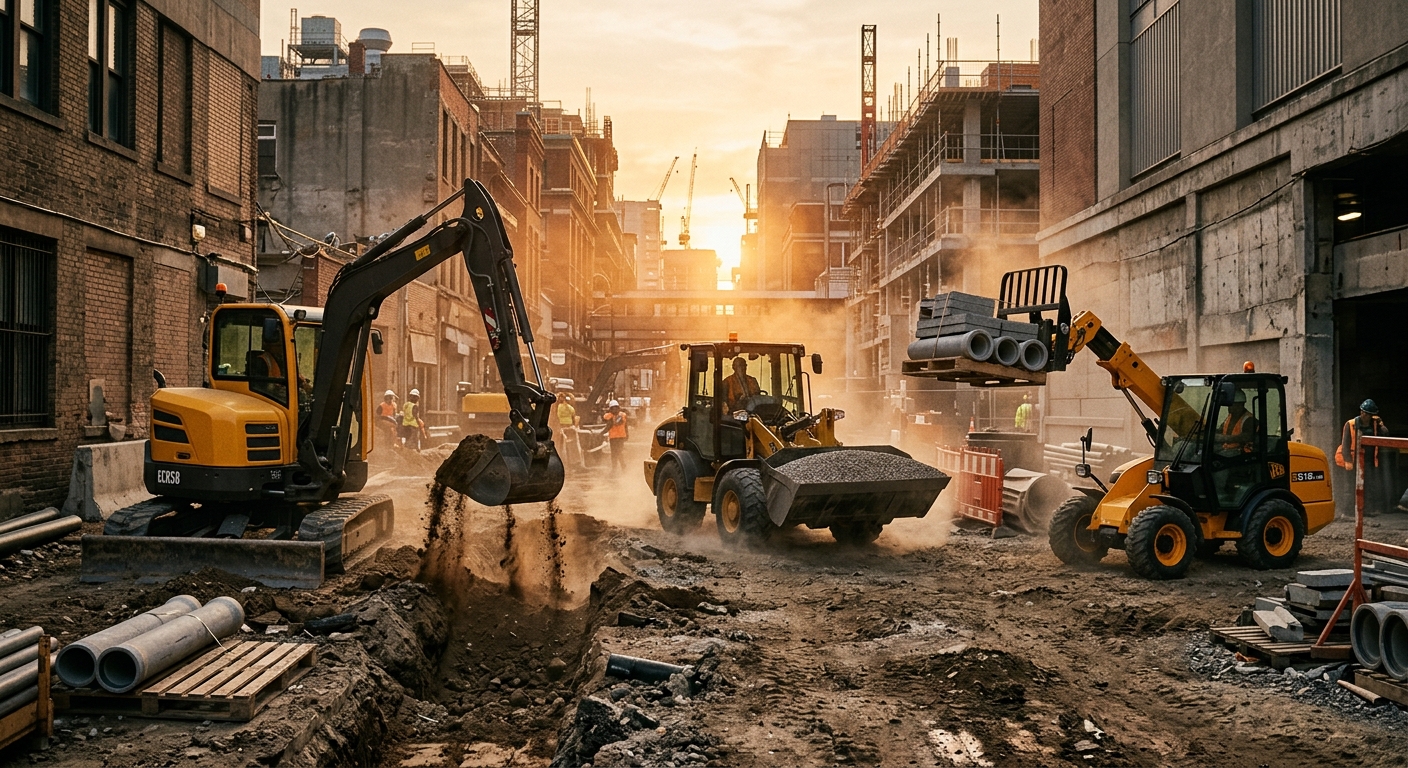
Wacker Neuson did not just bring a few new compact machines to market. It brought a pretty clear answer to the jobsite reality most contractors are living with right now: smaller crews, tighter sites, mixed scopes, and not enough expert operators to put one specialist in every seat.
The company introduced two compact excavators, the ET40 and EZ35, along with the WL750 wheel loader and TH625 telehandler at CONEXPO-CON/AGG 2026, according to Our Mechanical Center. The ET40 is close to production, while the EZ35 is expected later in 2026. Both excavators are designed and manufactured at Wacker Neuson’s Menomonee Falls, Wisconsin facility. The launch also adds a compact wheel loader and a telehandler aimed at lifting, material handling, light digging, sitework, municipal work, and general construction.
That mix is the story. A 3- to 4-ton excavator, compact wheel loader, and small telehandler are not flashy machines on their own. Put them together and you can see where the compact category is going. OEMs are trying to make machines easier to train on, easier to service, and useful across more than one narrow job.
FieldFix Editor’s Note: Compact fleets get expensive when every machine is treated like a mystery box. FieldFix helps equipment owners track maintenance, repairs, service notes, downtime, and cost per hour by machine, so a compact excavator, wheel loader, or telehandler can be managed with real numbers instead of memory.
The shared excavator platform matters more than the model names
The ET40 and EZ35 sit in the 3- to 4-ton excavator class. That is a crowded part of the market, but it is crowded for a reason. These machines are small enough for residential work, utilities, site development, municipalities, rental yards, and tight commercial sites. They are big enough to do real digging without jumping all the way into a larger truck-and-trailer problem.
Wacker Neuson’s smarter move is putting the two excavators on a common platform. The ET40 has a conventional tail swing. The EZ35 is the minimal-tail-swing option. Different site needs, same family.
For an owner, that means less weirdness across the fleet. Similar controls. Similar displays. Similar maintenance routines. Similar parts conversations. That stuff sounds boring until a machine goes down on a Thursday afternoon and nobody wants to play detective across five unrelated designs.
Rental yards should care even more. A shared platform can make branch training easier. It can make customer handoff easier. It can reduce the number of small mistakes that happen when a weekend renter or new operator climbs into something unfamiliar. The compact market is full of customers who are not full-time operators. A clean control layout is not a luxury for them. It is the difference between a productive day and a machine that comes back with bent panels and a bad story.
The reported 7-inch touchscreen, push-button start, updated cab layout, smooth hydraulics, and standard dozer blade with float are all part of that theme. None of those has are wild by themselves. Together, they reduce friction.
That is where compact equipment competition is getting sharper. Buyers still compare horsepower, dig depth, breakout force, weight, transport width, financing, dealer coverage, and resale. But when machines are close on spec, the owner starts asking a more practical question: which one will my people actually use well?
Operator comfort is becoming a production feature
There is still a bad habit in this industry of treating comfort like fluff. It is not.
A better cab, better visibility, cleaner controls, and smoother hydraulics show up in the work. They show up when a newer operator is trenching near a sidewalk. They show up when a contractor is working around finished turf. They show up when a municipal crew is patching drainage problems next to traffic. They show up when a rental customer has two hours of confidence instead of eight hours of fighting the machine.
The labor shortage makes this more obvious. Contractors cannot assume every machine will be run by the best operator in the company. Sometimes the best operator is on another site. Sometimes the owner is running estimates. Sometimes the new guy is careful but slow. Sometimes the crew has one person who can dig, load, grade, move pallets, and clean up, but only if the equipment makes that realistic.
That is why controls matter. Hydraulic feel matters. Touchscreen menus matter, as long as they are not buried under nonsense. Push-button start matters in rental and municipal settings where keys disappear or get copied. Float on the blade matters when cleanup and backfill are part of the same day.
The compact machine that wins jobs is often not the one that dominates a spec sheet. It is the one that lets average crews produce clean work without drama.
The WL750 fits the attachment-first jobsite
The WL750 wheel loader is part of a new Wacker Neuson loader lineup that also includes the WL950 and WL1150. The reported pitch is compact design, hydraulic quick-change systems, and compatibility with a wide range of attachments.
That is the right pitch.
Compact wheel loaders have been eating into skid steer and compact track loader territory for years, especially where ground disturbance, visibility, fuel use, tire life, travel speed, and operator comfort matter. They are not perfect replacements. A compact track loader still wins in mud, rough clearing, grading, and many attachment-heavy dirt jobs. A skid steer still wins where price, simplicity, and maneuverability carry the day.
But for material handling, loading, snow, mulch yards, municipal work, material yards, site cleanup, and repeated travel across hard surfaces, a compact wheel loader makes a lot of sense. It is easier on the ground. It gives the operator better visibility. It often burns less fuel. It can move material all day without beating up the operator the same way a small loader can.
The attachment angle is the point. Contractors are trying to squeeze more revenue from every asset. A loader that can swap between bucket, forks, broom, snow pusher, grapple, and specialty tools becomes a use machine. That does not mean owners should buy every attachment under the sun. That is how yards fill up with expensive rust. It means the base machine has to be versatile enough to earn its spot across seasons.
The TH625 is aimed at crews that need lift without a full-size telehandler
The TH625 may be the most interesting machine in the launch because it sits in a useful but often overlooked space. It has a maximum lift height of 18 feet 6 inches and a payload capacity of 5,511 pounds, according to the same launch coverage. It also has a skid steer-style attachment plate, auxiliary hydraulics, and driver assistance modes for bucket and fork work.
That combination tells you who it is for. This is not a massive telehandler for big commercial framing or industrial work. It is for crews that need lift, reach, forks, bucket work, and jobsite flexibility without dragging around more machine than the site can handle.
Think site contractors placing pallets of block. Municipal crews loading material and handling supplies. Small commercial sites moving pipe, forms, and pallets. Builders that need reach on a tight lot. Rental yards that want one machine that can make sense to several customer types.
The skid steer-style attachment plate is important because it meets contractors where they already are. A lot of small and mid-size fleets have skid steer attachments. They know that ecosystem. They understand forks, buckets, brooms, grapples, and basic hydraulic tools. A compact telehandler that can plug into some of that familiarity has a better shot at staying busy.
The risk is the same as every multi-role machine: owners can talk themselves into jobs the machine is not built for. Lift charts still matter. Ground conditions still matter. Attachment weight still matters. Operator training still matters. A compact telehandler can be incredibly useful, but it is not a physics exemption.
Compact fleets are getting more professional
The bigger pattern here is that compact equipment is no longer the casual end of the fleet. It used to be easy to think of compact machines as support equipment. The big iron did the serious work. The smaller stuff cleaned up, backfilled, carried tools, moved pallets, and handled odd jobs.
That line is fading.
Compact excavators are doing real utility and site prep work. Compact wheel loaders are replacing small loaders and some skid steer work in yards and municipalities. Mini track loaders are everywhere in residential construction. Compact telehandlers are making more sense as crews get smaller and jobsite access gets worse.
At the same time, these machines are getting more electronics, better displays, more attachment capability, more safety systems, and higher prices. That creates a management problem. If an owner has six compact machines, twelve attachments, three crews, and no good maintenance records, the fleet can look busy while quietly bleeding money.
Hours alone are not enough. Owners need to know which machines are earning, which attachments are sitting, which machines are chewing through tires or tracks, which operators are rough on equipment, which repairs repeat, and which machine should be sold before the next expensive failure.
That is especially true in rental. Compact equipment gets abused because customers underestimate it. They overload it, run it hot, skip grease, use the wrong attachment, and bring it back dirty with half a story. The rental company that documents condition, service, damage patterns, and use has an edge over the one that just washes it and sends it back out.
What buyers should ask before writing the check
The launch gives contractors a good reason to revisit their compact fleet strategy. Not because every owner needs Wacker Neuson’s newest machine, but because the questions around compact equipment are changing.
If you are buying a compact excavator, ask how similar the controls and service points are to the rest of your fleet. Ask how easy it is to train a new operator. Ask whether the dealer can support the electronics, hydraulics, and attachments you plan to use. Ask whether minimal tail swing is worth the tradeoff for your sites, or whether a conventional tail machine gives you better performance for the work you actually do.
If you are buying a compact wheel loader, start with the tasks. Loading what? Traveling how far? Running on what surface? Swapping which attachments? Working in what season? If the answers point to material handling and repeated travel on firm ground, a compact wheel loader deserves a hard look.
If you are buying a compact telehandler, do not start with lift height alone. Start with the heaviest loads, the worst ground, the tightest access, and the attachments you expect to run. Then make sure the lift chart, coupler, hydraulics, tires, and dealer support match that reality.
The wrong way to buy compact equipment is to chase versatility in the abstract. The right way is to buy around repeatable work. A machine that does three profitable jobs every week is better than one that could theoretically do fifteen jobs someday.
The takeaway
Wacker Neuson’s new compact lineup is not about one headline feature. It is about making compact equipment easier to run across messy real-world jobsites.
That is where the market is headed. Shared platforms, cleaner cabs, better controls, quick attachment changes, compact lift options, and machines that can move between tasks without needing a specialist for every hour.
The winners will not be the owners who buy the most versatile machine on paper. The winners will be the ones who match the machine to sold work, train people well, track maintenance closely, and keep compact iron busy without pretending it can do everything.
That is a less glamorous story than a giant excavator launch. It is probably more relevant to most contractors.