Market Analysis · May 28, 2026
Data Center Construction Is Turning Power Work Into an Equipment Story
AI data centers are pulling more contractors into utility work, backup power, site prep, and uptime-driven fleet planning. The machines that support the power buildout may matter as much as the buildings themselves.
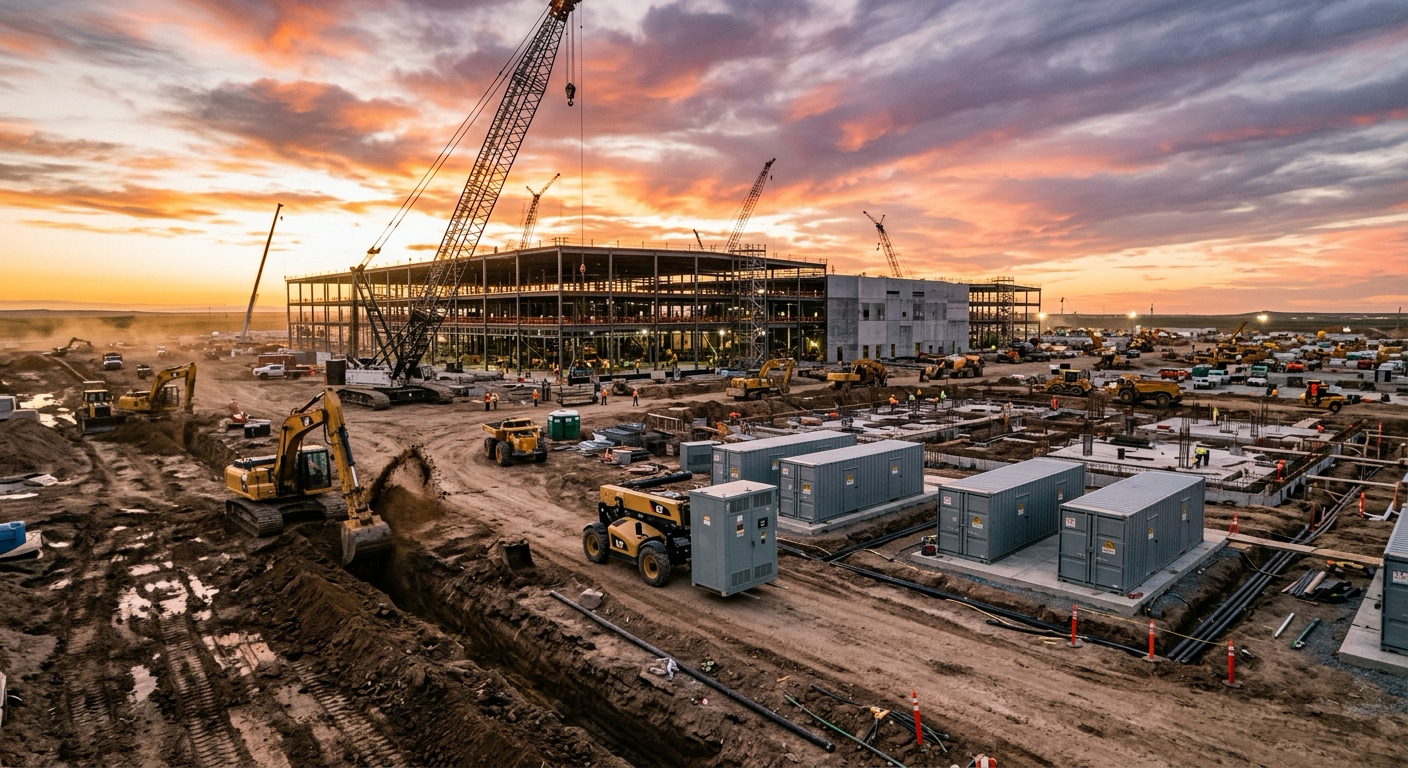
Data center construction used to sound like a real estate story. In 2026, it has become an equipment story.
The building gets the attention because it is huge, expensive, and tied to AI demand. But before the servers show up, somebody has to clear the site, move dirt, install utilities, build roads, place duct banks, manage stormwater, stage generators, handle concrete, and keep crews moving through a schedule that usually has very little slack. That work touches excavators, dozers, compact track loaders, cranes, telehandlers, trenchers, generators, pumps, light towers, fuel systems, service trucks, and the whole support fleet around them.
The U.S. Census Bureau’s March 2026 construction spending release put total construction spending at a seasonally adjusted annual rate of $2.185 trillion, up 1.6% from March 2025. That number covers far more than data centers, but it shows the bigger backdrop: construction volume is still large, even while demand is uneven across sectors.
Data centers sit in the part of the market where the pressure is different. The driver is not simply square footage. It is power. AI and cloud workloads need electricity, cooling, backup capacity, and sites that can be built fast enough to matter. The U.S. Energy Information Administration’s Annual Energy Outlook has been tracking the load growth problem, and the direction is clear enough for contractors: power infrastructure is moving from a background concern to a front-end constraint.
FieldFix Editor’s Note: Power-heavy jobs are rough on support equipment because delays, idle time, temporary power, fuel runs, and service calls pile up quietly. FieldFix helps equipment owners track hours, maintenance, repairs, downtime, and cost per hour, so machines working around critical infrastructure do not disappear into overhead.
The site work is not ordinary dirt work
A data center pad can look simple from the road. Big box. Big parking areas. Big utility feeds. Lots of concrete.
On the ground, it is not that simple.
The schedule tends to be compressed. The owners are often sophisticated. The utility coordination can be brutal. The site may need major grading, stormwater structures, access roads, laydown yards, retaining work, conduit banks, substations, backup generation areas, fuel storage, and permanent security before the project is fully handed over.
That changes what equipment has to do. The machines are not merely moving dirt. They are protecting sequence.
A dozer waiting on survey control can hold up a pad. An excavator down during duct-bank work can ripple into electrical crews. A telehandler shortage can slow material flow. A generator failure can stall temporary operations. A service truck that cannot keep up becomes a production problem, not an inconvenience.
This is the part equipment owners should pay attention to. Data center work rewards contractors who know their fleet cold. It punishes contractors who think uptime is something to worry about after a machine breaks.
The owners funding these projects are not buying romance. They are buying delivery. If a contractor cannot keep equipment available, staffed, fueled, and serviced, somebody else will.
Power is changing the construction sequence
On many jobs, power shows up late in the owner’s mind. On data center jobs, power is the job.
Grid interconnection, substation work, backup generation, switchgear, transformers, cooling loads, and commissioning all affect the construction path. That means earthwork and utility contractors are working around a much heavier electrical spine than they might see on a typical warehouse or commercial site.
It also means support equipment matters earlier.
Temporary power is not simply a convenience when the site is moving fast. Pumps, trailers, tools, lighting, security, heating, cooling, and commissioning support all depend on reliable energy. Backup generators and rental power packages can spend months on site. Fuel logistics become part of the work plan. Access for service trucks matters. So does noise, emissions compliance, containment, and safe refueling.
Generator demand is one of the clearer equipment signals coming from the data center boom. Caterpillar, Cummins, Kohler, Rolls-Royce, and other power suppliers are tied directly to the market because data centers are designed around resilience. They cannot treat backup power as an afterthought.
Contractors do not need to become data center engineers to understand the fleet lesson. If power availability is shaping where projects get built, then equipment that supports power work gets more useful. Trenchers, excavators with the right buckets, vacuum excavation, compactors, cranes, telehandlers, cable reel handling gear, generators, fuel trailers, and service trucks all move closer to the center of the job.
Utility contractors may see the biggest pull
The data center boom is not merely good for the contractor doing mass grading. It can be even better for the contractors who touch power, water, fiber, stormwater, access, and site systems.
That is where the repeat work lives.
Every large data center needs utility capacity. Many need upgrades outside the fence. Roads may need to be widened. Drainage may need to be rebuilt. Fiber routes have to be installed. Substations and transmission work can create additional packages around the main project. In some markets, the utility backlog is the real bottleneck.
For equipment fleets, that points toward machines that can stay productive in utility-heavy work: mid-size excavators, compact excavators, backhoes, compact track loaders, trenchers, wheel loaders, rollers, directional drilling support equipment, vacuum excavation units, and fleet support vehicles.
The exact mix depends on the contractor. A site contractor chasing big pads needs different iron than a utility contractor installing conduit or a rental company supporting temporary power and access. But the broader pattern is the same. Data centers create heavy demand for machines that can work around infrastructure, not simply machines that can move the most material in open ground.
This is also where small and mid-size contractors can find room. Not every company is going to win the main site package on a hyperscale build. But many can win related work: road improvements, clearing, erosion control, drainage repairs, utility trenching, restoration, material handling, fence lines, generator pad work, or support rentals.
The best opportunities may be one ring outside the headline project.
Rental fleets should watch the support package
Rental companies do not need to guess whether data center construction matters. They need to decide which parts of the work fit their fleet.
The obvious demand is temporary power, light towers, pumps, telehandlers, aerial lifts, forklifts, compact earthmoving equipment, trench safety, road plates, heaters, fuel tanks, and jobsite support tools. The less obvious demand is availability discipline.
Large projects burn through rental capacity quickly. If a contractor needs a 10,000-pound telehandler tomorrow and the local branch does not have it, the branch loses more than one rental. It loses trust on a site that may keep needing equipment for months.
That makes fleet planning harder. The wrong answer is to buy too much specialized equipment because data centers are hot this year. The better answer is to understand which categories will stay useful even if one project slows down. Telehandlers, compact track loaders, pumps, generators, trench safety, and aerial lifts have lives beyond data centers. Highly specific pieces need a stronger use case.
Rental companies should also treat service as part of the product. On a high-pressure site, a fast swap can matter more than a slightly lower rate. Contractors remember who kept them working.
The maintenance bar is higher on uptime-driven work
Data center construction exposes sloppy maintenance.
A contractor can sometimes limp through small private work with a machine that is overdue for service. That is harder on a job where access windows, inspections, electrical crews, concrete schedules, and owner milestones are stacked together.
The machine failure is rarely isolated. A down excavator can idle labor. A missed fuel delivery can shut down temporary systems. A telehandler with intermittent electrical problems can become a site-wide material handling headache. A generator that has not been load-tested can fail at the worst possible time.
This is why fleet records matter. Not because paperwork is fun. Because uptime is built before the job starts.
Contractors chasing data center work should know which machines are ready, which machines are marginal, which attachments are actually available, which trucks can support the site, and which repairs are likely to bite them mid-project. Preventive maintenance should be scheduled around production, not squeezed in after a breakdown.
The same applies to rental suppliers. A generator with poor service history is not a bargain. A telehandler that keeps faulting out is not available just because it is physically sitting on the job. Utilization only counts when the machine works.
The buying decision should follow the work, not the hype
Data centers are hot. That does not mean every contractor should go buy iron for data center work.
The smart move is to identify the repeatable work package first. Are you doing site clearing? Mass grading? Utility trenching? Temporary power support? Access roads? Material handling? Restoration? Stormwater? Each answer points to a different fleet decision.
A contractor doing utility work around these projects may justify another excavator, trench box setup, compact machine, or service truck. A rental house may justify more generators or telehandlers if local demand is real. A site contractor may need better GPS control, more compactors, or a stronger maintenance program before it needs more horsepower.
The wrong move is buying based on headlines. AI demand does not make a machine profitable. Work does.
This market may also be uneven by region. Power availability, land, permitting, tax policy, fiber access, and utility timelines will decide where projects actually happen. Some markets will feel flooded with work. Others will only hear about the boom from a distance.
That is another reason to stay disciplined. Track bids. Track rentals. Track machine hours. Track margins. If data center-adjacent work is feeding the fleet, the numbers will show it. If it is just a story in the trade press, the numbers will show that too.
The equipment opportunity is real, but it is practical
The data center buildout is not magic for the equipment industry. It is a practical shift in where demand is landing.
More power-intensive construction means more utility work, more site support, more temporary power, more material handling, more service pressure, and more attention on uptime. That is good for contractors and rental companies that already know how to run disciplined fleets.
It is less forgiving for companies that manage equipment by memory and gut feel.
The contractors that benefit will be the ones who can show up with the right machines, keep them working, document their costs, and stay useful around complex power-driven schedules. The machines do not have to be exotic. In many cases, the winners will be ordinary equipment managed unusually well.
That is the real equipment story behind data centers. The servers may be new. The lesson is old: when the schedule gets expensive, uptime becomes strategy.