Caterpillar's Unlikely AI Play: How Yellow Iron Became a Data Center Power Player
The iconic maker of bulldozers and excavators has found an unexpected growth engine in the AI revolution—and investors are taking notice.
For a century, Caterpillar’s identity has been built on yellow iron—the iconic bulldozers, excavators, and wheel loaders that move earth on construction sites around the world. But the company’s most exciting growth story right now has nothing to do with dirt.
It’s about electricity. Specifically, the staggering amounts of power required to run the artificial intelligence systems reshaping the global economy.
Editor’s Note: Whether you’re running dozers or generators, tracking maintenance and true operating costs is critical. FieldFix helps equipment operators log service records, calculate cost-per-hour, and diagnose issues with AI-powered assistance—because every hour of runtime counts.
From Jobsites to Server Farms
Caterpillar’s stock closed at $665.24 on Wednesday—up 3.4% on the day and within striking distance of its all-time high of $679.99 set just days earlier. The company’s market cap now exceeds $311 billion, making it one of the most valuable industrial companies in America.
What’s driving the surge? While Cat’s traditional construction and mining equipment businesses remain strong, it’s the company’s power generation segment that has Wall Street most excited.
Data centers—the massive server farms that train and run AI models for companies like OpenAI, Google, Microsoft, and Amazon—consume enormous amounts of electricity. A single hyperscale data center can draw as much power as a small city. And the AI boom is only accelerating that demand.
McKinsey estimates that global data center spending will hit $7 trillion by 2030. Much of that money is flowing to companies you might not expect: not just chip designers and cloud providers, but the manufacturers of the generators that keep these facilities running.
The Numbers Don’t Lie
Caterpillar’s transformation is visible in its financial statements. Power generation represented just 8.4% of the company’s total sales in 2021. By the first nine months of 2025, that share had grown to over 14%—and the segment is growing faster than any other part of the business.
The company’s order backlog tells an even more compelling story. At $39.8 billion, Cat’s backlog is nearly triple what it was five years ago. Melissa Busen, who runs Caterpillar’s electrical power division, says the largest customers are planning purchases years into the future.
“Power generation is a business that has never seen this kind of scale, in any way, ever,” Tom Shepherd, a data center executive at competitor Cummins, told Business Insider in December.
Why Generators? Why Now?
To understand Cat’s position, you need to understand the power crisis facing data center developers.
Electric utilities simply cannot connect new facilities to the grid fast enough. In some markets, wait times for grid connections have stretched to three years or more. For companies racing to train the next generation of AI models, that’s an eternity.
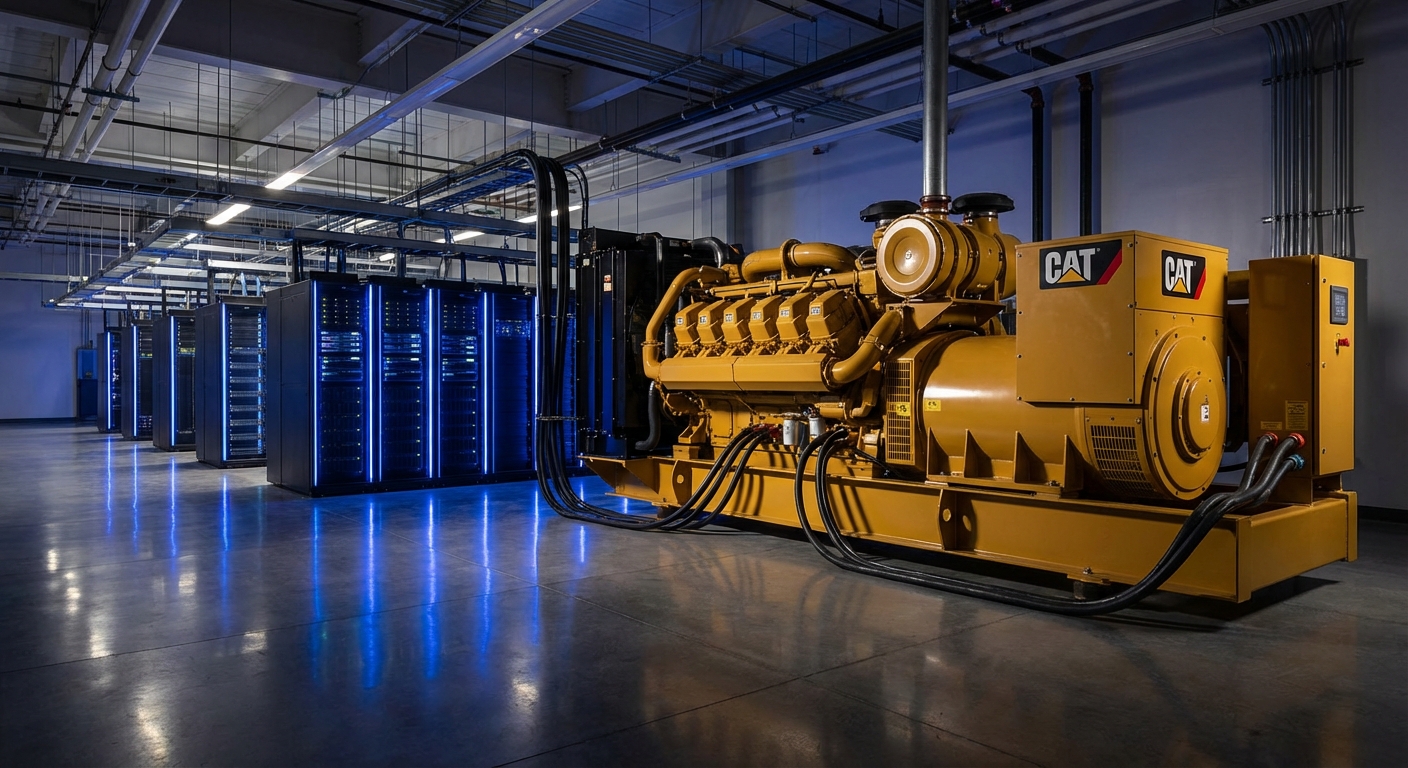
The solution? On-site power generation. Data centers are deploying fleets of massive natural gas-powered generators—some capable of powering more than 1,000 homes—that can run 24/7 for months or even years while waiting for permanent grid connections.
Even once connected to the grid, these facilities need backup power systems capable of keeping servers running during outages. A single minute of downtime at a major AI training facility can cost millions of dollars.
Caterpillar, with its century of experience building reliable diesel and natural gas engines, is perfectly positioned to meet this demand.
Investing in Growth
Cat isn’t resting on its laurels. Last year, the company broke ground on a $725 million expansion of its engine manufacturing facility in Lafayette, Indiana. The expansion will more than double the factory’s output of the large engines that power data center generators.
The Lafayette facility currently employs 1,900 workers. When the expansion comes online in 2027, that number is expected to grow substantially.
Caterpillar isn’t alone in recognizing the opportunity. Cummins has announced $200 million in investments across power generation manufacturing sites in Indiana, England, and the US. Rolls-Royce is expanding plants that build data center generator components in South Carolina and Minnesota.
Beyond Backup: Integrated Power Solutions
The data center opportunity goes beyond selling generators one at a time. Busen says Cat’s hyperscaler customers increasingly want “a complete, integrated solution” to their electrical needs—including batteries, inverters, control systems, and grid interconnection equipment.
This positions Caterpillar as a partner rather than just a vendor. The company has been supplying data centers since the early 1990s, giving it relationships and institutional knowledge that newer entrants lack.
“We’ve been able to build true partnerships with the new crop of hyperscalers,” Busen said.
What This Means for the Equipment Industry
Caterpillar’s AI-driven growth offers several lessons for the broader equipment industry:
1. Adjacent Markets Create Unexpected Opportunities
Cat’s core construction and mining customers aren’t building data centers. But the company’s expertise in reliable, heavy-duty power systems translated perfectly to a new market. Equipment manufacturers should constantly evaluate where their capabilities might find new applications.
2. Backlog Visibility Matters
Cat’s nearly $40 billion backlog provides years of revenue visibility. In capital-intensive industries with long lead times, that kind of forward clarity is incredibly valuable—for operations planning, workforce development, and investor confidence.
3. Manufacturing Capacity Is a Competitive Advantage
Companies that can actually deliver equipment win in constrained markets. Cat’s willingness to invest $725 million in expanded capacity signals confidence in sustained demand—and positions the company to capture market share from competitors who can’t scale as quickly.
4. The Energy Transition Creates Equipment Demand
Whether it’s AI data centers, electric vehicle manufacturing, renewable energy installation, or grid modernization, the global energy transition is driving massive infrastructure investment. Equipment companies positioned to serve these markets will benefit.
Analyst Sentiment Is Shifting
Wall Street has taken notice. According to company filings, the percentage of analysts rating Cat as a “buy” has grown from 41% to 54% over the past year. The company trades at about 35 times trailing earnings—a premium valuation for an industrial company, but one that reflects its growth trajectory.
Some analysts have raised concerns about valuation. Morgan Stanley estimated in October that Cat’s power generation segment alone was being valued at 60 to 100 times operating income—far higher than comparable businesses.
But Caterpillar’s leadership isn’t worried. If one hyperscaler customer faces challenges, Busen says, others will take its place. The demand for AI infrastructure isn’t slowing down—if anything, it’s accelerating.
Looking Ahead
Caterpillar will report fourth-quarter earnings on February 4, giving investors their next look at power generation segment performance. The consensus expectation is for continued strong growth, though year-over-year comparisons may become more challenging as the segment matures.
Longer term, the question is how sustainable the AI infrastructure boom will prove to be. Critics argue that current spending levels exceed actual AI revenue generation, creating bubble dynamics. Bulls counter that AI capabilities are still in their infancy and that the companies building the infrastructure to support them will be rewarded for years to come.
For Cat, the bet is already paying off. A company known for moving dirt is now powering the future—and the stock price reflects it.
Caterpillar (NYSE: CAT) is a member of the Dow Jones Industrial Average. The company is headquartered in Irving, Texas, and employs approximately 113,000 people worldwide.
Equipment Insider covers the companies, technology, and market forces shaping the heavy equipment industry. Follow us for in-depth analysis of the OEMs, dealers, and trends that matter to contractors and fleet operators.