
John Deere Settles Right-to-Repair Lawsuit. Here's What Actually Changes.
Deere says the settlement ends a closely watched repair-services lawsuit with no finding of wrongdoing. For equipment owners, the real question is what access looks like in the shop and in the field.
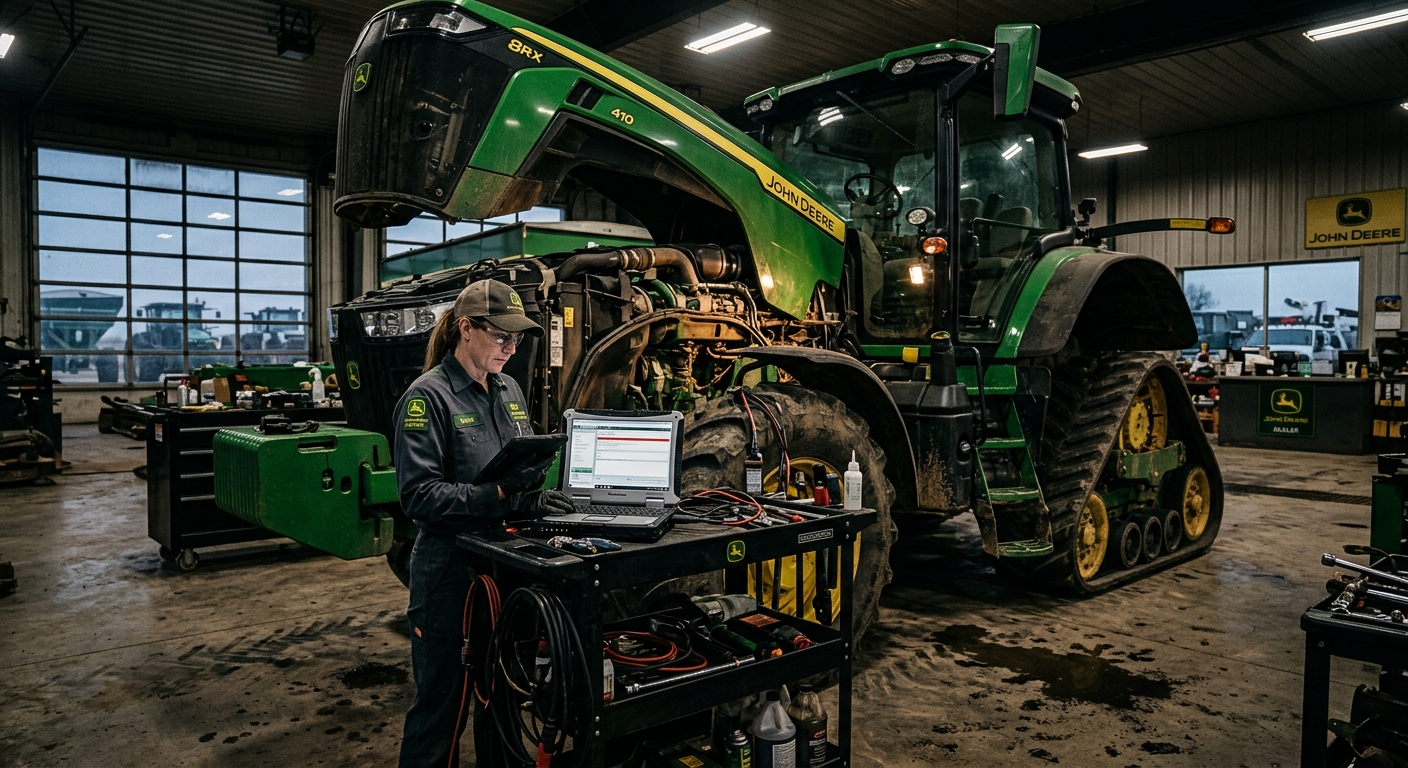
John Deere says it has reached a settlement in the multidistrict repair-services antitrust litigation that has hung over the company since 2022. The announcement landed on April 6 and, if approved by the court, will close one of the most watched legal fights in off-road equipment.
That matters well beyond Deere’s customer base. The case became a proxy battle over who really controls modern equipment after the sale: the owner, the dealer, the independent shop, or the software stack sitting behind the machine.
For contractors, farmers, and fleet managers, the headline is simple. Deere says it will pay into a class settlement fund and continue supporting access to repair resources, including tools, manuals, and diagnostic software. The harder question is whether that translates into a meaningfully easier repair experience when a machine is down and the clock is burning cash.
FieldFix Editor’s Note: When repair access gets murky, your own records matter more. Keep service history, fault notes, and machine-hour costs in one place so you’re not rebuilding the story every time a dealer, technician, or software portal changes. FieldFix helps fleets keep that history organized.
What Deere actually announced
In its official release, Deere said the settlement would resolve the multidistrict “right to repair” litigation pending in the U.S. District Court for the Northern District of Illinois. The company also said the agreement includes no finding of wrongdoing and still requires court approval.
Deere’s wording was careful, which is what you’d expect in a legal settlement. The company did not frame this as a philosophical shift. It framed it as a resolution to an existing case while reaffirming that customers and other service providers can access repair resources.
One quote in the release is worth paying attention to because it captures Deere’s position in plain terms. Denver Caldwell, vice president of Aftermarket & Customer Support, said Deere is “committed to providing customers and other service providers with access to repair resources.” He also pointed to tools, manuals, and diagnostic software as part of that access. Source: Deere press release.
That lines up with the company’s broader repair-resources page, which has for some time emphasized owner support, manuals, connected support, and Operations Center PRO Service. Deere’s message has been consistent: owners can do more than critics sometimes claim, but the company still wants that work happening inside a controlled ecosystem. Source: John Deere service and repair resources.
Why this case got so much attention
This wasn’t just another corporate lawsuit that only lawyers care about. It hit a nerve because modern equipment is no longer just iron, hydraulics, and grease. It’s electronics, telematics, controllers, encrypted software, calibrations, and remote diagnostics. When a machine throws a code, the wrench is only part of the fix.
That has created a real tension across the industry.
Owners believe that if they paid six figures, or seven, for a machine, they should be able to diagnose and repair it on their terms. Dealers and OEMs argue that modern systems are more complex, more regulated, and in some cases safety-critical enough that unrestricted access is not a simple yes-or-no question.
Both sides have a point, which is why this fight never fit neatly into slogans.
The angry version of the argument says OEMs use software and dealer-only tooling to trap customers inside expensive service networks. The corporate version says trained support, software controls, and authorized diagnostics protect uptime, emissions compliance, safety, and machine integrity. Reality is usually somewhere in the middle. Some jobs are absolutely owner-level. Others need factory-grade tools and current software for a reason. The problem starts when the line between those two buckets gets fuzzy, expensive, or slow.
What equipment owners should care about
The most important question is not whether Deere won or lost the PR war. It’s whether life gets better for the person staring at a dead machine on a Tuesday morning.
A few practical things matter here.
First, access has to be usable, not just technically available. A manual buried behind layers of account setup, subscription terms, or limited functionality is not the same thing as genuine field access. Same goes for diagnostic tools. If a customer can log in but still cannot complete the repair path without calling the dealer, the legal talking points don’t mean much.
Second, turnaround time matters more than ideology when a crew is waiting. If the settlement pushes Deere to make repair resources easier to get and easier to use, owners will feel that quickly. If the experience stays clunky, this story will fade from the headlines while the frustration stays exactly where it was.
Third, independent shops are part of the equation. Deere’s release specifically referenced “other service providers,” and that phrase matters. A lot of machine owners do not want every repair flowing through the dealership. They want options. They want the local diesel shop they trust, or the mobile technician who can be on-site by lunch, to have a fair shot at fixing the problem.
What probably does not change overnight
Nobody should read this settlement and assume the repair-access debate is finished. It isn’t.
For one thing, the settlement still needs court approval. Until that happens, this is an announced resolution, not a fully closed chapter.
For another, legal settlement language and real-world service experience are two different things. Deere can say it supports access to repair resources, and that may be true, while customers still argue over subscriptions, software permissions, calibration procedures, and dealer responsiveness. Those complaints do not vanish because a press release dropped.
There is also a broader industry issue here. Deere may be the biggest name in this conversation, but it is not the only manufacturer wrestling with software control, dealer economics, and customer demands for more direct access. If you’re running mixed fleets, this story is bigger than green paint.
And one more thing: modern machines are only getting more software-heavy. That means future repair fights will not be limited to whether a PDF manual is available. They will center on telematics permissions, remote support rights, software-enabled features, subscriptions, and who gets to approve or unlock certain functions after the machine is already in the field.
The dealer angle nobody should ignore
This story is also about dealers, whether the headlines mention them or not.
Dealerships make money on service. That’s not a scandal. That’s the business. They also carry the burden of training technicians, stocking parts, maintaining diagnostic systems, and supporting increasingly complicated equipment. When OEMs promise broader access, dealers have to absorb part of the downstream effect.
That creates a balancing act.
If owners and independents get more capability, dealers may lose some repair revenue on routine work. On the other hand, broader access can take low-value service pressure off the dealer network and let those shops focus on larger failures, warranty jobs, complex calibrations, and emergency support. In a lot of regions, service departments are already overloaded. There is a version of this where everyone wins a little.
There is also a version where nobody is happy. Customers think access is still too limited, dealers think support expectations are getting dumped on them unfairly, and OEMs keep getting dragged into legal and legislative fights. That outcome is still on the table if the user experience doesn’t improve.
Why this matters outside agriculture
Even though Deere’s public repair debates often get framed through farm equipment, construction and compact equipment owners should pay attention too.
The same pressures are showing up across skid steers, excavators, dozers, compact track loaders, and specialty machines. Fleets want uptime. They want more self-service capability. They want better diagnostic visibility before a field repair turns into a transport bill. And they do not want to feel like a machine they own is functionally half-rented because key repair pathways are gated.
That is especially true for smaller contractors. A large national fleet can absorb downtime differently. A small contractor with one compact track loader cannot. If that machine is down, revenue stops. In that world, repair access is not an abstract policy issue. It’s payroll.
This is also one reason software access keeps getting tangled up with the used-equipment market. Buyers are starting to ask a different set of questions. Not just hours, undercarriage, and maintenance history, but also: what tools can I access, what subscriptions do I need, and how dependent am I on a dealer for resets or diagnostics? That’s not a fringe question anymore.
My read on what Deere is doing
Deere is trying to close a legal fight without opening the floodgates.
That’s the cleanest way to read this. The company wants to reduce legal risk, avoid an ugly drawn-out narrative, and keep steering customers toward a Deere-managed support environment. It is not waving a white flag and saying, “Fine, do whatever you want with the software.” It is saying the current model already provides meaningful access and this settlement reinforces that position.
Strategically, that makes sense. Deere gets to sound cooperative without giving up the broader structure of how modern support works. Customers and independent service providers may still push for more, but Deere has moved the conversation from pure confrontation to implementation.
Now the burden shifts. If the practical repair experience improves, Deere will have a stronger argument that its approach works. If it doesn’t, critics will say the settlement changed the headlines more than the reality.
What to watch next
Three things are worth tracking over the next few months.
The first is court approval. Until that happens, the details remain partially procedural.
The second is customer experience. Watch forums, dealer chatter, and independent technician feedback. Are people actually getting what they need faster? Are diagnostic tools usable? Are more repairs getting handled outside the dealer without drama?
The third is copycat pressure across the industry. Once one major OEM settles a repair-access case this publicly, everyone else in equipment has to assume they are being watched through the same lens.
That may be the real significance of this story. Not that Deere ended one lawsuit, but that machine ownership keeps drifting toward a software-and-service model, and customers are pushing back hard enough that the biggest names in the business have to respond.
The old argument used to be simple: if you bought the iron, you owned the machine. Modern equipment blew that up. Deere’s settlement does not settle the whole industry debate, but it does tell you where the next round will be fought, in the messy gap between legal access and practical access.