The Equipment Market Is Splitting Between Mega Projects and Everything Else
Data centers, utilities, and infrastructure work are still pulling heavy iron into busy regions, but softer design billings and flat private spending make fleet discipline more important than raw optimism.
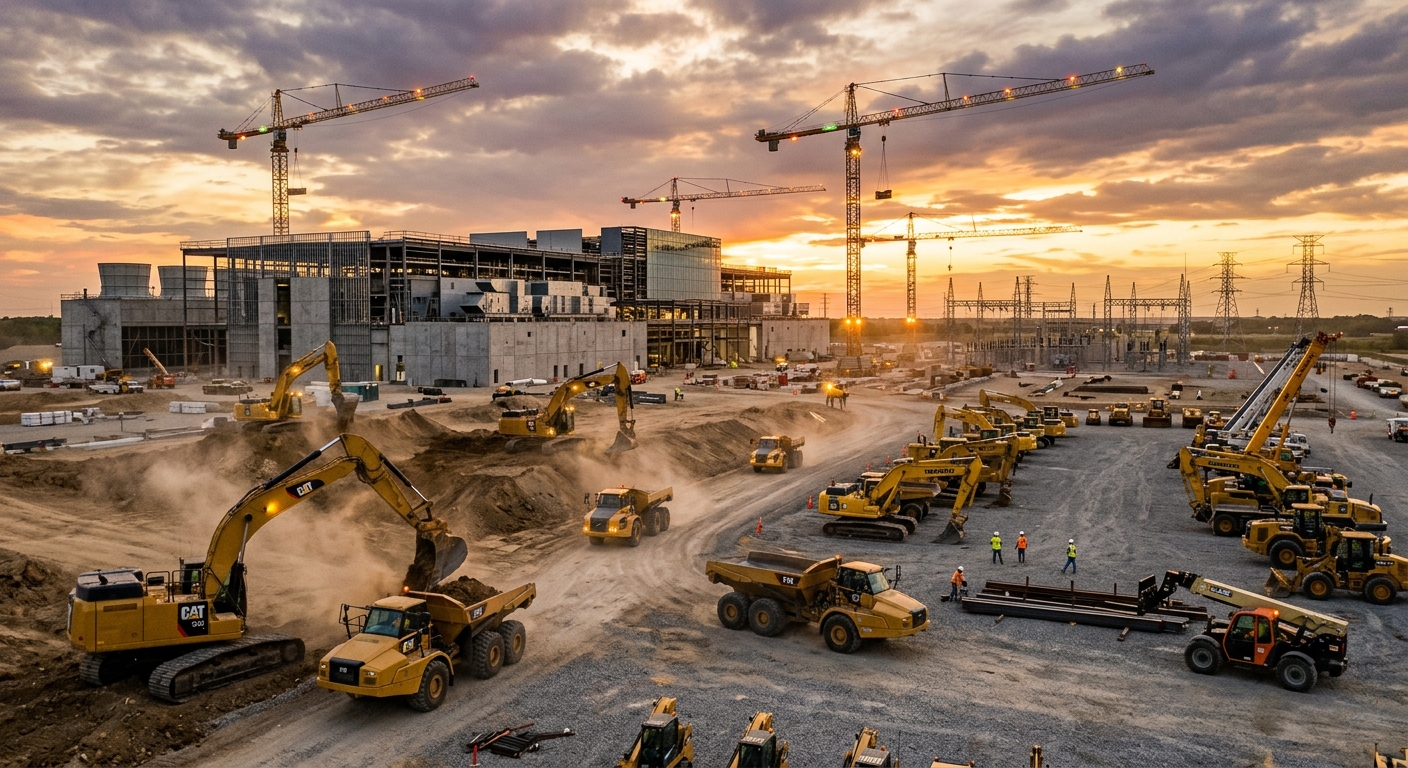
The construction equipment market looks strong if you only watch the biggest jobs.
Data centers, utility projects, highways, bridges, EV plants, hospitals, and LNG work are still pulling machines into busy regions. Contractors need excavators, dozers, cranes, articulated trucks, compact track loaders, telehandlers, light towers, generators, pumps, and support trucks. Rental yards are chasing the same jobs. Dealers are trying to keep parts and service moving while customers ask for uptime, not excuses.
But the broader market is not as clean as the headline numbers make it sound. May construction starts jumped. June planning cooled. Private nonresidential spending dipped. Architecture billings weakened. That mix tells a more useful story than any single data point: heavy equipment demand is being carried by large projects and a handful of hot categories, while the middle of the market is more uneven.
That does not mean fleet owners should freeze. It means the next machine purchase needs a second reason to exist after the big job is gone.
FieldFix Editor’s Note: A busy market can still hide weak machine economics. FieldFix helps equipment owners track service history, downtime, repair spend, and cost per hour by asset, so growth decisions are based on what each machine actually earns.
Starts are hot, but the heat is concentrated
Dodge Construction Network reported that total construction starts improved 34.1% in May to a seasonally adjusted annual rate of $1.78 trillion. Nonresidential building starts rose 17.8%, nonbuilding starts rose 91.9%, and total starts were up 12.7% year to date through May.
Those are big numbers. They explain why contractors in some regions still cannot get enough equipment, why rental yards are moving fleet hard, and why some dealers are seeing strong demand for earthmoving and support equipment tied to large commercial and infrastructure jobs.
The detail matters more than the headline. Dodge said the largest nonresidential projects breaking ground in May included a $5 billion Rivian EV plant in Georgia, a $3 billion Nebius data center in Alabama, and a $2.8 billion World Trade Center commercial tower in New York. On the nonbuilding side, the list included a $13.5 billion LNG export facility in Louisiana, a $4.2 billion express toll lanes project in Georgia, and a $4.1 billion Brent Spence Bridge project in Ohio and Kentucky.
That is not a normal diet of local commercial work. Those are large, equipment-heavy jobs that can move regional fleet demand by themselves.
For equipment owners, that creates opportunity and risk at the same time. A contractor can stay busy on a large project and feel like the market is wide open. A rental yard can push utilization up because one site is absorbing machines by the dozen. A dealer can see a rush of parts and service work around a project corridor.
Then the phase changes.
Earthmoving demand gives way to vertical work. Rough-terrain forklifts replace dozers. Temporary power becomes more important than grading equipment. The contractor who needed five machines for site prep may need one later, or none. The rental company that bought around the first phase has to find the second customer.
That is where the market punishes lazy fleet planning.
Planning is still high, but June pulled back
The forward-looking data is not collapsing, but it is getting less one-directional.
Dodge’s Momentum Index fell 1.9% in June to 271.7 from an upwardly revised May reading of 277.1. Commercial planning declined 6.8%, while institutional planning rose 10.9%. Year over year, the index was still up 21.8%.
The important part is what sat underneath that move. Dodge said data center activity still drove the index, but the pace moderated from recent highs. Without data centers, the commercial segment would have been up 7.6% from the prior year instead of the much larger headline increase.
That is the split in one statistic.
The market is not dead outside data centers. Traditional office, warehouse, retail, hotel, healthcare, recreation, government, and religious building planning all showed pieces of improvement in June. But data centers remain such a large force that they can make the whole market look hotter than many contractors are actually feeling.
Fleet owners should treat that as a warning. If a local market is benefiting from data center work, utility upgrades, or a specific industrial project, that demand may be real. It is still concentrated demand. A purchase decision tied to one category needs a plan for what happens when that category slows or moves.
A 35-ton excavator, crawler dozer, articulated truck, telehandler, or large generator can be a great asset when the work is there. It can also become a monthly payment with a parking spot if the next project has a different equipment mix.
Spending data is more cautious
The Census Bureau’s May construction spending release points to a flatter market than the starts data alone suggests. Total construction spending in May was estimated at a seasonally adjusted annual rate of $2.210 trillion, up 0.1% from April but down 1.5% from May 2025.
Private construction was essentially flat from April. Private residential spending rose 0.3%, while private nonresidential spending fell 0.3% to a seasonally adjusted annual rate of $738.7 billion. Public construction rose 0.5%, with highway construction at $150.6 billion.
That matters for equipment because spending is where planned work becomes real invoices. Starts can surge when a few megaprojects break ground. Spending tells you how broad the work is after projects begin moving through the job cycle.
Right now, the message is mixed. Public work and infrastructure remain important. Large private projects still matter. But private nonresidential is not running away across the board.
For contractors, that means backlog quality is more important than backlog size. A company can have work and still have thin margins. A contractor can be busy and still get squeezed by labor, financing, fuel, insurance, transport, parts, and repair costs. A fleet can look fully used while the machines are not earning enough after maintenance and downtime.
The old mistake is buying equipment because the calendar is full.
The better question is whether the machine can earn through the full ownership cycle. That means purchase price, financing cost, utilization, repairs, transport, attachments, operator availability, resale value, and the risk that the work changes before the note is paid off.
Design billings are flashing yellow
Architecture data adds another layer of caution. The AIA/Deltek Architecture Billings Index for May declined to 44.5, its lowest reading since January. A score below 50 means more firms reported declining billings than rising billings.
AIA describes the ABI as a leading indicator for nonresidential construction activity roughly 9 to 12 months ahead. That does not mean every contractor should panic. It does mean the next wave of private building work is not guaranteed to refill the pipeline evenly.
This is why the current market can feel strange. The jobsite in front of you may be slammed. The bid board may be thinner than it should be. The rental yard may be short on telehandlers this month and overloaded with a different class of machine three months later. Dealers may see customers fighting for uptime while also delaying a purchase that looked likely in the spring.
That is not contradiction. That is an uneven cycle.
Equipment demand is being pulled by the jobs that have capital, urgency, and political or commercial momentum. Data centers have it. Utilities have it. Some healthcare and infrastructure jobs have it. Speculative or rate-sensitive private projects are shakier.
The fleet strategy has to match that reality.
Rental demand will not save every machine
Rental companies usually benefit when contractors are unsure. If a contractor does not want to buy into a choppy market, renting is the easier call. That helps rental revenue and utilization.
But rental demand does not make every fleet decision smart.
Big projects can distort local rental markets. A data center or utility job can pull in machines for months, making utilization look excellent. If a rental company buys too much around that job, it may be left with equipment that does not fit the next local demand pocket.
Small and mid-size rental yards should be especially careful here. They can absolutely win around big jobs, especially when they provide better service than a national chain. But they need to know which machines are general-purpose workhorses and which ones are really project-specific bets.
Compact excavators, skid steers, compact track loaders, telehandlers, compressors, light towers, and small generators can usually move across customer types. Larger or more specialized equipment needs a tighter case. Who rents it after the current job? What rate does it need to carry? What parts are likely to fail? Can the shop support it without hurting the rest of the fleet?
The answer may still be yes. But it needs to be a measured yes, not a “the market is hot” yes.
Dealers are in the service business now
Dealers feel this split too. New equipment demand may be strong in certain categories, but the customer conversation is increasingly about uptime, repair speed, parts availability, telematics, machine health, and financing flexibility.
When work is concentrated in large projects, downtime is more expensive. A machine down on a data center pad or bridge corridor is not just inconvenient. It can hold up crews, subcontractors, trucking, inspections, and schedule commitments. That raises the value of dealer support.
It also raises expectations. Customers who are taking on larger jobs want faster answers. They want service history. They want preventive maintenance planned around production. They want rental replacements when a key machine goes down. They want parts departments that understand the job is not waiting.
Dealers that treat service as a back-office function will struggle in this market. Dealers that treat service capacity as the product will have a better shot. The iron matters, but the support around the iron is what keeps contractors earning.
This is also where smaller dealers can compete. They may not have the broadest inventory or the cheapest financing. They can still win by being close to the customer, fast with decisions, honest about availability, and disciplined about follow-through.
Contractors need a harder buying filter
The practical move for contractors is to make equipment purchases pass a harder test.
First, separate confirmed work from hoped-for work. A signed job with known duration, production needs, payment terms, and follow-on opportunity is different from a verbal maybe.
Second, match the machine to the work after the current job. If the purchase only makes sense on one project, it is not automatically wrong, but the numbers need to be very good.
Third, include service capacity. A contractor that already has a strained mechanic, weak maintenance records, and too many aging machines may not need more iron. It may need fewer weak links.
Fourth, compare ownership against rental honestly. Renting at a high monthly rate can feel painful, but owning the wrong machine for four years is worse. Ownership wins when utilization, maintenance control, resale value, and job fit are strong enough to beat flexibility.
Finally, watch the leading indicators without letting them run the company. Dodge’s starts data says large projects are still creating real demand. Dodge’s June planning data says the pipeline is still elevated, but less wild than before. Census spending says the broader market is flatter. AIA billings say future private work needs caution.
That combination calls for discipline, not fear.
The equipment market is not weak. It is selective. The businesses that do well from here will be the ones that know which demand is durable, which demand is temporary, and which machines deserve capital before the next busy season makes every purchase feel urgent.