Bauma 2025 Munich: Global Equipment Innovations on Display
The world's largest construction trade fair returned to Munich with record-breaking scale, featuring major announcements in electrification, automation, and sustainable construction technologies from manufacturers worldwide.
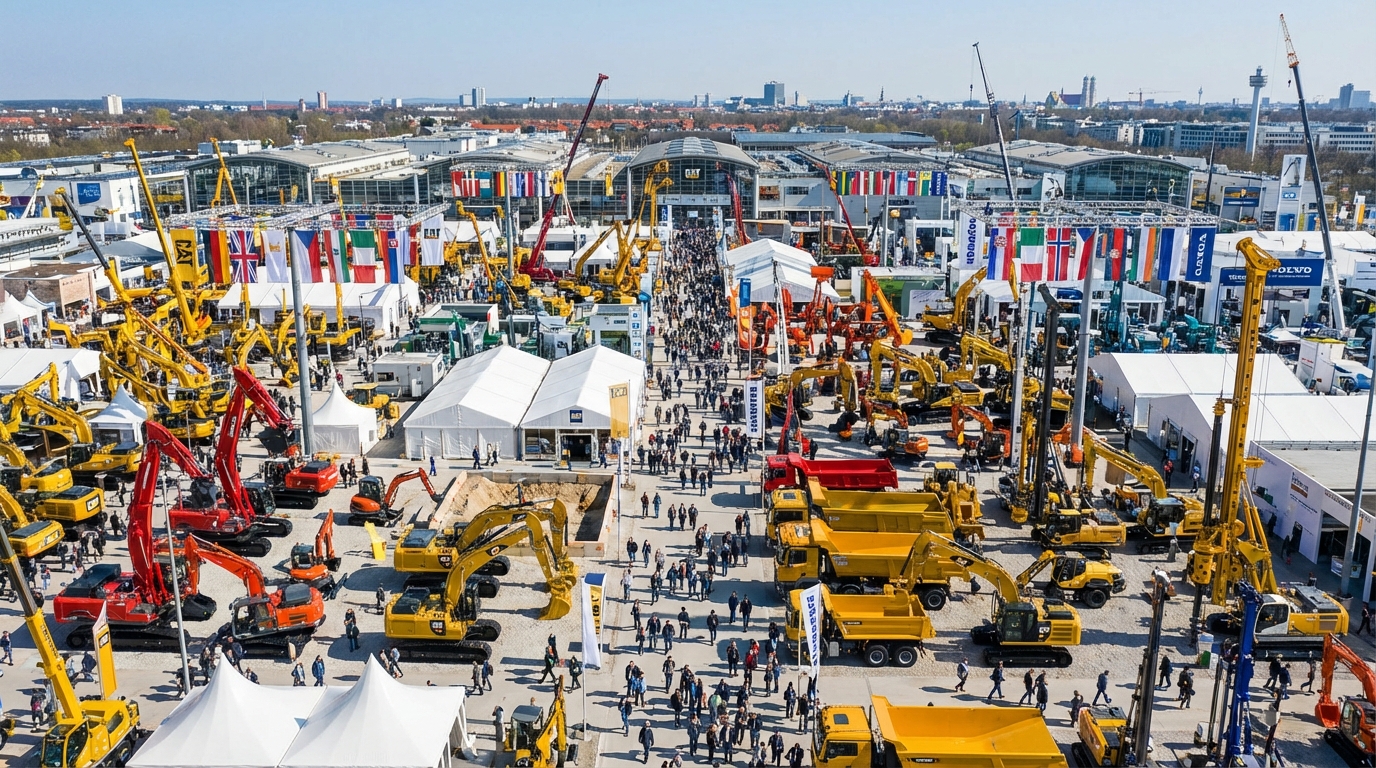
Bauma 2025, held April 7-13 at the Messe München fairgrounds, once again demonstrated why it remains the construction equipment industry’s most significant global gathering. With over 620,000 square meters of exhibition space and representation from manufacturers worldwide, the event provided unmatched insight into where the industry is heading.
For North American contractors and dealers, Bauma serves as a preview of technologies and trends that typically reach our market 12-24 months following their European introduction.
Scale and Attendance
Bauma 2025 reinforced its position as the industry’s largest event:
Exhibition space: Approximately 620,000 square meters (6.7 million square feet), dwarfing any other construction industry trade show.
Exhibitors: Over 3,500 companies from 63 countries participated.
Attendance: Preliminary figures indicate attendance exceeding 620,000 visitors from more than 200 countries.
Duration: Seven full days of exhibits and programming.
The event’s scale requires strategic planning—physically traversing the exhibition area takes hours, and complete coverage is impossible within the show’s duration.
Electrification Takes Center Stage
Electric equipment dominated the show, with major manufacturers displaying expanded lineups:
Liebherr
Liebherr made significant electrification announcements:
Battery-electric crawler excavators: Expanded range of battery-powered excavators up to 50-ton class.
Electric material handlers: Full lineup of electric material handling equipment for ports and recycling applications.
Hybrid drive systems: Enhanced diesel-electric hybrid systems for larger excavators balancing power requirements with emission reduction.
Volvo CE
Volvo Construction Equipment continued its electrification leadership:
Extended compact range: Additional models in the battery-electric compact equipment lineup.
Larger equipment prototypes: Preview of battery-electric equipment in heavier categories targeting production within 2-3 years.
Charging infrastructure: Partnerships with charging solution providers for jobsite electrification.
Hitachi
Hitachi showcased its electric strategy:
Dual-power excavators: Machines capable of operation on either electric power or conventional diesel.
Zero-emission prototypes: Concept machines demonstrating fully electric operation for larger excavators.
Battery technology partnerships: Collaboration announcements with battery manufacturers for construction-specific energy storage.
Komatsu
Komatsu emphasized its electrification roadmap:
Battery-electric dozers: Prototype electric dozers for low-carbon applications.
Overhead line equipment: Mining and quarry equipment designed for electric power from overhead lines.
Hydrogen applications: Conceptual hydrogen-powered equipment for demanding duty cycles where battery limitations are problematic.
Chinese Manufacturers
Chinese OEMs demonstrated aggressive electrification:
SANY, XCMG, Zoomlion: Each displayed comprehensive electric equipment ranges across multiple categories.
Competitive positioning: Electric equipment at price points significantly below European manufacturers.
Global expansion signals: Increased focus on European and global market penetration.
Automation and Digital Construction
Beyond electrification, automation and connectivity were prominent themes:
Autonomous Operation
Several manufacturers advanced autonomous operation capabilities:
Quarry automation: Integrated systems for autonomous operation of multiple machines in quarry environments.
Earthmoving automation: Semi-autonomous grading and earthmoving systems with enhanced precision.
Remote operation platforms: Sophisticated remote operation stations enabling operation from distant locations.
Digital Twins and BIM Integration
Digital construction technologies featured prominently:
Project visualization: Equipment integrating with BIM models for precise positioning and progress tracking.
Digital twins: Real-time digital representations of equipment for monitoring and optimization.
Data platform announcements: Industry initiatives toward standardized data formats and cross-manufacturer compatibility.
Predictive Maintenance
Maintenance technology advanced:
AI-powered diagnostics: Machine learning systems identifying developing issues before failures.
Component tracking: Detailed monitoring of individual component condition and remaining life.
Parts forecasting: Systems predicting parts requirements for proactive inventory management.
Sustainability Beyond Electrification
Environmental responsibility extended beyond electric drivetrains:
Alternative Fuels
Multiple fuel alternatives received attention:
HVO and biodiesel: Engines optimized for renewable diesel fuels with improved performance.
Hydrogen internal combustion: Development programs exploring hydrogen as a fuel for conventional engine designs.
Methanol and ammonia: Early-stage exploration of alternative fuels for specific applications.
Circular Economy
Material efficiency and lifecycle considerations featured:
Remanufacturing programs: Enhanced component remanufacturing extending equipment life and reducing waste.
Recyclable materials: Design for end-of-life recovery and material recycling.
Service life extension: Technologies and programs extending useful equipment life.
Low-Carbon Manufacturing
Manufacturing sustainability received attention:
Green steel: Equipment manufactured with reduced-carbon steel from renewable energy processes.
Factory electrification: Manufacturing facilities powered by renewable energy.
Supply chain transparency: Reporting on embodied carbon throughout supply chains.
European Regulatory Preview
Bauma provided insight into European regulatory direction:
Stage VI Emissions
European Stage VI emission standards, equivalent to U.S. Tier 5, are advancing:
Timeline clarity: Clearer implementation schedules for various power categories.
Technology requirements: Manufacturer responses to anticipated requirements.
Cost implications: Discussion of compliance cost impacts.
EU Taxonomy and Reporting
European sustainability regulations affect equipment:
Reporting requirements: Documentation and reporting obligations for equipment environmental performance.
Green procurement: Public procurement requirements favoring sustainable equipment.
Financial implications: Investment and financing considerations tied to sustainability credentials.
Compact Equipment Innovations
Compact equipment saw substantial innovation:
Mini Excavators
Mini excavator advances included:
Electric dominance: Nearly every manufacturer displayed electric mini excavators.
Enhanced capability: Increased performance in compact packages.
Operator comfort: Improved cab designs and control interfaces.
Compact Track Loaders and Skid Steers
Compact loaders featured:
Electric options: Growing availability of battery-electric compact loaders.
Visibility improvements: Enhanced sight lines and camera systems.
Attachment integration: Improved hydraulics and attachment mounting for versatility.
Material Handling and Lifting
Cranes and material handling equipment showed evolution:
Tower Cranes
Tower crane innovations:
Electric and hybrid drives: Reduced fuel consumption and emissions for tower cranes.
Automation features: Assisted operation and collision avoidance systems.
Remote monitoring: Enhanced telematics for fleet management.
Mobile Cranes
Mobile crane advances:
Compact designs: Increased capacity within compact footprints for congested sites.
Electric carrier concepts: Battery-electric carrier vehicles for mobile cranes.
Safety systems: Enhanced stability monitoring and operator assistance.
Road Construction Equipment
Paving and road construction equipment featured:
Pavers and Compactors
Road building innovations:
Electric compactors: Battery-electric rollers and compactors for urban applications.
Intelligent compaction: Enhanced compaction monitoring and documentation.
Material optimization: Systems reducing waste and improving quality.
Milling Machines
Cold milling technology advanced:
Dust and emission controls: Improved environmental performance.
Automation: Enhanced automatic grade control and milling precision.
Productivity: Higher capacity and improved efficiency.
Regional and Partnership Observations
Strategic positioning was evident:
Chinese Manufacturer Presence
Chinese OEM presence was significant:
Space commitment: Major exhibition space from SANY, XCMG, Zoomlion, LiuGong, and others.
Product breadth: Full product ranges across categories.
Quality advancement: Continued improvement in build quality and feature sophistication.
Partnership Announcements
Strategic partnerships featured:
Technology sharing: Cooperation agreements for automation, electrification, and connectivity.
Regional manufacturing: Announcements of manufacturing investments in various regions.
Distribution expansion: Dealer network developments and market entry strategies.
Implications for North American Markets
Several Bauma observations have North American relevance:
Electrification timeline: Electric equipment shown at Bauma typically reaches North American availability within 18-24 months.
Regulatory preview: European emission and sustainability regulations often preview similar North American developments.
Competitive dynamics: Chinese manufacturer capabilities signal competitive pressure in global markets, including North America.
Technology direction: Digital and automation technologies demonstrated at Bauma indicate industry direction.
Looking Ahead
Bauma 2025 confirmed that the construction equipment industry is in the midst of its most significant technological transition in decades. Electrification, automation, and sustainability are moving from concepts to commercial reality at accelerating pace.
For North American contractors and dealers, monitoring European developments provides strategic advantage. Technologies debuting at Bauma will shape equipment decisions in our market within the coming years.
For related coverage, see our ConExpo 2026 preview and analysis of electric equipment developments.