World of Concrete 2026: Battery Power Takes Center Stage as Tool Makers Push Cordless Limits
From robotic drilling systems to 62-joule demolition hammers, this year's WOC showcased how cordless technology is reshaping jobsite productivity.
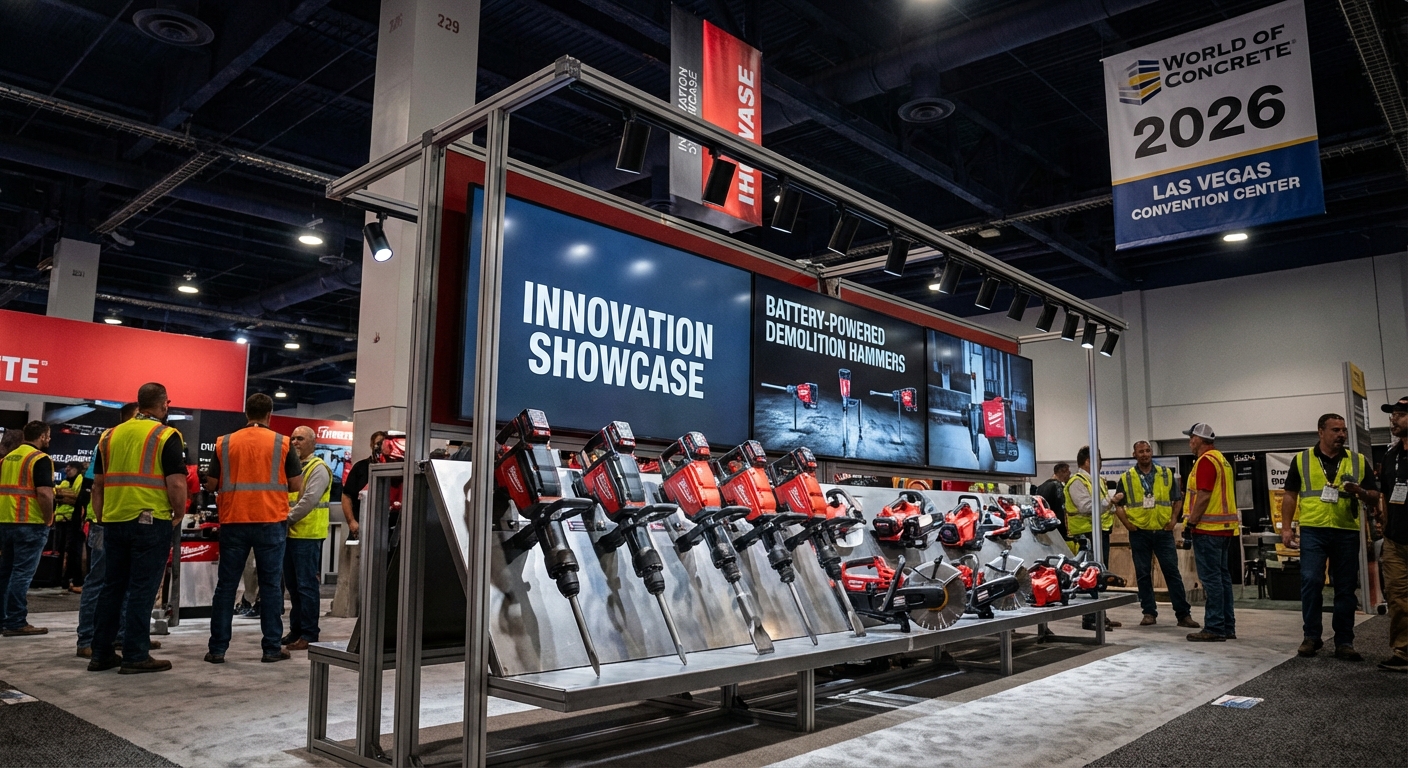
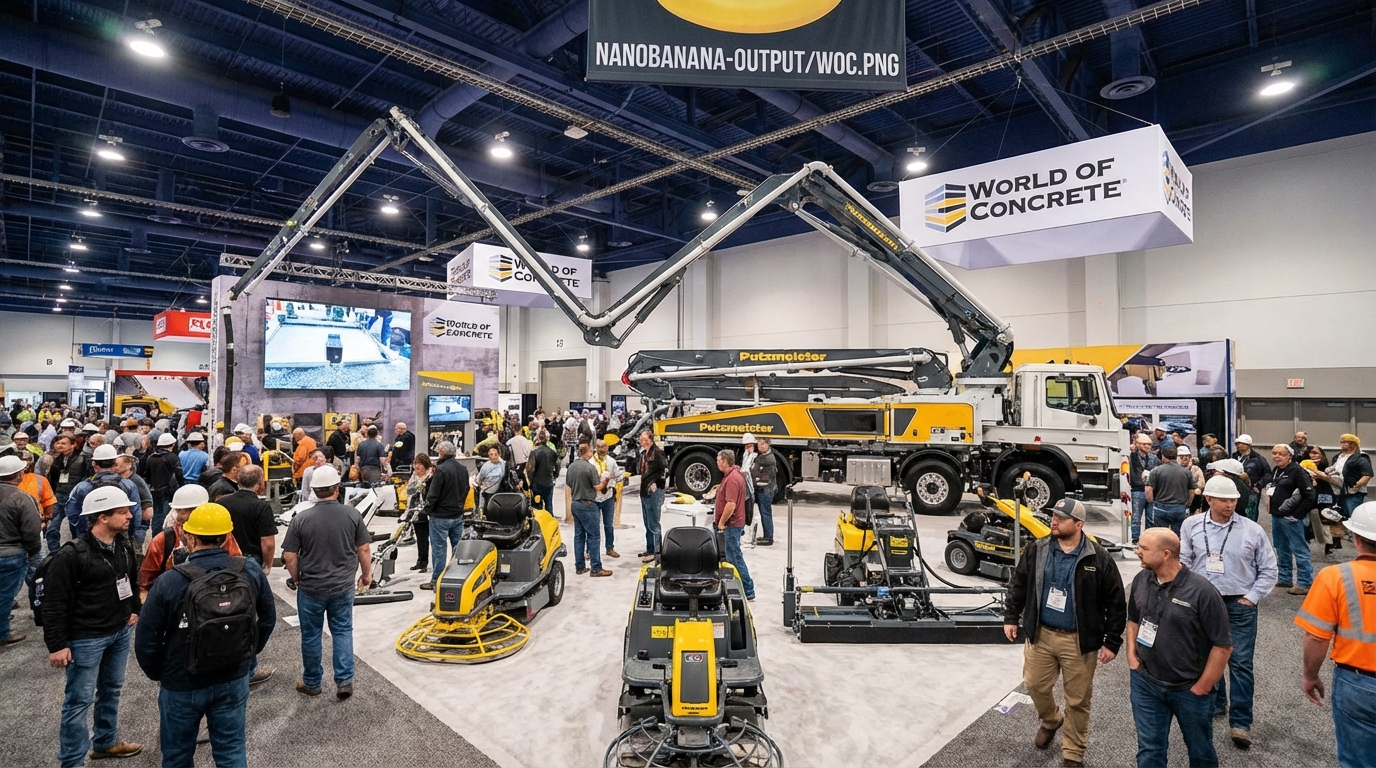
The Las Vegas Convention Center transformed into a proving ground for battery-powered innovation last week as World of Concrete 2026 delivered what may be the most significant showcase of cordless construction technology in the trade show’s history. With CONEXPO 2026 just weeks away at the same venue, tool manufacturers used WOC as a launching pad for products that fundamentally challenge assumptions about what battery power can accomplish on the jobsite.
The message from every major booth was unmistakable: cordless isn’t just catching up to corded and gas-powered tools—in many applications, it’s surpassing them. From Hilti’s 62.7-foot-pound demolition hammer to DeWalt’s autonomous drilling robot designed for data center construction, the announcements signal an industry in the midst of a profound technological transition.
For contractors navigating this rapidly evolving landscape, the sheer volume of new products can be overwhelming. Here’s what mattered most from this year’s show.
Editor’s Note: Fleet Visibility in a Mixed-Power World
As contractors adopt battery-powered tools alongside traditional equipment, tracking utilization becomes increasingly complex. FieldFix provides GPS tracking and fleet management that works across all equipment types—gas, diesel, and electric. Know which tools are where, track runtime for maintenance scheduling, and get the visibility you need to manage a modern mixed fleet. FieldFix works with equipment from any manufacturer.
DeWalt and August Robotics: Automation Meets Concrete
The most forward-looking announcement at WOC 2026 came from DeWalt, which unveiled a collaborative robotic drilling system developed with Hong Kong-based startup August Robotics. The unnamed autonomous unit represents the first downward-drilling, fleet-capable construction robot designed specifically for the booming data center market.
The numbers are striking: the robot can drill holes in concrete floors up to ten times faster than traditional methods while maintaining 99.97% accuracy on location and depth. DeWalt reports these figures based on over 90,000 drilled holes completed during pilot programs.
Applications include drilling for server rack stops and structural legs supporting overhead mechanical, electrical, and plumbing systems—the kind of repetitive, precision-demanding work that dominates data center construction.
Perhaps most telling: DeWalt revealed the robot is already deployed with an unidentified “hyperscaler”—one of the world’s largest tech companies. After ten completed phases of data center construction, the system has reduced construction timelines by 80 weeks. That’s not a typo—nearly two years of schedule compression through robotic drilling alone.
The partnership reflects DeWalt’s recognition that battery technology enables more than just untethered hand tools. By eliminating cords and reducing the operator to a supervisor role, autonomous systems become practical in ways impossible with traditional power sources.
Demolition and Cutting: Power Meets Portability
DeWalt also expanded its battery-powered demolition lineup with the DCPS966AG2, a 1-1/8-inch hex demolition hammer built on an all-metal housing that delivers 45 joules of impact energy. The company claims 20% vibration reduction through its Shocks Active Vibration Control system—a meaningful improvement for operators who spend hours breaking concrete.
The DCPS612AG2 12-inch cut-off saw drew crowds to DeWalt’s demo area. Billed as “the most powerful cordless cut-off saw in the industry across power source and blade size,” the unit cuts 4-3/4 inches deep through concrete with up to 8 linear feet of cutting per charge. Integrated base wheels enable quick adjustments, while the electronic brake stops the blade within 3 seconds of trigger release.
Bosch: A New Battery Platform Takes Aim at Professionals
Bosch chose WOC 2026 to launch its Expert 18V battery platform, available in 4Ah, 6Ah, 8Ah, and 15Ah configurations. The platform represents more than incremental improvement—it’s a wholesale reimagining of how professional batteries should perform.
The 4Ah and 8Ah packs incorporate tab-less cell technology for cooler operation, while the flagship 15Ah pack uses three layers of high-power 21700 5Ah cells. All four packs share features designed for professional use:
- Push-button activation for easier battery swapping mid-task
- Central recesses on pack undersides for improved handling
- TPE edge material for shock absorption and grip
- Multi-function status indicators showing charge level and cell balance
The cell balance indicator addresses a real contractor concern: battery packs that degrade prematurely due to unbalanced cells. By providing visibility into pack health, Bosch enables proactive maintenance rather than unexpected failures on the jobsite.
Expanding Into Outdoor Power
Bosch devoted significant booth space to new outdoor power equipment, including the GKE18V-40 16-inch chainsaw. With 41 feet-per-second chain speed, electronic motor brake, and integrated kickback protection, the saw targets landscapers and light-duty tree work—markets traditionally dominated by gas-powered equipment.
The company also unveiled concrete-specific tools including the GLT18V-5000N tower light, GDS18V-780N mid-torque impact wrench, and GBR18V-15S 5-inch surface grinder. The grinder drew particular attention, offering power equivalent to 13-amp corded tools with variable speed, enhanced dust control, and an adjustable shroud for confined spaces.
Hilti: Nuron Platform Grows More Powerful
Hilti’s Nuron platform has established itself as the benchmark for professional-grade cordless tools, and WOC 2026 brought significant additions to the lineup.
The DSH 900-22 ATC 14-inch cut-off saw may be the most ambitious battery-powered saw yet introduced. Hilti claims performance matching a 90cc gas saw—a statement that would have been dismissed as marketing fantasy just a few years ago.
The saw’s 3D active torque control provides safety by stopping unexpected kickback in under one second, while the blade brake halts rotation within four seconds. At 32.8 pounds with two B 22-290 batteries and a 360mm blade, it’s no lightweight—but it eliminates fuel mixing, pull-starting, and the exhaust emissions that increasingly limit where contractors can work.
Demolition Hammers Hit New Highs
The TE 3000-22 demolition hammer represents the high end of battery-powered breaking. Its 62.7 foot-pounds of single impact energy—running at 840 impacts per minute—enables max performance of 9 tons per hour. Hilti calculates roughly 1.8 tons of concrete removal per charge on paired B 22-290 batteries.
Active vibration reduction and two fully decoupled handles address the ergonomic challenges of heavy demolition, while soft-start reduces the initial jumpiness that can fatigue operators over long shifts.
The smaller TE 1000-22 fills a different niche: controlled demolition requiring precision. At 18.2 foot-pounds and up to 2,040 impacts per minute, it offers force control that increases power output as applied force increases—a feature that gives operators intuitive control over aggressive versus delicate work.
Makita: Breadth and Innovation
Makita brought over a dozen new products to WOC 2026, demonstrating the Japanese manufacturer’s commitment to comprehensive cordless lineups.
The GRT01 rebar tying tool stands out as the world’s first 40V max 16-gauge unit of its kind. Makita claims 65% stronger ties and up to 3,000 ties per charge—numbers that could significantly impact productivity for concrete contractors who spend hours tying rebar before pours.
The BL4080H battery pack incorporates tab-less cell technology to deliver 35% more power than Makita’s previous BL4080F while running 32% cooler. Heat management remains the Achilles’ heel of lithium-ion tools, and any improvement directly translates to longer runtime and extended pack life.
Notable Additions
Other Makita announcements included:
VL001 Vibrating Power Screed: A 6-foot vibrating bar generating 11,000 vibrations per minute with 90 minutes of runtime. Battery-powered screeds eliminate cord management on wet concrete pours—a real workflow improvement.
GPH03 Hammer Driver-Drill: 1,590 inch-pounds of torque through a three-speed brushless motor. The performance targets heavy-duty fastening that previously required corded tools.
GCS01ZK Rebar Cutter: Up to 250 cuts of #5 rebar per charge with 40% faster cutting speed than previous models. The 360-degree rotating head addresses awkward positioning common in rebar work.
Milwaukee Tool: Power and Practicality
Milwaukee’s booth featured over 25 new solutions, with two demolition hammers generating the most attention.
The MX Fuel 27-pound SDS Max delivers 26.1 joules powered by MX Fuel Redlithium Forge batteries. Milwaukee claims 1.5 tons of chipping per charge with XC8.0 batteries, or 33 minutes of continuous trigger time. Push-button start eliminates the hassle of pull-starting that plagues gas-powered equivalents.
VACLINK wireless dust control earned praise from attendees—activating dust extractors through the tool itself rather than requiring separate switches streamlines workflow and improves compliance with increasingly stringent silica regulations.
The M18 Fuel 18-pound SDS Max fills the mid-weight category at 11.4 foot-pounds of impact energy. Multiple speed settings and chisel lock enable controlled demolition, while Milwaukee’s anti-vibration system reduces operator fatigue.
Practical Innovation: Hardhat Cooling
Perhaps the most unexpected announcement was the Bolt Redlithium USB cooling fan for hard hats. Generating 15 mph airflow with six hours of runtime from a USB 3.0 battery, the fan attaches via Milwaukee’s Bolt mounting system with three included air duct variations for customized airflow.
It’s a small thing—but for crews working summer concrete pours, personal cooling could meaningfully impact productivity and safety. Heat stress remains a leading cause of construction injuries, and any mitigation helps.
The Roll-On 7200W/3600W power supply extends battery utility beyond tools. With two 20A GFCI duplex outlets, USB-C, and USB-A, it provides jobsite power without generators—a significant advantage for noise-sensitive locations or sites without grid access.
JLG: Tracks Meet Telehandlers
While not battery-powered, JLG’s surprise reveal of the 1043T Quad Track Telehandler prototype deserves mention for what it represents about equipment evolution.
The tracked telehandler targets applications where wheeled units struggle: below-grade foundation work, heavy civil construction, and deep sheeting projects. Tracks reduce ground pressure from 100-115 psi typical for wheeled telehandlers to approximately 75 psi—enabling operation in mud and loose material that would otherwise require tracked excavators.
Powered by a 127-hp Cummins 3.8 diesel (up from 114 hp in the standard 1043), the prototype maintains 10,000-pound capacity while reaching 43 feet 5 inches at maximum lift height. Dana-supplied axles and an upgraded cab interior with new multi-function display and joystick round out the improvements.
JLG plans market introduction in the first half of 2027—giving contractors time to evaluate whether tracked telehandlers fit their fleet strategies.
What It All Means
World of Concrete 2026 confirmed what forward-thinking contractors already suspected: battery power isn’t the future of construction tools—it’s the present. The performance gap between cordless and traditional power sources has effectively closed for most applications, while cordless offers advantages in noise, emissions, and workflow that corded and gas-powered tools cannot match.
For fleet managers, the proliferation of battery platforms presents both opportunity and challenge. Standardizing on fewer platforms simplifies battery inventory and charger logistics; chasing best-in-class tools across multiple platforms creates complexity that may outweigh performance gains.
The data center robotics announcement from DeWalt hints at where this technology ultimately leads. When batteries enable autonomous operation, the question shifts from “Is cordless powerful enough?” to “What else becomes possible when we untether from the cord?”
CONEXPO 2026 will likely bring additional announcements building on WOC’s foundation. Contractors attending both shows should prepare for a concentrated dose of battery-powered innovation that will shape equipment decisions for years to come.
Equipment Insider will provide comprehensive coverage of CONEXPO 2026 from the Las Vegas Convention Center in March. Follow our coverage for the latest equipment announcements and industry analysis.