ConExpo 2026 Wrap-Up: The 7 Biggest Reveals from Las Vegas
From tracked telehandlers to AI-powered cabs, ConExpo 2026 delivered some genuinely surprising product launches. Here's what actually matters.
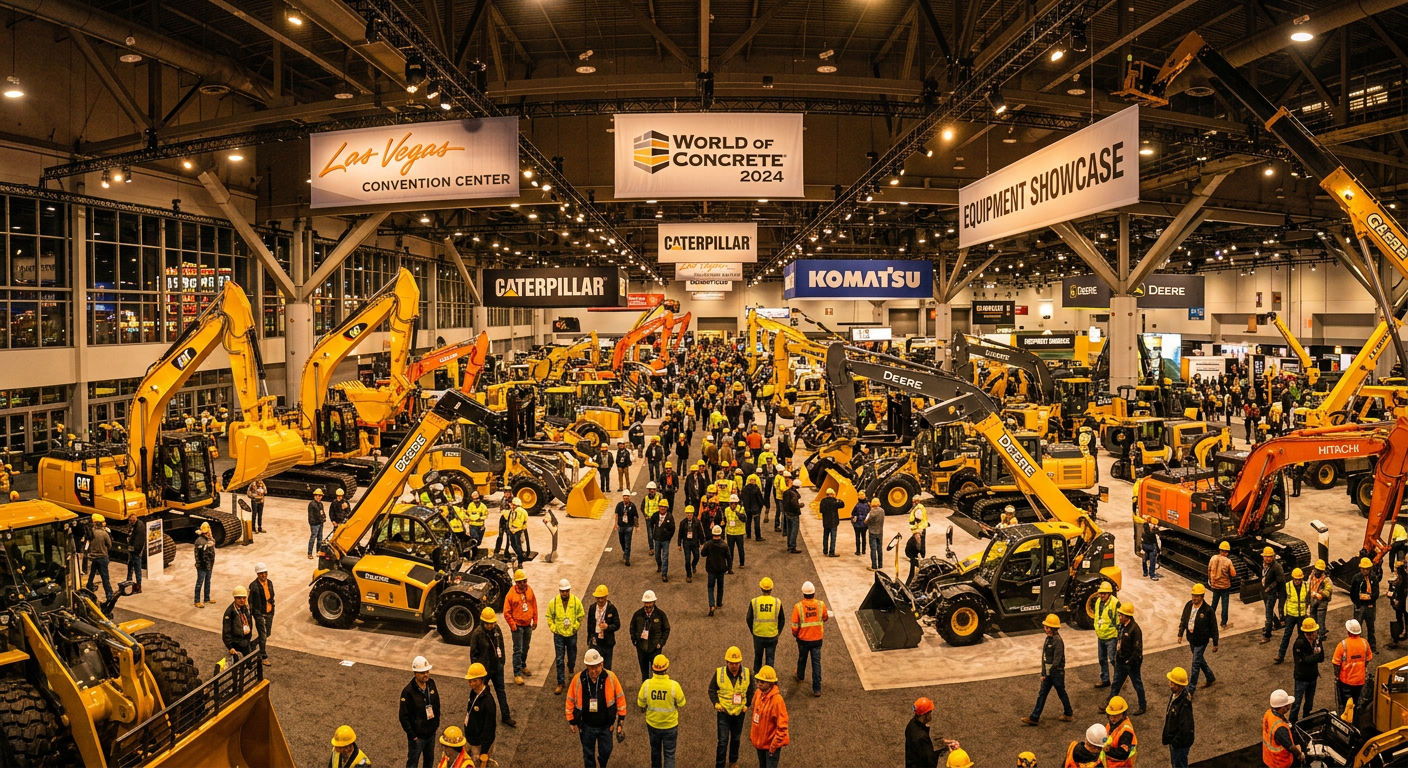
ConExpo-Con/Agg 2026 wrapped up on March 7 after five days, 2,000+ exhibitors, and 3 million square feet of exhibit space at the Las Vegas Convention Center. The next edition won’t happen until March 2029, so manufacturers treated this one like their Super Bowl.
We spent the week sorting signal from noise. Here are the seven reveals that will actually shape how contractors buy, operate, and maintain equipment over the next three years.
Editor’s Note: Managing a fleet of heavy equipment? FieldFix helps contractors track maintenance, log service records, and calculate true cost-per-hour across their machines. Free for up to 3 machines.
1. JLG’s Quad-Track Telehandler Is Weird — and Might Be Brilliant
JLG brought a prototype 1043T telehandler to the show floor, and it turned heads for good reason: it runs on four independent triangle-shaped track systems instead of tires.
The concept targets a real problem. Anyone who’s tried to run a telehandler on a muddy civil site or across loose sand knows the limits of rubber tires. The 1043T keeps the same 10,000-pound rated capacity and 43.5-foot lift height as the standard wheeled 1043, but swaps in Soucy tracks (a Canadian manufacturer) on all four corners.
JLG upgraded the axles to a new Dana set, pulled the outriggers and counterweight, and bumped the Cummins 3.8 diesel from 114 to 127 horsepower. Despite the tracks, the machine is only 1,100 pounds heavier than the standard model. Top speed drops to 10 mph, but if you’re working in conditions that need tracks, you weren’t going fast anyway.
The cab gets a new multi-function display, multi-reverse camera system, and redesigned joystick. JLG is targeting shoring work, rough-terrain municipal jobs, oil and gas operations, and deep foundation projects.
It’s still a prototype, and JLG hasn’t announced production plans. But they showed it at both World of Concrete and ConExpo back-to-back, which suggests they’re serious about gauging demand.
Why it matters: Telehandlers have been stuck in a design rut for years. Putting one on tracks opens up job types that previously required a crane or a crawler carrier with a fork attachment. If JLG brings this to market, it could create a new equipment category.
2. Develon’s Next-Gen Excavators Put the Cab on Notice
Develon (formerly Doosan) used ConExpo to launch four excavators in its new dash-9 series: the DX230LC-9, DX260LC-9, DX360LC-9, and DX400LC-9, ranging from 53,000 to 95,000 pounds.
The specs are solid — new Develon diesel engines with up to 20% more power and 8% better fuel economy than the previous generation. But the real story is what happened inside the cab.
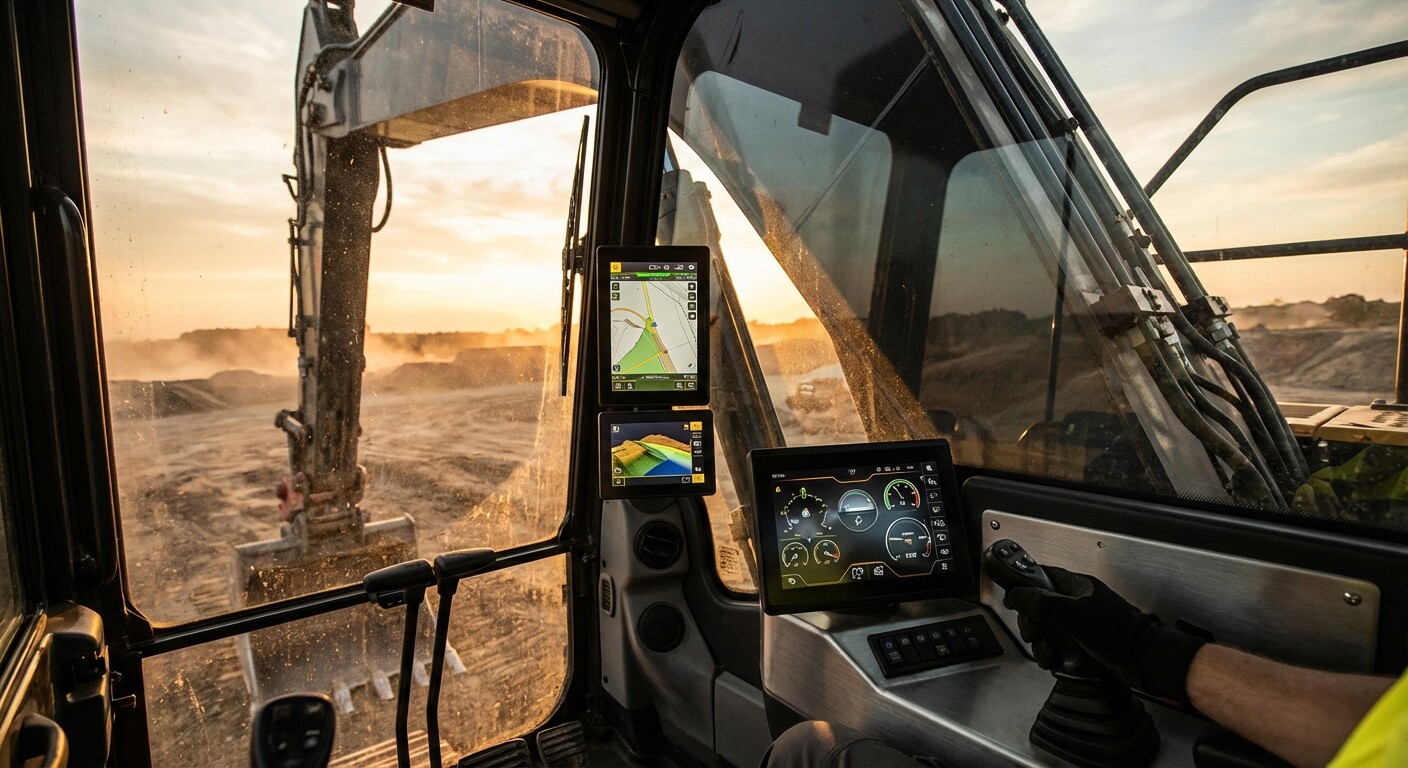
Develon redesigned the operator station from scratch with electro-hydraulic controls and dual 12-inch tablet-style monitors. The screens support split-view, so an operator can pull up 2D grade control, a weighing system, camera feeds, and machine vitals all at once. There’s also a digital key function — unlock the cab, start the engine, and pre-condition the HVAC from your phone.
The safety tech is the most aggressive in this class. An AI-powered human-detection system distinguishes people from objects, and the radar range extends to 20 feet. When the system detects someone nearby, it can automatically slow or stop the machine.
Stick steer travel lets operators use the joystick thumb wheels to drive the machine, and a breaker assist function prevents dry-firing when running a hydraulic hammer.
Why it matters: Develon is pushing hard on operator experience and safety at a time when finding qualified operators is getting harder. The digital key and phone integration is the kind of feature that fleet managers will love and operators under 35 will expect.
3. Caterpillar Built a Concept Foreman Truck (and It’s Not a Joke)
Remember those AI-generated images of a Caterpillar pickup truck that went viral in late 2024? Cat was quick to deny any truck plans at the time. Then they showed up to ConExpo with a concept smart truck built on a Ford F-450 chassis.
The one-of-a-kind truck is designed to be the ultimate foreman’s vehicle. Cat stripped the exterior and rebuilt it with matte black-and-yellow branding, Cat badging on the grille and tailgate, a lined bed with headache rack, and Continental MPT 81 all-terrain tires. Inside: black leather seats with Cat logos.
The tech is where it gets interesting. The truck is loaded with Cat AI Assistant, VisionLink fleet management, and a roof-mounted autonomous drone for aerial site monitoring. The idea is that a foreman running multiple jobsites could manage them all from one vehicle without setting foot on each one.
Cat’s creative director, Archie Lyons, said customer research showed foremen need better tools for managing multiple sites simultaneously. Cat is encouraging contractors to think about how they can equip their own trucks with similar technology.
Cat is clear that this won’t go into production. But it hints at where the company sees construction management heading — less time driving between sites, more remote visibility.
Why it matters: The concept truck is really a VisionLink and AI Assistant marketing vehicle (literally). But it points toward a future where equipment OEMs compete not just on iron, but on the software ecosystem around it.
4. Bobcat Put a Voice Assistant in the Cab
Bobcat showed an in-cab AI voice assistant that lets operators control machine functions using natural language. Press a button on the joystick, speak a command, and the system responds.
The demos were practical: “Turn on the work lights.” “Show the backup camera.” “My machine is pulling to the right, what do I do?” For that last one, the system walks the operator through steering drift compensation settings step by step.
Where it gets useful for experienced operators: instead of stopping, removing gloves, and navigating three menu layers to change response rates, you push the button and say what you want while driving across the site.
Attachment setup is another strong use case. Tell the system what you’re connecting, and it offers to configure the machine’s settings for that attachment automatically.
Why it matters: Voice control in equipment isn’t new as a concept, but Bobcat’s implementation looks production-ready and practical. For contractors running machines with high operator turnover, a system that teaches new operators how to use features while they work could reduce training time significantly.
5. New Holland Dropped Five Mini Excavators at Once
New Holland is building out its mini excavator lineup fast. The company launched five new D-Series models at ConExpo: the E12D (1.3 tons), E19D (1.9 tons), E30D (3 tons), E38D (3.8 tons), and E60D (6 tons).
All five are designed and built in-house by New Holland — a shift from the earlier days when CNH brands relied more on partnerships for compact equipment. Every model gets zero tail swing, first and second auxiliary hydraulics, pattern changers, rearview cameras, and LED work lights as standard.
The smallest two — E12D and E19D — have retractable tracks for squeezing through gates and tight access points. All models except the E12D can be fitted with cabs. Attachment options include CNH-branded buckets, thumbs, couplers, hammers, compaction plates, grapples, augers, mowers, and mulchers. Some models even get a dedicated high-flow mulcher hydraulic line.
Why it matters: New Holland is clearly targeting landscapers and utility contractors who have been buying Kubota, Bobcat, and Cat minis. Launching five models at once signals they’re not testing the water — they’re jumping in. The retractable tracks on the smaller models are a smart touch for residential and urban work.
6. Link-Belt’s 245 X4S Goes After Tight Urban Sites
Link-Belt launched the 245 X4S, a 27-metric-ton reduced-tail-swing excavator powered by a 160-horsepower Isuzu engine that doesn’t need a diesel particulate filter.
The machine targets urban construction, roadwork, utility installation, and demolition — jobs where full-size tail swing is a liability. Operators get four modes: Lifting, Eco, Power, and Speed Priority.
The tech package is solid for a machine in this class. A 10-inch anti-glare LCD integrates with Link-Belt’s WAVES camera system for 230-degree visibility. The machine comes pre-wired for Precision Grade, so adding IMU sensors and 2D machine guidance takes less time and labor than a retrofit.
Optional features include height and depth alarms, a digital level for slope cutting, and a payload system that stores truck capacities and bucket dimensions for real-time load monitoring.
Why it matters: The no-DPF Isuzu engine will appeal to contractors tired of dealing with aftertreatment issues. The pre-wired Precision Grade setup lowers the barrier for smaller contractors to add machine control without a massive upfront investment.
7. JLG’s Robotics Play Goes Beyond Aerial Lifts
Beyond the tracked telehandler, JLG (owned by Oshkosh) made a bigger strategic move at ConExpo by doubling down on robotics.
The company showed an electric articulated boom lift equipped with an autonomous end-effector system. The setup lets the boom lift perform tasks like welding, painting, ductwork, and material handling without a human working at height. For high-risk tasks on commercial construction sites, removing the operator from the platform is a safety win.
JLG also demonstrated micro-sized scissor lifts with leader-follower technology, where one operator guides multiple units for coordinated material movement.
The biggest news was JLG’s acquisition of core technology from Canvas, a California robotics startup that specializes in automated drywall installation. Canvas’ 1200CX robot automates fit-and-finish drywall work, and JLG plans to pair the technology with its access equipment for a range of interior construction applications.
Why it matters: JLG is positioning itself as more than a lift company. The Canvas acquisition and autonomous end-effector work suggest a future where boom lifts become robotic work platforms, not just people-movers. Interior construction — drywall, painting, finishing — is one of the most labor-constrained trades, and automation there has real demand.
The Bigger Picture
ConExpo 2026 had a clear theme: the cab is becoming a cockpit. Between Develon’s dual-screen command center, Bobcat’s voice AI, and Cat’s drone-equipped foreman truck, OEMs are competing as hard on software and operator experience as they are on hydraulic specs.
The other undercurrent was automation creeping into every category. Not full autonomy — nobody’s claiming excavators will run themselves next year. But targeted automation: a telehandler that goes where tires can’t, a boom lift that welds without an operator in the basket, a voice assistant that eliminates menu-diving.
For contractors, the practical takeaway is this: the machines hitting the market in 2026 and 2027 will expect more from your technology stack. GPS, telematics, grade control, and fleet management software are shifting from nice-to-have to table stakes. The OEMs are building for a connected jobsite whether every contractor is ready for it or not.
ConExpo 2029 is set for March 13-17 at the Las Vegas Convention Center. Three years is a long time in this industry. Based on what we saw this week, the machines at that show might barely resemble what’s on your lot today.
Sources: Equipment World, JLG Industries, Develon, New Holland, Link-Belt, Caterpillar