JCB Lands $205 Million U.S. Marine Corps Contract for 535 Militarized Wheel Loaders
British equipment manufacturer secures third consecutive Marine Corps competitive award, cementing its position as a key supplier of military earthmoving equipment.
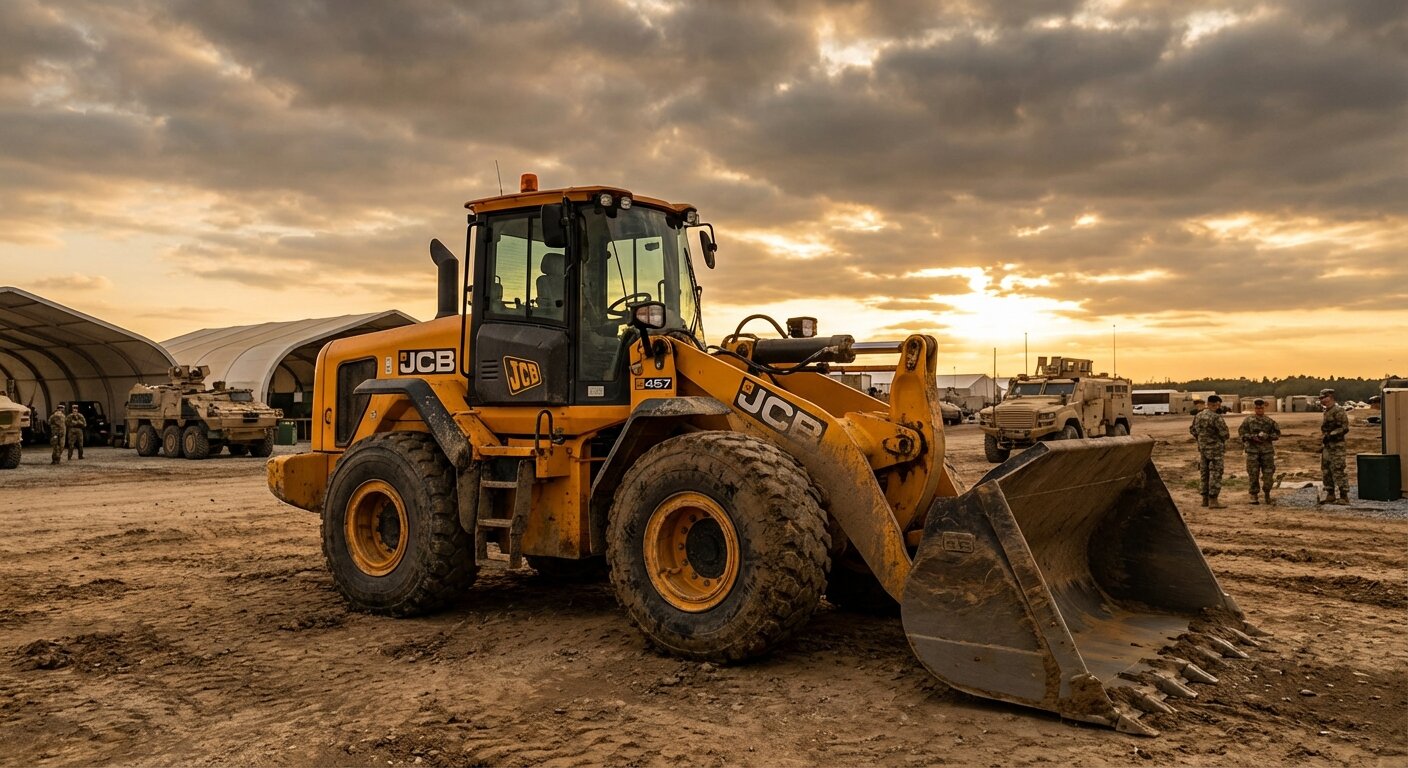
JCB has secured a $205 million contract to supply 535 militarized wheel loaders to the United States Marine Corps, marking the British equipment manufacturer’s third consecutive competitive military award and its largest U.S. defense deal to date.
The contract falls under the Marine Corps’ TRAM (Tractor, Rubber Tired, Articulated-Steering Multi-Purpose) vehicle program, which supports engineering and material handling operations across military installations and deployments worldwide. Test and evaluation units are scheduled for delivery later this year, with full-rate production expected to begin in 2027.
Editor’s Note: Military and commercial fleets alike face the same challenge: tracking maintenance across dispersed equipment. FieldFix helps operators log service records, calculate true operating costs, and get AI-powered diagnostics when issues arise. Built for the operators who keep machines running.
The Hat Trick: Three Consecutive Marine Corps Wins
The wheel loader contract caps a remarkable run for JCB’s Government & Defense division. Over the past several years, the company has won three separate competitive Marine Corps equipment awards:
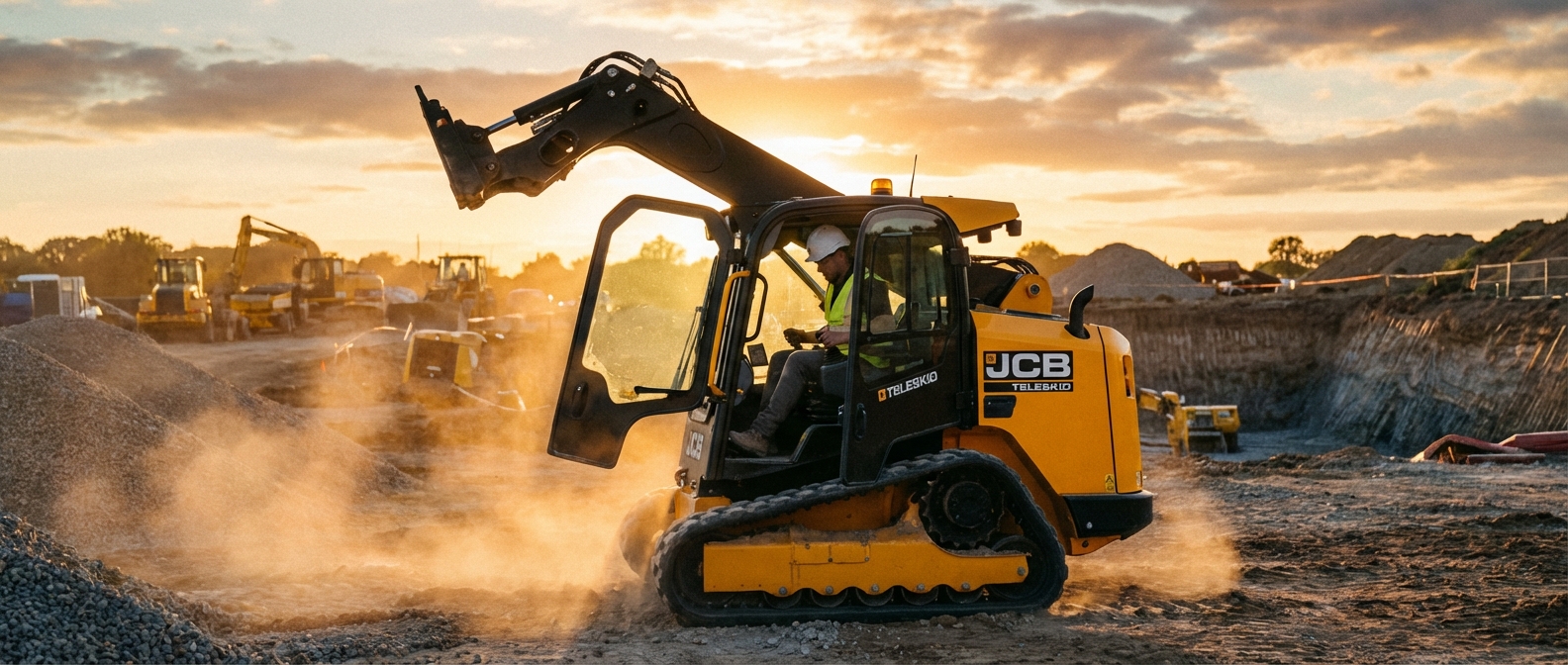
2023: Teleskid Compact Track Loaders — A $39 million contract for militarized versions of JCB’s innovative telescopic-arm compact track loader. The Teleskid’s unique ability to reach forward and upward while maintaining stability made it attractive for military logistics and engineering applications.
2024: 4CX Backhoe Loaders — A $45 million award for military-spec 4CX backhoes, versatile machines that handle digging, loading, and material handling across diverse terrain. The backhoe’s four-wheel-steer capability proved particularly valuable for military applications requiring maneuverability in confined spaces.
2026: 437HT Wheel Loaders — The new $205 million contract for 535 wheel loaders under the TRAM program, JCB’s largest single U.S. military award.
Combined, these three contracts represent nearly $290 million in Marine Corps equipment orders—a significant achievement for a non-American manufacturer competing in a market often dominated by domestic suppliers.
Why JCB Keeps Winning
The Marine Corps’ repeated selection of JCB equipment reflects a broader shift in military procurement philosophy. Rather than developing clean-sheet military-only designs, defense buyers increasingly prefer adapting proven commercial platforms for military use. This approach offers several advantages that JCB has capitalized on effectively.
Commercial Pedigree, Military Adaptation
The 437HT wheel loader selected for the TRAM program is based on JCB’s commercial 437 platform, a machine that already operates in demanding civilian applications including quarries, waste handling, and heavy construction. Starting with a proven commercial design reduces development risk and accelerates delivery timelines.
The commercial platform also brings established manufacturing processes, a global parts network, and a service infrastructure that military logistics can tap into. When something breaks on a deployed machine, finding replacement components becomes significantly easier when the base platform shares parts with thousands of civilian units worldwide.
Performance Where It Matters
The 437HT platform delivers the capabilities military engineering units need: strong lift performance for material handling, efficient cycle times for production-oriented tasks, and integrated ROPS/FOPS protection for operator safety. The machine’s articulated steering provides excellent maneuverability, while its serviceability design minimizes downtime during maintenance.
For the Marine Corps, which must move equipment between ships, forward operating bases, and varied terrain, the 437HT’s combination of power density and transportability made it an attractive choice.
Lifecycle Cost Advantages
Military equipment buyers increasingly evaluate total lifecycle costs rather than just acquisition price. Commercial-based platforms typically offer lower lifecycle expenses thanks to:
- Parts availability through established commercial supply chains
- Technician familiarity with machines already in civilian service
- Reduced training requirements for operators and mechanics
- Proven reliability data from commercial field experience
JCB’s approach of militarizing commercial platforms rather than designing military-only equipment aligns perfectly with this procurement philosophy.
Contract Details and Timeline
The Marine Corps will receive its first test and evaluation units of the militarized 437HT later this year. This phased approach, standard for major military equipment programs, allows the service to validate real-world performance and identify any needed modifications before committing to full production.
Once testing confirms the machines meet operational requirements, full-rate production will begin in 2027. The 535 wheel loaders will be distributed across Marine Corps Combat Engineer Battalions and other units that require heavy material handling and earthmoving capability.
The machines will likely undergo modifications for military service, though JCB hasn’t disclosed specific details. Typical military adaptations for commercial equipment include:
- Blackout lighting for tactical operations
- Lifting and tie-down points for transport by ship, aircraft, or heavy equipment transporter
- Paint schemes matching military specifications
- Communication equipment mounting provisions
- Enhanced air filtration for dusty or contaminated environments
JCB’s Three-Decade Military Partnership
While the recent contracts have drawn attention, JCB’s relationship with the U.S. military stretches back more than 30 years. The company has supplied equipment across multiple branches and programs, building a defense portfolio that includes both purpose-built military machines and militarized commercial products.
Current Military Product Line
High Mobility Engineer Excavator (HMEE) — JCB’s purpose-designed military excavator, developed specifically for U.S. Army requirements. The HMEE can travel at highway speeds (approximately 55 mph), a capability that eliminates the need for low-boy transport between work sites. The Army has ordered more than 900 HMEE units since the program’s inception.
Light Capability Rough Terrain Forklift (LCRTF) — A militarized telehandler that handles container loading, ammunition handling, and general logistics across forward operating bases and ports.
Military 4CX Backhoe Loader — The versatile backhoe selected by the Marine Corps, capable of digging, trenching, loading, and material handling across diverse terrain.
Military Teleskid — JCB’s compact track loader with telescopic arm capability, offering unique reach and versatility for confined-space operations.
Military 437HT Wheel Loader — The newest addition, providing heavy material handling capability for Marine Corps engineering units.
Manufacturing Presence
JCB’s ability to compete for U.S. military contracts has been bolstered by its North American manufacturing footprint. The company operates a major production facility in Savannah, Georgia, where it manufactures backhoes, telehandlers, and other equipment for the North American market.
Having domestic production capability addresses “Buy American” preferences in government procurement while reducing lead times and logistics complexity for military orders. The Savannah facility, which opened in 2001 and has expanded multiple times since, now employs hundreds of workers and produces machines for both commercial and military customers.
What This Means for the Industry
JCB’s three consecutive Marine Corps wins send several signals to the broader construction equipment industry:
Military Markets Are Open
Foreign-headquartered manufacturers can compete successfully for U.S. military contracts, provided they can demonstrate product capability, lifecycle cost advantages, and ideally some domestic production presence. JCB’s success may encourage other international OEMs to pursue military opportunities more aggressively.
Commercial-Military Crossover Is Growing
The days when military equipment required entirely bespoke designs may be ending for many applications. Procurement officials increasingly recognize that commercial platforms offer proven reliability, established support infrastructure, and lower lifecycle costs. Manufacturers with strong commercial products and the capability to militarize them have expanding opportunities.
Defense Spending Remains Robust
Despite periodic budget debates, defense spending on construction and engineering equipment continues. The Marine Corps’ willingness to commit $205 million to wheel loader procurement suggests that military construction and logistics capabilities remain funding priorities.
Competition Is Fierce
JCB’s three wins came through competitive processes, meaning other manufacturers—including major American OEMs—competed and lost. This reflects the increasingly sophisticated evaluation criteria military buyers employ, looking beyond simple price comparisons to total lifecycle value.
JCB’s Broader North American Strategy
The military contracts complement JCB’s aggressive commercial expansion in North America. The company has invested heavily in dealer network development, manufacturing capacity, and product introductions over the past decade.
Recent North American product launches have included expanded compact track loader and skid steer lineups, new telehandler models, and the innovative Teleskid that combines compact track loader maneuverability with telescopic arm reach. The company has also invested in electric and alternative-fuel equipment development, positioning for emerging sustainability requirements.
The Savannah manufacturing facility has expanded multiple times to increase production capacity for the North American market. JCB has positioned itself as a serious competitor across multiple equipment categories, challenging established players in backhoes, wheel loaders, telehandlers, and compact equipment.
Looking Ahead
The $205 million wheel loader contract demonstrates JCB’s emergence as a significant player in U.S. military equipment supply. With three consecutive competitive Marine Corps wins totaling nearly $290 million, the company has proven it can deliver equipment that meets stringent military requirements while offering attractive lifecycle economics.
Deliveries of test units later this year will begin validating the 437HT’s capabilities in Marine Corps service. Assuming successful testing, full production in 2027 will add hundreds of JCB wheel loaders to the military’s earthmoving and material handling fleet.
For JCB, the contract validates its strategy of adapting proven commercial platforms for military applications rather than pursuing clean-sheet military designs. For the construction equipment industry, it demonstrates that military markets reward capable equipment regardless of manufacturer nationality.
The Marine Corps’ repeated selection of JCB also highlights how military procurement has evolved. Performance, reliability, lifecycle cost, and support infrastructure now matter as much as—or more than—traditional relationships or domestic-only sourcing preferences. Manufacturers who can deliver across all these dimensions will find military markets increasingly accessible.
Equipment Insider covers the companies, technology, and trends shaping construction and heavy equipment. Follow us for breaking news and in-depth analysis.