Saudi Arabia's $1.1 Billion Bet: HEC 2026 Signals New Era for Heavy Equipment Manufacturing
The inaugural Heavy Equipment Connect forum drew global OEMs to Dammam, resulting in over $1 billion in manufacturing deals as the Kingdom accelerates its Vision 2030 industrial ambitions.
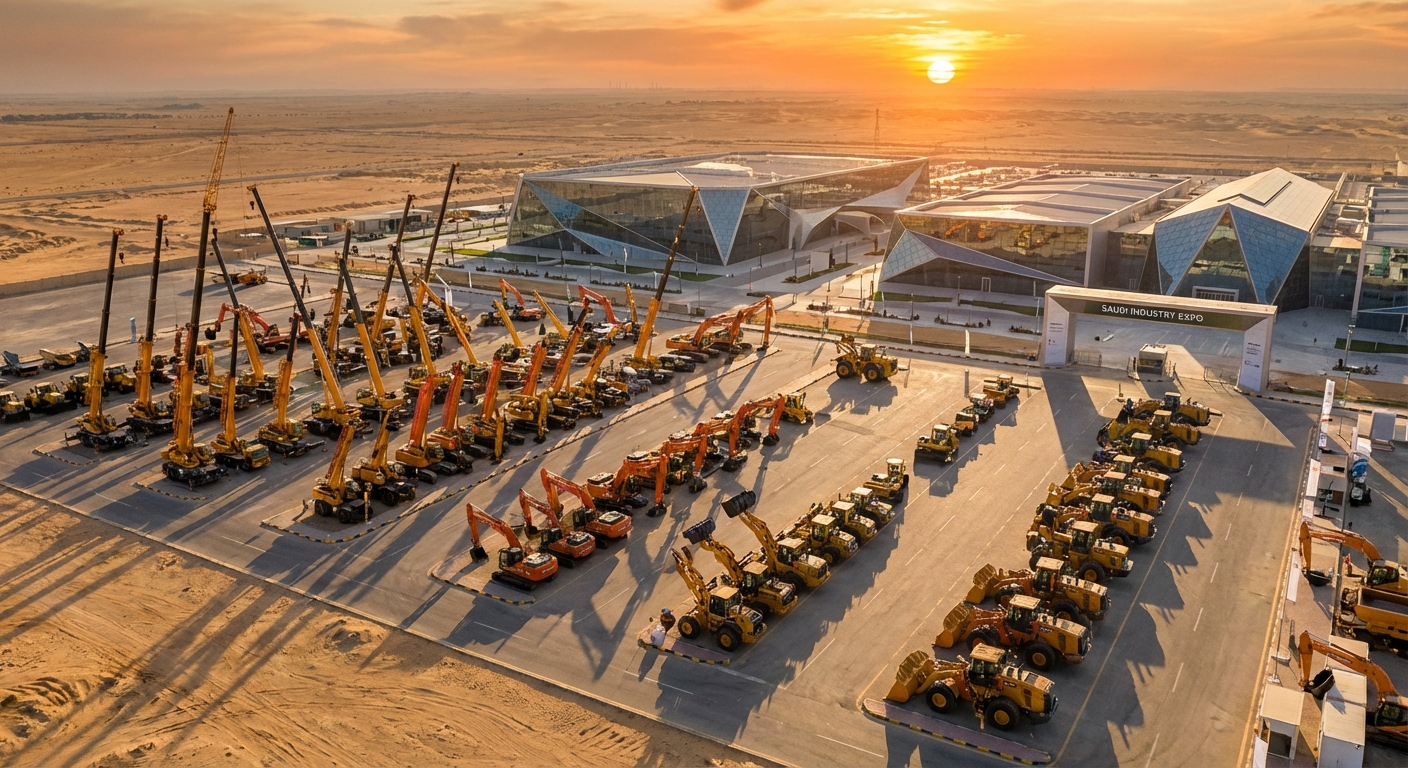
The heavy equipment industry just witnessed a seismic shift in global manufacturing geography. Over the course of three days in early February, the inaugural Heavy Equipment Connect (HEC) 2026 forum in Dammam, Saudi Arabia, generated more than SAR 4 billion (approximately $1.1 billion USD) in joint ventures, memorandums of understanding, and industrial licenses—all aimed at establishing the Kingdom as a major hub for construction equipment manufacturing.
For an industry long dominated by manufacturing centers in the United States, Germany, Japan, and China, the message from HEC 2026 was unmistakable: Saudi Arabia isn’t just buying heavy equipment anymore. It’s building it.
Editor’s Note: Tracking equipment costs across international operations? FieldFix helps fleet managers monitor maintenance expenses, log service history, and calculate true cost-per-hour—essential data for companies expanding into new markets.
The Scale of Commitment
The numbers from HEC 2026 tell a compelling story. Over 100 exhibitors showcased their latest machines at Dhahran Expo, but the real action happened in the conference rooms and signing ceremonies where billion-dollar deals took shape.
The most substantial commitments came from Saudi conglomerate Abdel Hadi A. Qahtani & Sons (AHQ Group), which received industrial licenses to produce Saudi Arabia’s first domestically manufactured rough terrain cranes and reach stackers—a SAR 500 million ($133 million) investment that marks a historic milestone for the Kingdom’s industrial capabilities.
But AHQ didn’t stop there. The company formed a joint venture with German manufacturer Sennebogen through its PWS Equipment division, valued at SAR 220 million ($58.7 million), focused on crawler lattice boom cranes. Separately, AHQ signed an MOU with Chinese OEM LiuGong to localize production of excavators and wheel loaders, and another with India-based Action Construction Equipment (ACE) worth SAR 600 million ($160 million) covering tower cranes, backhoe loaders, and pick-and-carry cranes.
German-Swiss tower crane manufacturer Wolffkran also received an industrial license at the show. Their SAR 400 million ($107 million) investment will establish tower crane manufacturing not just for Saudi Arabia, but for the entire Middle East North Africa (MENA) region.
Why Saudi Arabia, Why Now?
The timing of HEC 2026 is no accident. Saudi Arabia’s Vision 2030 initiative—Crown Prince Mohammed bin Salman’s ambitious plan to diversify the Kingdom’s economy beyond oil—has unleashed an unprecedented construction boom.
Mega-projects like NEOM, the $500 billion futuristic city; The Line, a 170-kilometer linear smart city; and the Red Sea Project are driving equipment demand to historic levels. But Vision 2030 isn’t just about consuming equipment—it’s about building industrial capacity.
H.E. Eng. Khalil Bin Salamah, the Kingdom’s Vice Minister of Industrial Affairs at the Ministry of Industry and Mineral Resources, attended HEC 2026, underscoring the government’s commitment to heavy equipment localization. The presence of such high-level officials at an inaugural trade show signals that equipment manufacturing has become a strategic priority.
The logic is straightforward: with $1 trillion in announced construction projects, Saudi Arabia can’t afford to remain dependent on imported machinery. Local manufacturing means shorter supply chains, reduced logistics costs, job creation for Saudi nationals, and crucially, supply security in an increasingly fragmented global trade environment.
The Strategic Players
Several patterns emerged from the HEC 2026 announcements that reveal how global OEMs are approaching the Saudi market.
European manufacturers are betting on premium, specialized equipment. Wolffkran’s tower crane factory will serve the entire MENA region, leveraging Saudi Arabia’s geographic position as a manufacturing hub for export. Sennebogen’s joint venture with AHQ focuses on crawler lattice boom cranes—complex machines that command premium prices and require sophisticated manufacturing capabilities.
Chinese OEMs see Saudi Arabia as a beachhead for regional expansion. SANY, in partnership with the National Industrial Development Center (NIDC) and Saudi firm Al Alameriah, is investing SAR 475 million ($126.7 million) in localized production of screeners and crushers—equipment essential for the Kingdom’s mining sector, which sits atop an estimated $2.5 trillion in mineral reserves.
Indian manufacturers are positioning for labor market synergies. ACE’s partnership with AHQ is particularly strategic given that a significant portion of heavy equipment operators in the Gulf Cooperation Council (GCC) countries come from India and Pakistan. Ajay Malik, ACE’s head of international business, noted at HEC 2026 that operators’ existing familiarity with ACE machines could prove advantageous as the company expands.
German precision meets Saudi capital. Liebherr signed an MOU with NIDC to explore localization opportunities for concrete mixer manufacturing, valued at SAR 65 million ($17.3 million). While smaller than other announcements, it signals that even the most established European brands see value in Saudi manufacturing partnerships.
Beyond Assembly: The Component Supply Chain
Perhaps the most significant development from HEC 2026 isn’t the headline-grabbing billion-dollar deals—it’s the emergence of Saudi component manufacturing.
Bin Harkil, a Saudi industrial company, signed an MOU with NIDC to invest SAR 115 million ($30.6 million) in local manufacturing of components like buckets and booms for global manufacturers. The company also entered agreements with Dutch specialist Snijder for long-reach excavator manufacturing and South African firm Rosond for mining exploration drilling rigs.
This component-level localization matters enormously. Equipment manufacturing is only as resilient as its supply chain. By developing domestic capacity for critical components, Saudi Arabia is building an ecosystem that can support not just assembly operations, but genuine manufacturing independence.
Market Implications
The HEC 2026 announcements have significant implications for the global heavy equipment industry.
For established manufacturers: The Saudi market is no longer just about sales—it’s about manufacturing partnerships. Companies that fail to establish local production risk being shut out of one of the world’s fastest-growing construction markets. Expect more European, American, and Asian OEMs to announce Saudi partnerships in the coming months.
For equipment dealers: The emergence of Saudi-manufactured equipment could reshape regional distribution networks. Dealers in neighboring GCC countries may find themselves competing with Saudi-based operations that benefit from shorter supply lines and potential tariff advantages.
For rental companies: Increased local manufacturing should eventually translate to better parts availability and service support throughout the Middle East. Companies like United Rentals and Sunbelt, which have been expanding internationally, should monitor these developments closely.
For contractors: Local manufacturing means more options. As Saudi-produced equipment enters the market over the next 2-5 years, contractors may benefit from increased competition, potentially moderating equipment prices that have risen significantly since the pandemic.
The Road Ahead
HEC 2026 was just the beginning. Hassan Al-Shehri, senior manager for machinery and equipment at NIDC, called it “the beginning of a new industrial era.”
That may not be hyperbole. Saudi Arabia has money, strategic location, government commitment, and now, after HEC 2026, the partnerships needed to execute its manufacturing ambitions.
The next major test will be CONEXPO-CON/AGG 2026 in Las Vegas this March, where many of the same OEMs that signed Saudi deals will showcase their latest equipment. Industry observers will be watching for follow-up announcements and concrete timelines for when Saudi production facilities will come online.
One thing is certain: the geography of heavy equipment manufacturing is changing. And Saudi Arabia, for the first time in the industry’s history, is positioning itself not as a customer, but as a producer.
Key Takeaways
- $1.1 billion+ in JVs, MOUs, and industrial licenses announced at HEC 2026
- First-ever Saudi-manufactured rough terrain cranes and reach stackers to enter production
- Wolffkran to establish tower crane manufacturing for entire MENA region
- Component manufacturing emerging alongside assembly operations
- Vision 2030 driving strategic shift from equipment importing to local production
Equipment Insider provides daily coverage of the heavy equipment industry. For breaking news and analysis, follow us on X/Twitter and LinkedIn.