JCB Secures $205 Million US Marine Corps Contract for 535 Militarized Wheeled Loaders
The 10-year deal marks JCB's third major USMC contract in three years, solidifying the British manufacturer's position as a go-to supplier for military-grade construction equipment.
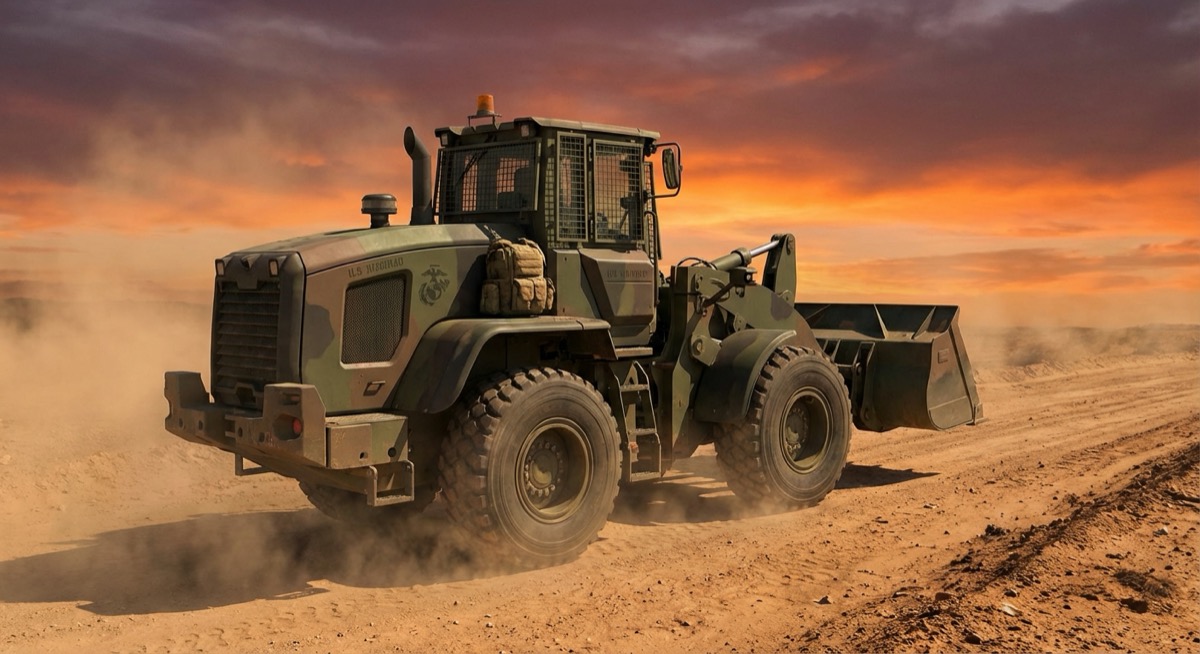
British heavy equipment manufacturer JCB has secured its largest US military contract to date—a $205 million agreement to supply 535 militarized JCB 437HT wheeled loaders to the United States Marine Corps. The deal, which spans a 10-year delivery period, represents a significant milestone for the family-owned company and underscores the growing importance of commercial equipment manufacturers in supporting military operations.
The contract is part of the Marine Corps’ TRAM (Tractor, Rubber Tired, Articulated-Steering Multi-Purpose) program, which aims to modernize the service’s fleet of tactical construction equipment. Test machines are scheduled for delivery later this year, with full-scale production beginning in 2027.
Editor’s Note: Managing equipment hours effectively is crucial for fleet operations. Tools like FieldFix help operators track equipment usage in hours rather than miles—a game-changer for heavy equipment businesses.
JCB’s Military Momentum: Three Contracts in Three Years
This latest award marks JCB’s third major contract with the US Marine Corps in just three years, creating a remarkable run of success in the American defense market:
- 2024: $39 million contract for JCB Multi Terrain Loaders (Teleskid)
- August 2025: $45 million contract for JCB 4CX backhoe loaders
- January 2026: $205 million contract for JCB 437HT wheeled loaders
Combined, these three contracts total approximately $289 million—a staggering sum for a manufacturer that, while globally recognized in construction and agriculture, had limited presence in US military procurement just five years ago.
“This contract award demonstrates the trust and confidence that the United States Marine Corps places in JCB equipment and our commitment to supporting their mission,” said Chris Giorgianni, Vice President of JCB Government & Defense. “We’re honored to continue our partnership with the Marines and to provide them with equipment that meets the demanding requirements of military operations worldwide.”
The 437HT: From Construction Site to Combat Zone
The JCB 437HT wheeled loader represents the company’s flagship offering in the wheel loader category, known for its combination of power, maneuverability, and operator comfort. In its civilian configuration, the machine has earned a reputation among contractors for its fuel efficiency and productivity in material handling applications.
However, the military variant destined for USMC service will undergo significant modifications to meet the rigorous requirements of tactical operations. While JCB hasn’t disclosed all the specifics of the militarization package, typical modifications for defense applications include:
Enhanced survivability features: Armored cab protection, ballistic-resistant glass, and reinforced structural components designed to protect operators in hostile environments.
Tactical mobility upgrades: Heavy-duty suspension systems, run-flat tire capability, and corrosion-resistant coatings suitable for amphibious and expeditionary operations—key considerations for Marine Corps equipment.
Operational adaptability: Blackout lighting systems, NATO slave connections for cold-start capability, auxiliary power provisions, and compatibility with military transportation systems for rapid deployment.
Environmental hardening: Extended temperature range operation from arctic to desert conditions, enhanced dust and water ingress protection, and simplified maintenance requirements for forward-operating locations with limited support infrastructure.
The 10-year delivery timeline suggests a phased approach that allows for continuous improvement and incorporation of lessons learned from initial fielding—a procurement strategy that benefits both the military customer and the manufacturer.
Understanding the TRAM Program
The Tractor, Rubber Tired, Articulated-Steering Multi-Purpose (TRAM) program represents the Marine Corps’ effort to maintain a modern, capable fleet of tactical construction equipment. Unlike tracked vehicles, wheeled equipment offers significant advantages for the expeditionary missions that define Marine Corps operations:
Strategic mobility: Wheeled loaders can be loaded onto transport aircraft more easily than heavy tracked equipment, enabling rapid deployment to emerging crisis zones.
Operational flexibility: On improved roads and surfaces, wheeled equipment can self-deploy at highway speeds, reducing dependence on heavy equipment transporters.
Reduced logistics burden: Wheeled machines typically require less fuel and simpler maintenance than tracked alternatives, critical considerations for expeditionary forces operating far from established supply lines.
Multi-mission capability: Loaders equipped with various attachments can perform tasks ranging from earthmoving and fortification construction to material handling and obstacle clearance.
The Marine Corps has historically operated a diverse fleet of engineering equipment, much of it dating to the 1980s and 1990s. Programs like TRAM aim to replace aging assets with modern commercial-derived equipment that offers improved reliability, reduced lifecycle costs, and better interoperability with allied forces.
JCB’s Defense Pedigree: A Decade of Global Military Sales
While these recent USMC contracts have generated significant attention in North America, JCB’s involvement in defense markets extends back decades. The company reports having sold nearly 10,000 machines to military forces worldwide over the past decade alone—a figure that positions JCB among the leading commercial manufacturers serving defense customers.
This experience matters. Military procurement officials increasingly favor manufacturers with established track records in defense applications, recognizing that the unique demands of military service—austere operating environments, extended deployment cycles, and limited maintenance support—differ substantially from commercial construction applications.
JCB equipment currently serves in military inventories across NATO and allied nations, including the United Kingdom, Australia, and various European countries. This global installed base provides several advantages:
Interoperability: When coalition forces operate together, common equipment simplifies logistics and training. A Marine Corps operator trained on the JCB 437HT could potentially work alongside British Royal Engineers using similar equipment.
Proven reliability: Military procurement officials can examine actual operational data from allied forces rather than relying solely on manufacturer claims or limited testing.
Established supply chains: JCB’s existing defense logistics networks can support US military deployments worldwide, reducing the need to build new support infrastructure from scratch.
What This Means for JCB North America
The implications of this contract extend well beyond the immediate revenue. For JCB’s North American operations, the USMC deal provides:
Manufacturing stability: A 10-year contract creates predictable demand that justifies investment in production capacity, workforce development, and supplier relationships. JCB’s North American headquarters in Savannah, Georgia—where the company has invested over $500 million since 2001—stands to benefit from sustained military production.
Market credibility: Success in US military procurement opens doors to other government contracts at federal, state, and local levels. Agencies often view military adoption as validation of equipment durability and support infrastructure.
Technology transfer: Innovations developed for military applications frequently migrate to commercial products. Enhanced durability features, improved telematics for remote monitoring, and advanced operator protection systems often find their way into civilian equipment lines within a few years of military introduction.
Brand elevation: In a market dominated by established American brands, military contract wins provide JCB with visibility and credibility among US contractors who might not otherwise consider European equipment.
Industry Implications: The Military-Commercial Equipment Nexus
JCB’s success in the military market reflects broader trends affecting the entire heavy equipment industry. Defense agencies worldwide are increasingly turning to commercial-off-the-shelf (COTS) and commercial-derivative equipment rather than purpose-built military vehicles.
This shift is driven by several factors:
Cost pressures: Dedicated military equipment development is extraordinarily expensive. Leveraging commercial platforms that already incorporate decades of engineering development offers significant cost savings.
Faster fielding: New military vehicles can take 10-15 years to develop and field. Commercial-derivative equipment can reach units in a fraction of that time.
Support infrastructure: Commercial equipment comes with established dealer networks, training programs, and parts supply chains that military forces can leverage.
Technology advancement: Commercial equipment now incorporates sophisticated technologies—GPS guidance, telematics, advanced hydraulics—that once required custom military development.
For equipment manufacturers, military contracts offer attractive opportunities but also significant challenges. Defense procurement involves extensive documentation, testing, and compliance requirements that commercial sales don’t require. Manufacturers must invest in specialized capabilities—security clearances, defense-specific quality systems, dedicated program management—that represent substantial overhead.
The manufacturers succeeding in this space are those treating defense as a strategic business line rather than opportunistic one-off sales. JCB’s establishment of a dedicated Government & Defense division, led by experienced defense industry executives, exemplifies this approach.
Looking Ahead: Full Production in 2027
With test machines scheduled for delivery later this year and full production beginning in 2027, the Marine Corps will have ample opportunity to validate the 437HT’s performance before committing to large-scale fielding. This approach allows for refinements based on operator feedback and realistic operational testing.
For JCB, the challenge now shifts to execution. Delivering 535 machines over 10 years requires consistent production quality, reliable supply chain management, and responsive customer support—all while meeting the exacting documentation and quality standards that military contracts demand.
The company’s track record suggests it’s prepared for this challenge. The earlier Teleskid and backhoe loader contracts have provided valuable experience with US military procurement processes, and JCB’s substantial investment in North American manufacturing capacity positions it well to meet production requirements.
The Bottom Line
JCB’s $205 million USMC contract represents more than a single sales win—it signals a fundamental shift in how the US military approaches construction equipment procurement and validates JCB’s strategic investment in defense markets.
For the heavy equipment industry, this deal illustrates the growing importance of military contracts as both revenue source and credibility builder. As commercial equipment increasingly meets military requirements, the traditional boundaries between these markets continue to blur.
And for contractors and fleet operators watching from the civilian sidelines, JCB’s military success offers an interesting data point: if equipment is rugged enough for the Marine Corps, it’s probably rugged enough for your next highway project.
The machines rolling off JCB’s production lines in 2027 will face some of the most demanding operating conditions imaginable. Their performance over the coming decade will write the next chapter in JCB’s American story—and potentially reshape how the entire industry thinks about durability, reliability, and what “military-grade” really means.