Orion Group Holdings Completes $60 Million Acquisition of J.E. McAmis, Bolstering Marine Construction Muscle
Houston-based marine contractor acquires Pacific Northwest breakwater specialist in a deal that includes a $1.4 billion project pipeline and Jones Act marine assets.
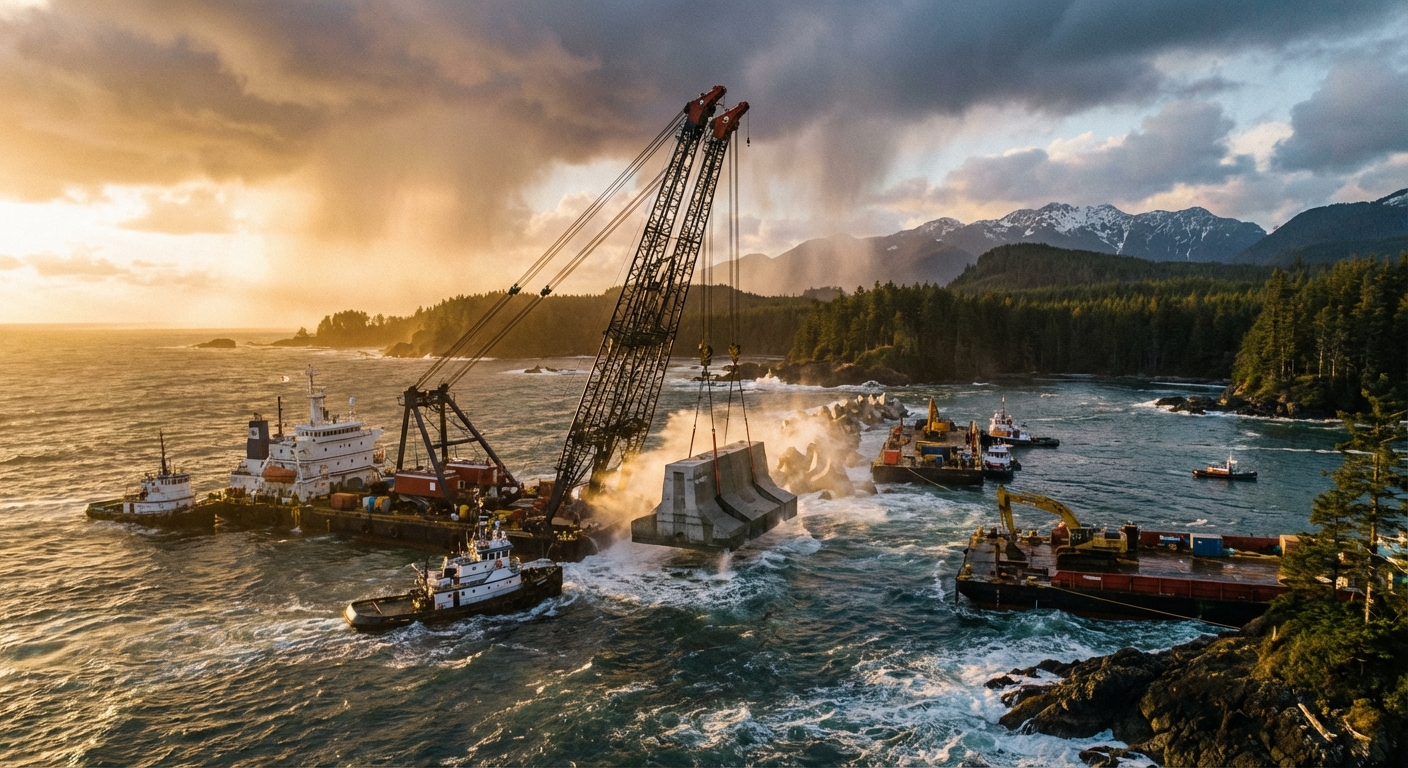
Orion Group Holdings, Inc. (NYSE: ORN) announced today that it has completed the acquisition of J.E. McAmis, Inc. and JEM Marine Leasing LLC for approximately $60 million, net of cash acquired. The deal brings one of the Pacific Northwest’s most experienced marine heavy construction firms under the umbrella of the Houston-based contractor—adding jetty and breakwater construction capabilities, a deep federal client roster, and a project pipeline valued at $1.4 billion.
The acquisition, finalized on February 3, represents Orion’s most significant strategic move since the company began executing its long-term growth plan, and it arrives at a moment when federal infrastructure spending is poised to keep marine construction demand elevated through the rest of the decade.
Editor’s Note: Managing a mixed fleet of marine and land-based equipment? FieldFix helps contractors track equipment hours, maintenance schedules, and operating costs across every machine—whether it’s a crane barge or a track loader. Try it free for fleets up to three machines.
Deal Structure: Cash, Debt, and Upside
The $60 million headline figure breaks down into several components that reveal how Orion structured the deal to manage risk while keeping McAmis leadership invested in future performance.
The bulk of the consideration—$46 million—was paid in cash at closing. An additional $12 million comes in the form of a five-year subordinated promissory note carrying 6% interest, giving Orion breathing room on the immediate cash outlay. Another $2 million was paid in Orion common stock.
But the more interesting piece is the contingent consideration: up to $10 million in additional payments tied to profits from projects currently in McAmis’s backlog, plus 40% of the profit on select near-term project pursuits. That structure does two things—it aligns incentives for the McAmis team to keep delivering during the transition, and it caps Orion’s downside if market conditions shift.
For context, Orion Group Holdings currently carries a market capitalization of approximately $525 million, with shares trading around $13.15. The company’s stock has been on a tear, returning roughly 83% over the past six months—a signal that investors have been buying into the growth story well before today’s announcement.
Who Is J.E. McAmis?
Founded in 1973, J.E. McAmis has spent more than five decades building its reputation in some of the most technically demanding segments of marine construction. The company’s core specialties include jetty and breakwater construction, dredging, environmental restoration, and dam and spillway work—projects that require specialized equipment, deep engineering knowledge, and the kind of institutional experience that can’t be acquired quickly.
McAmis operates primarily out of Washington and Oregon, but its project footprint extends far beyond the Pacific Northwest. The company has executed work in Alaska, Hawaii, Florida, and Canada, demonstrating the geographic flexibility that federal marine construction contracts often demand.
What makes McAmis particularly valuable is its client base. The company maintains strong relationships with two of the largest buyers of marine construction services in the United States: the U.S. Department of Defense and the U.S. Army Corps of Engineers. Those relationships represent decades of past performance ratings and institutional trust—assets that no amount of capital spending can replicate overnight.
The $1.4 Billion Pipeline
Perhaps the most eye-catching number in the deal isn’t the purchase price—it’s the $1.4 billion pipeline of project opportunities that McAmis brings to the table. While a pipeline is not a backlog (these are opportunities at various stages of pursuit, not signed contracts), it signals the depth of federal and public-sector demand for the exact services McAmis provides.
That pipeline is fueled by several converging trends. The Infrastructure Investment and Jobs Act (IIJA), signed into law in late 2021, has been steadily releasing funding for port improvements, coastal resilience projects, and waterway maintenance across the country. The Army Corps of Engineers alone has seen its construction budget expand significantly, with appropriations for navigation, flood risk management, and environmental infrastructure all trending upward.
Additionally, climate adaptation is driving a new wave of coastal protection spending. Jetties, breakwaters, and seawalls that were built decades ago are being reinforced or rebuilt to handle rising sea levels and more frequent storm events. For a company like McAmis—with demonstrated expertise in exactly these types of structures—the demand outlook over the next five to ten years looks robust.
Strategic Logic for Orion
Orion Group Holdings has been building its marine construction business methodically, and the McAmis acquisition fills several specific gaps.
First, it adds jetty and breakwater construction as a core capability. While Orion has deep experience in marine infrastructure, the specialized knowledge required for large-scale coastal protection structures is a distinct competency. McAmis’s track record in this area—built over 50 years of project execution—gives Orion immediate credibility in a segment that’s seeing rising demand.
Second, the deal brings Jones Act-compliant marine assets into Orion’s fleet. The Jones Act requires that goods shipped between U.S. ports be transported on vessels built, owned, and crewed by Americans. In marine construction, Jones Act compliance is a prerequisite for most federal projects, and the specialized vessels and barges that meet these requirements are expensive and time-consuming to build or acquire. McAmis’s marine equipment portfolio, along with real estate assets valued at approximately $34 million, adds immediate operational capacity.
Third, there’s the workforce factor. Marine construction faces the same skilled labor challenges as the rest of the heavy construction industry, but the problem is amplified by the specialized certifications and experience required for over-water work. McAmis brings a trained workforce that knows how to operate in challenging marine environments—from the rough waters of the Pacific Northwest to the logistically complex environments of Alaska and Hawaii.
Orion expects the acquisition to be accretive to its 2026 adjusted EBITDA and margin, meaning it should begin contributing positively to the bottom line within the current fiscal year. That’s an optimistic but not unreasonable projection given McAmis’s existing backlog and the favorable federal spending environment.
Orion’s Broader Trajectory
The McAmis acquisition doesn’t exist in isolation. It’s part of a broader strategic push that has seen Orion Group Holdings transform from a regional marine contractor into a diversified infrastructure player with national reach.
The company operates through two primary segments: Marine and Concrete. The marine segment handles the heavy civil marine construction work—building, repairing, and maintaining infrastructure in and around waterways, ports, and coastal areas. The concrete segment focuses on commercial and structural concrete work, primarily in the Texas and Florida markets.
In recent months, Orion has been on a winning streak with new contract awards. The company secured marine contracts worth $143.5 million, including a headline $113.7 million contract from the Texas Department of Transportation to replace the State Highway 6 bridge over Lake Waco. That single project represents one of the largest in Orion’s history and demonstrates the scale of work the company is now capable of pursuing.
With McAmis now in the fold, Orion’s combined capabilities span virtually the full spectrum of marine construction services: bridge construction, port and harbor work, jetty and breakwater installation, dredging, environmental restoration, and coastal protection. That breadth of capability is increasingly important as project owners look to reduce the number of contractors they need to coordinate on complex, multi-phase marine infrastructure programs.
What This Means for the Marine Construction Market
The Orion-McAmis deal reflects a broader consolidation trend in the marine construction sector. As federal infrastructure spending ramps up and project complexity increases, the advantage tilts toward contractors who can offer comprehensive capabilities, maintain Jones Act-compliant fleets, and demonstrate past performance on similar projects.
For smaller marine contractors, the message is clear: scale matters more than it used to. The bonding requirements for large federal projects, the capital costs of maintaining specialized marine equipment, and the regulatory complexity of environmental and coastal work all favor larger, well-capitalized firms. Companies like Orion, which can spread those fixed costs across a larger project portfolio, have a structural advantage that’s difficult for smaller players to overcome.
At the same time, the deal highlights the premium that the market places on specialized capabilities and established federal relationships. Orion paid roughly $60 million for a company whose primary assets include institutional knowledge, client relationships, and a trained workforce—intangibles that don’t show up cleanly on a balance sheet but drive long-term competitive advantage.
The Infrastructure Spending Tailwind
The timing of this acquisition is no accident. Federal infrastructure spending, fueled by the IIJA and supplemented by additional appropriations, is projected to peak in the 2026-2027 timeframe. For marine construction specifically, that translates into elevated demand for port modernization, inland waterway improvements, and coastal resilience projects.
The Army Corps of Engineers, which administers a significant portion of federal waterway and coastal protection spending, has been working through a backlog of authorized-but-unfunded projects for years. As appropriations catch up to authorizations, the pipeline of available work for marine contractors is expanding.
Additionally, the Department of Defense continues to invest in port and harbor infrastructure at military installations, both domestically and at overseas bases. McAmis’s existing DoD relationships position the combined Orion-McAmis entity to compete effectively for this specialized work.
For the broader heavy equipment and construction industry, the deal is another data point in a consistent trend: the companies that can combine specialized capabilities with financial scale are positioning themselves to capture a disproportionate share of the infrastructure spending cycle. Whether the sector is marine construction, forestry mulching, or bridge building, the strategic playbook looks remarkably similar—acquire niche expertise, integrate it into a larger platform, and leverage the combined capabilities to win bigger projects.
Looking Ahead
Orion Group Holdings has scheduled a conference call for later today to discuss the acquisition in detail. Investors and industry observers will be listening for specifics on integration plans, how McAmis’s backlog is expected to convert into revenue, and whether Orion has additional acquisitions in its sights.
With a stock price that’s nearly doubled in six months, a $1.4 billion pipeline of new opportunities, and the tailwind of historic federal infrastructure spending, Orion appears to be betting that the best time to grow a marine construction business is right now. The McAmis acquisition suggests they intend to be ready when the biggest wave of project opportunities arrives.
Sources: Orion Group Holdings, Inc. press release via GlobeNewsWire (February 4, 2026); SEC filings; industry analysis.