
Virnig Built a Real Business by Taking Compact Attachments Seriously
Virnig Manufacturing grew from a two-car garage in rural Minnesota into a multi-facility attachment maker by staying focused on compact equipment, in-house production, and the kind of product categories dealers can actually move.
A lot of equipment companies talk big. Virnig is more interesting because it looks like a company that kept doing the boring parts well and got bigger because of it.
The Minnesota manufacturer started in 1989 as Virnig Manufacturing and Welding, working out of a two-car garage near Pierz, Minnesota. Dean and Lois Virnig began with repair work for local farmers and construction companies. Within a few years the business moved into a larger building, expanded into skid steer attachments and dump trailers, and eventually became Virnig Manufacturing. Since then the company has added facilities in Rice, Minnesota, expanded repeatedly, and opened a 62,000-square-foot plant in Pikeville, Tennessee to keep up with demand.
That timeline matters. It tells you Virnig did not come into this market with a grand theory or a bunch of corporate spin. It came up through repair work, fabrication, and the practical reality of what local customers needed fixed, built, or delivered. That background still shows in the product mix today.
FieldFix Editor’s Note: Attachments get treated like sidekicks until one goes down in the middle of a paying job. That is usually when crews realize they should have been tracking wear parts, serial numbers, service intervals, and operating costs separately from the carrier. FieldFix gives attachment-heavy fleets a cleaner way to stay on top of that.
This is the kind of company the market tends to underrate
Virnig is not a giant OEM. It is not trying to be. That is part of the appeal.
The company lives in a very practical part of the industry, where buyers care about durability, lead time, fit, dealer access, and whether the attachment survives real abuse. That sounds obvious, but it matters. Compact-equipment attachments are one of those categories that look simple from a distance and get complicated fast when the machine is on a job.
A bad attachment can waste a whole week. Wrong flow. Wrong mount. Weak materials. Bad welds. Poor visibility. Hydraulic issues. A dealer that cannot answer questions. It all adds up fast.
Virnig seems to understand that this market is less about hype and more about repeatability. Its public pitch is built around four things: people, designs, materials, and processes. Usually I ignore neat little brand frameworks like that. In this case, the underlying point is fair enough. The attachment business is won by execution.
The product strategy is tighter than it first appears
Virnig’s website lays out a broad product line: attachments for skid steers, compact wheel loaders, compact tractors, mini skid steers, and mini excavators, plus dump trailers. Inside that lineup are the categories that actually drive work in the field, brush cutters, grapples, buckets, pallet forks, brooms and sweepers, snow tools, agricultural tools, and construction or landscaping attachments.
That breadth is not random.
It gives Virnig multiple ways into the same customer base. A contractor may start with a fork or grapple, then move into brush cutting, grading, snow removal, or material handling. A dealer can carry a few fast-turn categories first, then add more of the line once the relationship proves out. That is good business. It lowers the barrier to entry while creating room for expansion later.
It also keeps the company tied to the compact-equipment segment, which has become one of the most useful corners of the market. Small and midsize contractors, municipalities, property maintenance crews, snow operators, and rental houses all want more output from smaller machines. They do not always want to buy a bigger carrier. A lot of the time they want to make the one they already own more useful.
That is where attachment makers earn their keep.
Virnig grew the old-fashioned way
The company’s own history page is one long record of additions.
After the original start in 1989, Virnig added space in 1994, 1997, and 1999. It built a new manufacturing facility in Rice in 2001. It added another facility in 2010. A 28,000-square-foot expansion followed in 2014, including an automated wash bay and powder-coat paint system. In 2021, the company added a 24,000-square-foot welding addition and a separate engineering and office building. That same year it purchased the Tennessee facility, which became operational in early 2022.
That is not the growth story of a trendy brand riding one hot product. It is the growth story of a manufacturer that kept finding more work, more demand, and more reason to invest in capacity.
I like this kind of company profile because it usually means the business has some actual discipline underneath it. You do not keep expanding plants for three decades by accident. You do it because customers keep buying, dealers keep selling, and operations are strong enough to support the next step.
In-house manufacturing is not just a talking point here
Virnig says its facilities handle engineering, raw-material cutting, machining, welding, and painting in-house. On the homepage, it also points to high-precision laser cutting, robotic welding, and powder coating as core parts of the process.
Every manufacturer says its process matters. Some of them mean it. In attachments, process really does matter because tolerances, weld quality, materials, and finish quality show up in the field pretty quickly.
Compact-attachment buyers are hard on equipment. They are not gently moving mulch around a demo yard. They are dragging, cutting, scraping, clamping, grading, backdragging, and slamming tools into work that can wreck weak equipment fast. If a company is controlling more of the production stack in-house, that usually gives it a better shot at consistency, especially when it is managing several machine platforms and a wide menu of product categories.
That does not make Virnig unique, but it does help explain how the company has stayed relevant while competing in a crowded market.
The compact-equipment angle is smart
One thing I keep coming back to is how deliberately Virnig has stayed in the compact lane.
A lot of attachment companies are tempted to stretch too far, chasing every adjacent category they can find. Sometimes that works. Sometimes it just turns the catalog into a mess.
Virnig’s range still feels coherent. It stays centered on the machines that many contractors, acreage owners, municipalities, and rental fleets actually use every day: skid steers, compact track loaders, compact wheel loaders, compact tractors, mini skids, and mini excavators.
That matters because this part of the market is sticky. Compact machines are everywhere. They are cheaper to own than larger iron, easier to transport, and flexible enough to cover a lot of jobs if the attachment lineup is strong. When labor is tight, that flexibility matters even more. One operator with the right compact machine and the right attachments can cover a surprising amount of work.
Virnig is basically selling ways to multiply the usefulness of those machines.
That is a good place to be.
Brush cutters and grapples tell you a lot about the business
Virnig’s site gives special emphasis to brush cutters, grapples, buckets, and several other staple categories. That makes sense. Those are not novelty products. Those are core revenue tools.
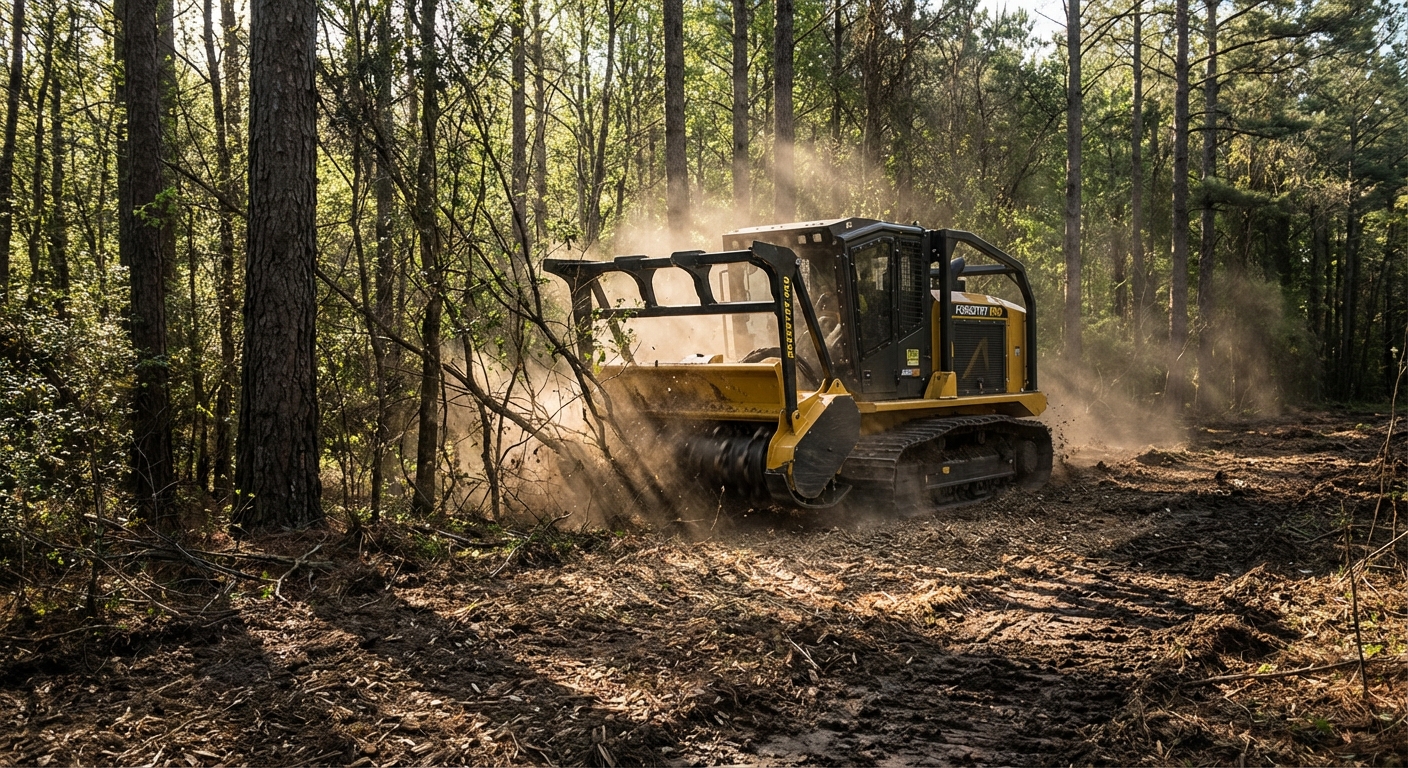
Brush cutters are one of the clearest examples. They are a category where a bad design gets exposed immediately. Operators notice cut quality, deck strength, motor protection, spindle quality, debris handling, and hydraulic compatibility very quickly. If a cutter is weak, the field will tell on it.
Grapples tell a similar story. Buyers want strength, visibility, jaw design that fits the application, and enough variety to match land clearing, demolition, scrap, rock, or brush work. This is not a place where vague product claims get you very far.
When a manufacturer builds around these categories and keeps showing up in dealer networks, it usually means the product is at least passing the real test: crews keep using it and dealers keep ordering it.
Dealers are still the whole game
Virnig’s dealer-finder page is basic, but the existence of the tool says what it needs to say. This business still runs through dealers.
That is not glamorous, but it is true.
Attachment makers love to talk about engineering and durability, and sure, that matters. But growth usually depends on whether a customer can find the product locally, get the right recommendation, and get support after the sale. If the local dealer likes the line, understands the product, and can get answers quickly, the brand has a real shot. If not, it gets bumped by something easier to source.
This is one reason I think mid-sized attachment companies are worth watching. Their businesses are a direct test of whether they can support distribution without the umbrella of a giant OEM. Virnig appears to have done that well enough to keep adding facilities and expanding output.
There is also a quiet geographic advantage here
Virnig grew in Minnesota and then expanded into Tennessee. That is not a flashy headline, but it is a sensible footprint.
Minnesota keeps the company close to an established manufacturing culture and a lot of the upper Midwest compact-equipment market. Tennessee gives it another production base in the Southeast, where construction, land management, agriculture, and equipment distribution all matter.
For a company serving dealers across North America, that kind of footprint can help with freight, lead times, labor access, and resilience when one facility gets tight. Again, not sexy. Also genuinely useful.
Where the pressure comes from
Virnig still operates in a rough category.
There is constant price pressure from lower-cost attachment lines. Dealers have a lot of options. End users can be brutally pragmatic. If a cheaper product looks good enough on paper, some buyers will take the gamble. On the other end, premium brands and OEM-affiliated options can lean on stronger visibility or a broader dealer ecosystem.
So the middle only works if the manufacturer keeps delivering.
And compact attachments are not immune to the same headaches the rest of the industry feels. Steel costs move. Freight gets weird. Dealers want shorter lead times. Customers want fast support. Rental fleets want attachments that survive abuse from operators who absolutely did not read the manual.
This is not an easy business. Which is exactly why a company that survives and expands in it is worth a closer look.
What I would watch next
If I were tracking Virnig over the next year, I would watch three things.
First, I would watch how much the company leans into compact wheel loader and mini-excavator attachments. Those segments still look like fertile ground because buyers want more jobsite versatility without moving all the way up to larger carriers.
Second, I would watch dealer execution. Product matters, but attachment growth usually lives or dies at the distributor level.
Third, I would watch manufacturing cadence more than marketing. Virnig’s whole business case points back to building dependable tools at scale. If it keeps doing that, it stays in a strong position. If lead times slip or category sprawl gets out of hand, the market will notice.
The bigger takeaway
Virnig is a good reminder that the most durable equipment businesses are often built far from the spotlight.
This company started with repair work in a two-car garage. It grew by adding space, adding capability, and sticking close to the kind of products that working crews actually buy. It did not need to become a giant brand with a giant story. It needed to make attachments that do their job, fit the machine, and hold up.
That may sound simple. It is not.
It is also why Virnig is worth paying attention to.
Sources
- Virnig Manufacturing, “The Virnig Story”: https://www.virnigmfg.com/about/
- Virnig Manufacturing homepage: https://www.virnigmfg.com/
- Virnig Manufacturing, dealer finder: https://www.virnigmfg.com/dealer-finder/
- Bing search results for Virnig product categories and company overview, accessed April 21, 2026: https://www.bing.com/search?q=Virnig+Manufacturing+history+dealer+network