OSHA Silica Dust Exposure Rules: Heavy Equipment Operator Compliance Guide
Respirable crystalline silica poses serious health risks to construction workers, and OSHA's exposure limits create compliance obligations that extend to heavy equipment operations, cab filtration systems, and engineering controls.
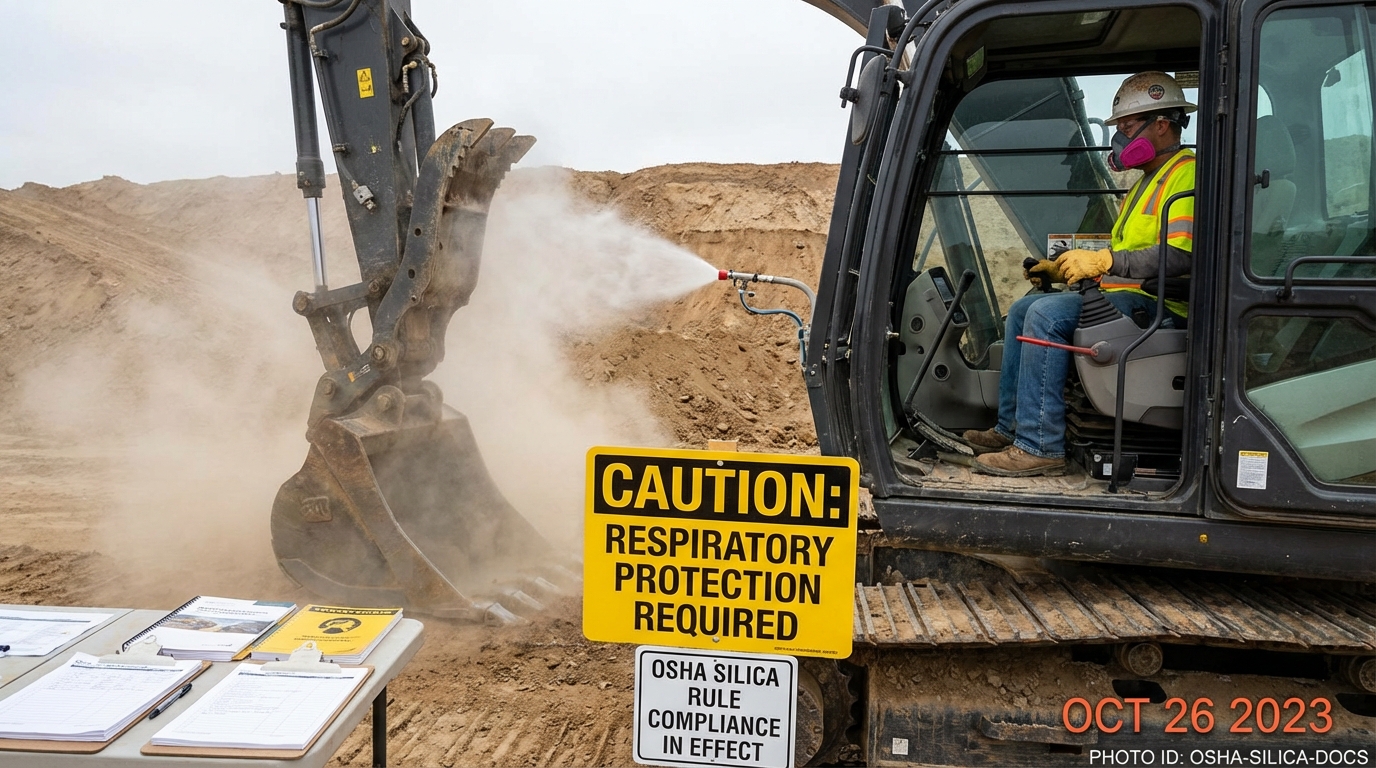
Respirable crystalline silica, generated during cutting, grinding, drilling, and crushing of concrete, stone, and other materials, represents one of the most significant occupational health hazards in construction. OSHA’s comprehensive silica rule establishes specific requirements that directly affect how contractors operate heavy equipment and protect workers from this invisible threat.
Understanding these requirements is essential for compliance—and more importantly, for preventing life-altering diseases among equipment operators and ground crews.
Understanding Silica Exposure Risks
Crystalline silica occurs naturally in materials common to construction: sand, gravel, stone, concrete, and brick. When these materials are disturbed, microscopic silica particles become airborne. Particles small enough to reach deep into the lungs cause progressive, irreversible damage.
Health Effects
Silica exposure causes several serious conditions:
Silicosis: An incurable lung disease causing scarring that progressively reduces breathing capacity. Severe exposure can cause acute silicosis, developing within months rather than years.
Lung cancer: OSHA classifies crystalline silica as a known human carcinogen. Long-term exposure significantly increases lung cancer risk.
Chronic obstructive pulmonary disease (COPD): Silica exposure accelerates COPD development and severity.
Kidney disease: Recent research links silica exposure to increased kidney disease risk.
Autoimmune disorders: Silica exposure is associated with rheumatoid arthritis, lupus, and other autoimmune conditions.
The latency period between exposure and disease development—often 10-30 years—means workers exposed today may not exhibit symptoms until decades later, making prevention critically important.
OSHA’s Silica Rule Requirements
The construction silica rule (29 CFR 1926.1153) establishes multiple compliance obligations:
Permissible Exposure Limit
OSHA’s permissible exposure limit (PEL) for respirable crystalline silica is 50 micrograms per cubic meter of air, averaged over an 8-hour work shift. This represents a five-fold reduction from the previous construction limit.
For perspective, 50 micrograms per cubic meter is roughly equivalent to 50 millionths of a gram in a cubic meter of air—essentially invisible and undetectable without specialized monitoring equipment.
Action Level
OSHA also establishes an action level of 25 micrograms per cubic meter. When exposures exceed this threshold, employers must implement additional controls, monitoring, and medical surveillance.
Specified Exposure Control Methods
For common construction tasks, OSHA’s Table 1 specifies required engineering controls and work practices that, when fully and properly implemented, eliminate the need for exposure monitoring:
Stationary crushers: Enclosure with water suppression and negative pressure ventilation.
Heavy equipment for demolition: Enclosed cab with HEPA-filtered positive-pressure air supply and water sprays for dust suppression.
Heavy equipment for grading/excavating: Water and/or air supplied cab with particulate filter.
Following Table 1 specifications provides a compliance safe harbor. Employers who deviate from these specifications must conduct exposure monitoring to demonstrate alternative controls achieve equivalent protection.
Equipment Cab Requirements
For heavy equipment operators, cab design and maintenance are critical compliance factors:
Enclosed Cab Specifications
OSHA’s Table 1 addresses enclosed cab requirements for various operations:
Demolition operations: Requires cabs with HEPA-filtered, positive-pressure air supply. This is more stringent than standard construction requirements.
Grading and excavation: Requires either water suppression with any enclosed cab, or cabs with supplied air or particulate filtration.
The key distinction is between general “enclosed cabs” and cabs meeting specific filtration and pressurization requirements.
Filtration Standards
Equipment cabs providing silica protection must filter incoming air to remove respirable dust. Filter specifications include:
HEPA filtration: High-efficiency particulate air filters capture 99.97% of particles 0.3 microns and larger. Required for demolition operations.
Particulate filters: Less stringent than HEPA but still effective for typical construction dust. Rating requirements vary by application.
Filter maintenance: Filters require regular inspection and replacement. Clogged filters reduce cab pressurization and protection effectiveness.
Cab Pressurization
Positive-pressure cabs maintain slightly higher air pressure inside than outside, preventing dust-laden air from entering through gaps and seals. Effective pressurization requires:
- Properly functioning HVAC systems
- Intact door and window seals
- Closed doors during operation
- Regular inspection and maintenance of sealing components
Operators who prop open doors or windows eliminate cab pressurization benefits and may expose themselves to silica concentrations exceeding permissible limits.
Factory vs. Aftermarket Equipment
Not all equipment cabs meet OSHA requirements for silica protection:
Factory-equipped cabs: Many newer machines come with cabs designed for dust environments, but specifications vary. Verify cab filtration and pressurization capabilities match application requirements.
Aftermarket upgrades: Older equipment may require aftermarket cab upgrades to meet current requirements. Upgrading filtration systems and improving seals can bring equipment into compliance.
Open-station equipment: Equipment without enclosed cabs provides no silica protection to operators. Respiratory protection, administrative controls, or equipment replacement may be necessary.
Water Suppression Requirements
When enclosed cabs aren’t practical or don’t meet specifications, water suppression becomes essential:
Dust Suppression Systems
Many equipment types incorporate dust suppression:
Integrated systems: Modern crushers, conveyors, and material handling equipment often include integrated water spray systems.
Portable units: Water trucks, spray systems, and portable suppression units can control dust on material piles and travel surfaces.
Application rates: Effective suppression requires adequate water volume. Light misting may be insufficient for high-dust operations.
Water Availability Considerations
Dust suppression creates water supply challenges:
- Remote sites may lack water access
- Water consumption can be substantial for continuous operations
- Environmental regulations may restrict water discharge
- Freezing conditions complicate water use
Alternative controls may be necessary when water suppression isn’t feasible.
Respiratory Protection
When engineering controls don’t reduce exposures below permissible limits, respiratory protection is required:
Respirator Selection
Respirator selection depends on exposure levels:
Filtering facepiece respirators (N95/P100): Appropriate for lower exposure levels, typically up to 10 times the PEL for N95 or 50 times for P100.
Half-mask elastomeric respirators: Provide better fit and higher protection factors than disposable filtering facepieces.
Full-facepiece respirators: Provide both respiratory and eye protection, with higher protection factors.
Powered air-purifying respirators (PAPRs): Offer comfort advantages and high protection factors for extended use.
Respiratory Protection Program
When respirators are required, employers must establish comprehensive respiratory protection programs including:
- Medical evaluation for respirator use
- Fit testing for tight-fitting respirators
- Training on proper use, maintenance, and limitations
- Procedures for inspecting, cleaning, and storing respirators
- Written program documentation
Voluntary Use
When exposures are below the action level but workers request respirators, employers must permit their use. However, even voluntary respirator use triggers certain program requirements.
Medical Surveillance
Workers with significant silica exposure must receive medical surveillance:
Surveillance Requirements
Medical surveillance includes:
- Initial examination within 30 days of assignment to covered work
- Periodic examinations every three years
- Chest X-rays and pulmonary function testing
- Physician review of examination results
- Written medical opinions provided to employers and workers
Covered Workers
Medical surveillance applies to workers who:
- Are exposed at or above the action level for 30 or more days per year
- Are required to use respirators for 30 or more days per year
The 30-day threshold captures workers with regular silica exposure while exempting those with only occasional contact.
Recordkeeping and Documentation
OSHA requires specific documentation:
Exposure Monitoring Records
When exposure monitoring is conducted, results must be maintained for at least 30 years.
Medical Records
Medical surveillance records must be retained for the duration of employment plus 30 years.
Training Documentation
Training records should document who was trained, when, and on what topics.
Practical Compliance Strategies
Effective silica compliance requires systematic approaches:
Identify silica-generating activities: Review operations to identify tasks creating respirable dust. Common sources include concrete cutting, drilling, crushing, and demolition.
Evaluate current controls: Assess whether existing equipment and practices meet OSHA requirements. Gap analysis identifies needed improvements.
Implement Table 1 controls: Following Table 1 specifications provides compliance confidence without requiring exposure monitoring.
Maintain cab systems: Regular maintenance of cab filtration, seals, and pressurization systems is essential. Document maintenance activities.
Train operators: Workers must understand silica hazards, control measures, and their roles in maintaining protection. Annual refresher training maintains awareness.
Monitor compliance: Periodic observation of work practices identifies degradation in control effectiveness or procedural compliance.
Enforcement and Penalties
OSHA actively enforces silica requirements:
Inspection focus: Silica exposure is a National Emphasis Program priority, meaning increased inspection focus on industries with silica exposure.
Penalty levels: Serious violations can generate penalties exceeding $15,000 per violation, with willful or repeat violations reaching $150,000 or more.
Abatement requirements: Beyond penalties, OSHA can require immediate abatement of hazardous conditions, potentially halting operations until corrections are implemented.
Looking Ahead
Silica protection continues evolving as research advances and enforcement experience accumulates. Contractors who invest in proper controls—including appropriate equipment, maintenance, training, and medical surveillance—protect their workers while positioning themselves favorably for regulatory compliance.
The irreversible nature of silica-related diseases makes prevention the only effective strategy. The cost of compliance is knowable and manageable; the cost of worker illness is not.
For related coverage, see our analysis of OSHA safety regulations and operator certification programs.