Hitachi Drops a Battery-Electric Excavator Right Before CONEXPO — and Itochu Is Betting Big on What Comes Next
The new ZX135-7EB is a 13-tonne electric excavator with dual-mode power. Meanwhile, Itochu is raising its stake in Hitachi Construction Machinery to 33.4%, with eyes on North America.
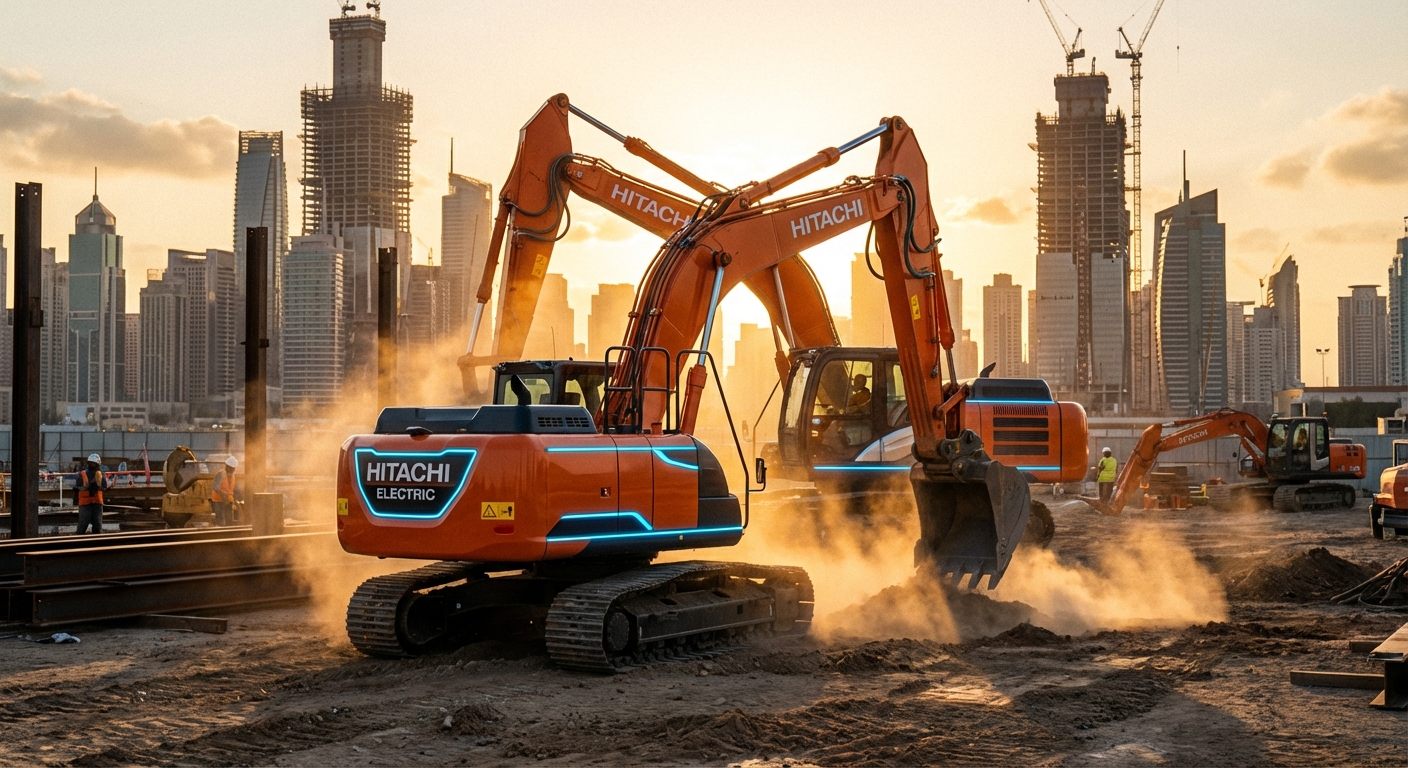
Hitachi Construction Machinery just pulled the curtain back on the ZX135-7EB, a 13-tonne battery-electric excavator that’s heading to CONEXPO 2026 in Las Vegas next month. The timing isn’t accidental. It lands right as Itochu Corporation is locking in a bigger ownership stake in Hitachi CM — from 20.4% to 33.4% — with a clear focus on cracking North America wide open.
Two separate announcements, but they tell one story: Hitachi is done treating electrification as a side project.
The ZX135-7EB: What It Actually Does
FieldFix Editor’s Note: Tracking electric equipment adoption across your fleet? FieldFix logs service records, fuel vs. electricity costs, and maintenance intervals — so you can compare your diesel and electric machines side by side. Free for small fleets.
The ZX135-7EB is built around a 198 kWh lithium-ion battery pack. In a straight battery run, that’s enough for a typical work shift depending on application and conditions. But the real selling point is dual-mode operation: when the batteries run low, operators can plug into a CEE 400V AC three-phase power supply and keep working in grid-assist mode. No downtime waiting for a charge.
Hitachi says the machine delivers performance comparable to the ZX135-7 diesel version. That’s the claim every electric equipment maker has to lead with, and it matters. Contractors aren’t going to accept an electric machine that can’t keep pace with what they’re already running.
On paper, the specs check the boxes that matter most for urban and residential work. Zero exhaust emissions. Significantly lower noise levels than diesel equivalents. Reduced maintenance requirements — fewer fluids, fewer filters, no DPF regens, no DEF. The machine also includes Hitachi’s Aerial Angle camera system, which gives a 270-degree bird’s-eye view around the excavator.
Remote monitoring covers the electric drivetrain specifically — battery status, motor load factor, and charging state can all be tracked offsite. That’s a practical detail for fleet managers running mixed diesel/electric spreads who need to know how these machines actually perform day-to-day, not just on a spec sheet.
Who This Machine Is Actually For
Let’s be honest about where the ZX135-7EB fits. This isn’t a machine for open highway construction or mass earthmoving. At 13 tonnes, it sits in the mid-size utility class — the kind of excavator you’d find on a building demolition in a European city center, digging foundations in a residential neighborhood, or working inside a noise-restricted zone.
That’s not a knock. That segment is exactly where electric equipment makes the most financial sense right now. Cities across Europe already enforce low-emission zones and noise curfews that make diesel machines either illegal or impractical for certain jobs. London, Amsterdam, Oslo, and Paris have all tightened the screws in the last two years. Contractors working those markets need machines like the ZX135-7EB or they lose the bid.
North American adoption is slower, but the trajectory is clear. Several U.S. cities and states are pushing toward zero-emission construction equipment mandates. California’s been the most aggressive — CARB regulations on off-road diesel equipment are getting stricter every year. New York City’s local law requirements on construction emissions continue to expand.
The infrastructure money helps too. Federal funding tied to sustainability goals gives general contractors an incentive to show up with electric equipment on certain jobs, even if it’s not strictly required yet.
The Itochu Play: Follow the Money
If the ZX135-7EB is Hitachi’s technology play, the Itochu stake increase is the business play. And it might be the more important story.
Itochu Corporation is acquiring shares held by HCJ Holdings — a special purpose company set up through Japan Industrial Partners — to raise its voting rights in Hitachi Construction Machinery from 20.4% to 33.4%. The deal is expected to clear regulatory review by April 2026.
Why does a Japanese trading house want a bigger piece of an excavator company? Because Itochu isn’t just a passive investor. It’s one of the largest trading and logistics companies on the planet, with deep distribution networks in North America and connections across finance, ESG compliance, and supply chain management.
The stated goal is to accelerate Hitachi CM’s push into North American sales, rental, and finance businesses — and to pursue M&A opportunities on the continent. Read between the lines: Itochu is bringing the playbook and the rolodex that Hitachi needs to compete with Caterpillar and Deere on their home turf.
North America is the gap in Hitachi’s portfolio. The company is strong in Japan, solid in Europe and Southeast Asia, but has never had the dealer density or brand recognition in the U.S. to match the big domestic OEMs. Itochu’s additional capital and operational support is designed to change that.
Itochu has also said it won’t increase its stake beyond 33.4%. That’s a meaningful detail — it keeps Hitachi CM as an independent operator rather than a subsidiary, which matters for dealer and customer relationships.
The Landcross Rebrand: Bigger Than a Name Change
Here’s the piece that connects everything. Hitachi Construction Machinery plans to rename itself Landcross Corp in April 2027.
This has been in the works since Hitachi Ltd. (the parent conglomerate) sold its majority stake in the construction machinery division back in 2022. Since then, Hitachi CM has been operating under a licensing agreement to use the Hitachi brand. That agreement has an expiration date, and Landcross is what comes after.
A full rebrand of a major global OEM is a massive undertaking. New name on every machine, every dealer sign, every parts catalog, every piece of marketing. It’s also an opportunity. Hitachi CM gets to define what Landcross stands for from the ground up — and electric equipment like the ZX135-7EB is clearly going to be central to that identity.
The Itochu investment makes even more sense through this lens. Launching a new brand in North America — the world’s most competitive equipment market — requires serious financial backing, distribution muscle, and local partnerships. That’s what Itochu brings to the table.
Where Electric Excavators Stand in 2026
Hitachi isn’t the only OEM in this space. Volvo CE has been selling electric compact excavators and wheel loaders for several years. Caterpillar has battery-electric prototypes. Komatsu has been testing electric models in Japan. Liebherr, Takeuchi, Wacker Neuson, and JCB all have electric machines either on the market or in late-stage development.
But the 13-tonne class is a step up from where most of the market has been playing. The majority of electric excavators available today are in the 2-to-8-tonne range — compact machines for light utility work. The ZX135-7EB pushes into territory where the machines are doing real production work, not just small-scale urban tasks.
Battery density and cost remain the limiting factors. Lithium-ion packs big enough for a 13-tonne excavator are expensive, and they add weight. The dual-mode approach is Hitachi’s answer to the range anxiety problem — you’re never stuck waiting for a charge if you have grid access. It’s a practical workaround while battery technology catches up.
Charging infrastructure on jobsites is another bottleneck. Most construction sites don’t have ready access to three-phase 400V power at every work location. That’s solvable — portable power units and on-site generation are options — but it adds cost and planning complexity.
What to Watch at CONEXPO
Hitachi will have the ZX135-7EB on display at CONEXPO 2026 (March 3-7 in Las Vegas). Expect it to draw a crowd, especially given the Itochu news and the Landcross rebrand timeline. This is Hitachi’s chance to make a statement about where the company is heading before the name on the iron changes.
The bigger question for the North American market is whether Hitachi — or Landcross — can build the dealer and service network to actually support electric machines at scale. Selling an electric excavator is one thing. Having a technician who can diagnose a battery management system fault within driving distance of the jobsite is something else entirely.
Itochu’s capital and M&A ambitions could accelerate that. If they start acquiring or partnering with regional dealers in the U.S. and Canada, the support infrastructure fills in faster than organic growth alone would allow.
For now, the ZX135-7EB is a statement piece — a machine that proves Hitachi can build competitive electric equipment in a size class that matters. Whether it becomes a volume seller depends on factors the company can’t fully control: battery costs, charging infrastructure, and how fast emission regulations tighten in North America.
But the investment from Itochu says something important: the people with the checkbook think the bet is worth making.