Caterpillar Unveils the D8 XE: Electric-Drive Comes to the Big Dozer Class
Cat's new D8 XE brings electric-drive technology to its large dozer lineup, promising 10% fuel savings and 6% more material moved per hour. Here's what it means for contractors.
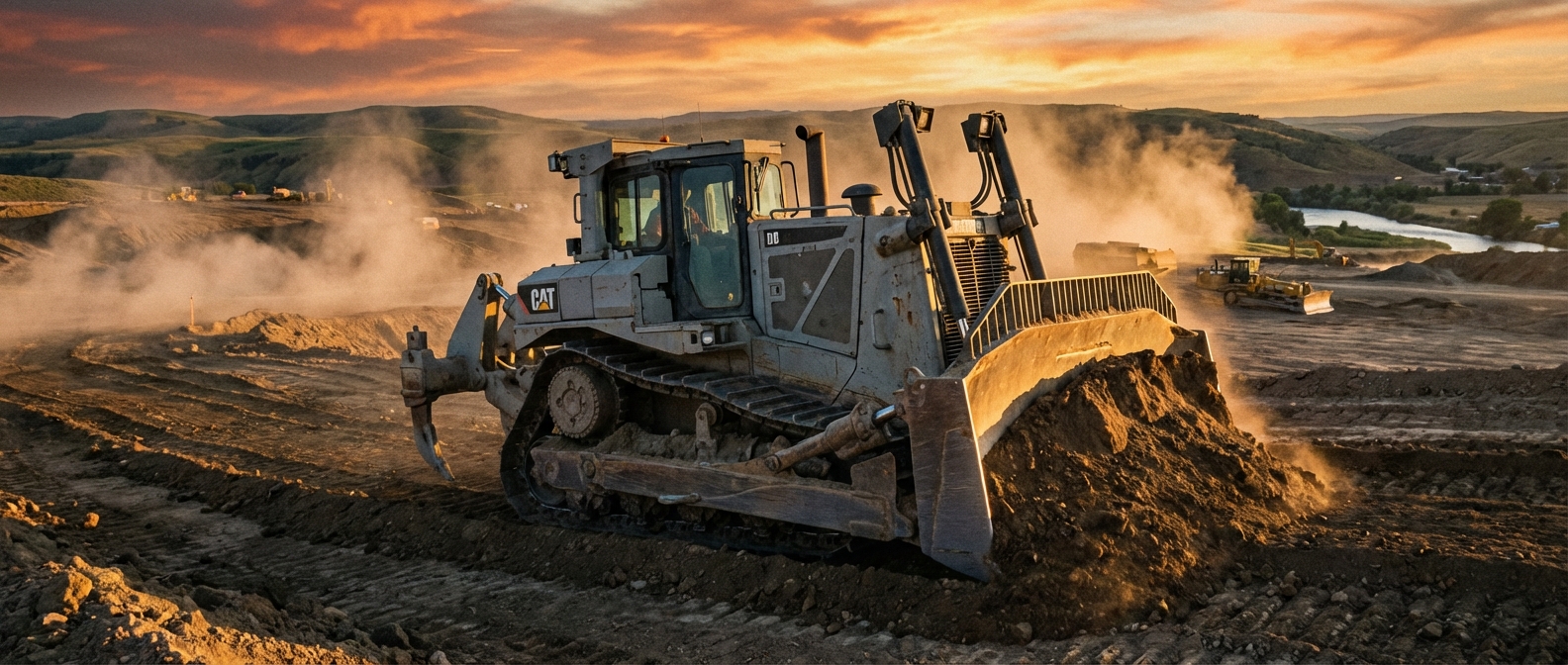
Caterpillar just made the biggest announcement of CONEXPO 2026 for the earthmoving crowd: the D8 XE, an electric-drive version of its workhorse large dozer. The machine debuted in Las Vegas wearing Caterpillar’s Centennial Grey paint scheme — a nod to the company’s 100th anniversary — but the real story is under the hood.
The D8 XE isn’t battery-electric. It’s a diesel-electric hybrid that replaces the conventional torque converter with a fully sealed, liquid-cooled electric generator bolted to the back of a Cat C15 diesel engine. That generator feeds an inverter, which manages energy flow to an electric motor in the propulsion module connected to the final drives.
The result, according to Caterpillar: up to 10% less fuel burned and up to 6% more material moved per hour compared to the standard D8.
FieldFix Editor’s Note: Electric-drive systems like the D8 XE’s change how you think about maintenance scheduling. With fewer moving parts in the drivetrain, your traditional transmission rebuild intervals go away — but you’re now tracking inverter health, coolant temps on two separate loops, and electric motor wear patterns. Fleet management software that can handle these new data points is going to separate the operators who save money from those who just bought an expensive machine. Try FieldFix free to track your fleet’s maintenance and costs.
Why Electric-Drive Matters at This Size Class
Caterpillar proved the concept with the D6 XE, which has been on the market for several years. Scaling it up to the D8 class is a different ball game. The D8 is a production dozer — the machine contractors buy when they need to move serious volumes of dirt on road construction sites, mine overburden, or push material at large-scale land reclamation jobs.
At this scale, a 10% fuel savings is real money. A standard D8 burns roughly 12 to 15 gallons per hour depending on the application. At $4 per gallon, that’s $48 to $60 per hour in fuel alone. Knock 10% off and you’re saving $5 to $6 per hour. Over a 2,000-hour work year, that’s $10,000 to $12,000 in fuel savings on a single machine.
The 6% productivity increase stacks on top of that. Caterpillar says the electric-drive system delivers more torque and constant power to the ground, which lets the D8 XE move faster when pushing loads in second gear. In practice, that means shorter cycle times on every pass.
How the Drivetrain Works
The system is straightforward in concept, even if the engineering is complex. The Cat C15 engine spins the electric generator instead of a conventional transmission. The generator produces electricity, which flows into an inverter that conditions and distributes it to the electric drive motor in the propulsion module.
The key advantage over a torque converter: no power loss through fluid coupling. The electric motor delivers near-instant torque response and maintains consistent power output across the entire speed range.
Caterpillar runs two separate cooling systems on the machine. The engine water circuit operates at 180 to 200 degrees Fahrenheit — standard stuff. The power electronics circuit runs much cooler, at 125 to 130 degrees, which protects the inverter and electric motor from heat damage and extends component life.
Fewer moving parts in the drivetrain also means less that can break. There’s no torque converter to rebuild, no planetary gear sets to wear out, and fewer seals to leak. Caterpillar says maintenance and rebuild costs on the electric-drive transmission are lower than on a conventional power-shift setup.
Serviceability: Designed for the Real World
One of the biggest concerns contractors have with new drivetrain technology is whether their dealer can actually work on it. Caterpillar addressed this head-on with the D8 XE’s service design.
The electric-drive transmission module slides out on rails, just like a power-shift transmission. Pull the axle shafts, disconnect the electronics, crane it off, rebuild it, and put it back in. Caterpillar says technicians already familiar with D8 service procedures won’t need to relearn the entire process.
Outside of the drive system, the D8 XE shares most components with the standard D8. That means dealers don’t need to double their parts inventory, and contractors running mixed fleets of standard and XE models can stock common wear parts.
Upgraded Undercarriage
The D8 XE gets an improved Heavy Duty XL undercarriage with larger bushings and a standard HD Link. Caterpillar says the goal was to optimize all undercarriage components for even wear, which extends the time between turns and reduces total undercarriage cost per hour.
A built-in track wear monitor uses a small sensor inside one link on each rail to alert both the operator and the dealer when undercarriage service should be scheduled. It’s a small feature, but proactive undercarriage management is one of the easiest ways to control owning and operating costs on a dozer.
New Heavy-Duty Ripper
The D8 XE comes with a redesigned heavy-duty weighted single-shank ripper. The added weight at the rear improves penetration in hard rock applications. An integrated toe point on the ripper also works for dragging materials around the jobsite — or pulling the dozer out of a spot it shouldn’t have been in, as Caterpillar put it during the CONEXPO demo.
Counterweights are optional, giving contractors flexibility to configure the rear of the machine based on whether they’re ripping rock, need extra ballast for dozing, or want to keep the machine lighter for transport.
What This Means for Contractors
The D8 XE represents where the heavy equipment industry is heading: not a wholesale jump to battery-electric (which still doesn’t make sense for machines this size), but a smart application of electric-drive technology that reduces fuel costs, increases productivity, and simplifies maintenance.
The diesel-electric approach makes sense for contractors who need their machines running 10-plus hours a day without worrying about charging infrastructure. The C15 diesel provides the energy — the electric drive just delivers it to the ground more efficiently.
For fleet operators, the math is simple. If the D8 XE costs a modest premium over the standard D8, the fuel savings and lower maintenance costs should pay back the difference within the first couple of years. The 6% productivity gain is gravy on top.
Pricing hasn’t been announced yet, and Caterpillar hasn’t given a production timeline beyond confirming the machine debuted at CONEXPO 2026. Expect availability details to come from your local Cat dealer in the coming months.
The Bigger Picture: Electric-Drive’s Expanding Footprint
The D8 XE is part of a broader push across the industry. Caterpillar now has electric-drive in both the D6 and D8 size classes. Other OEMs are exploring similar hybrid approaches for large machines, while battery-electric technology continues to gain ground in the compact equipment space.
The pattern is clear: battery-electric works for compact machines with shorter duty cycles and access to charging. Diesel-electric hybrid makes sense for production machines that need to run all day. Pure diesel isn’t going away anytime soon, but the efficiency gap between conventional and electric-drive transmissions is hard to ignore when you’re burning 15 gallons an hour.
For contractors watching from the sidelines, the D8 XE is the clearest signal yet that electric-drive technology is ready for prime time in production earthmoving. It’s not experimental. It’s not a concept machine. It’s an evolution of a proven platform, built to do the same job better and cheaper.
Sources: Equipment World, Caterpillar CONEXPO 2026 product reveal.