Steelwrist Is Betting Big on North America — And Building the Factory to Prove It
The Swedish tiltrotator maker just opened a U.S. assembly hub in Connecticut, launched new products at CONEXPO 2026, and is pushing hard to make American contractors rethink how they use their excavators.
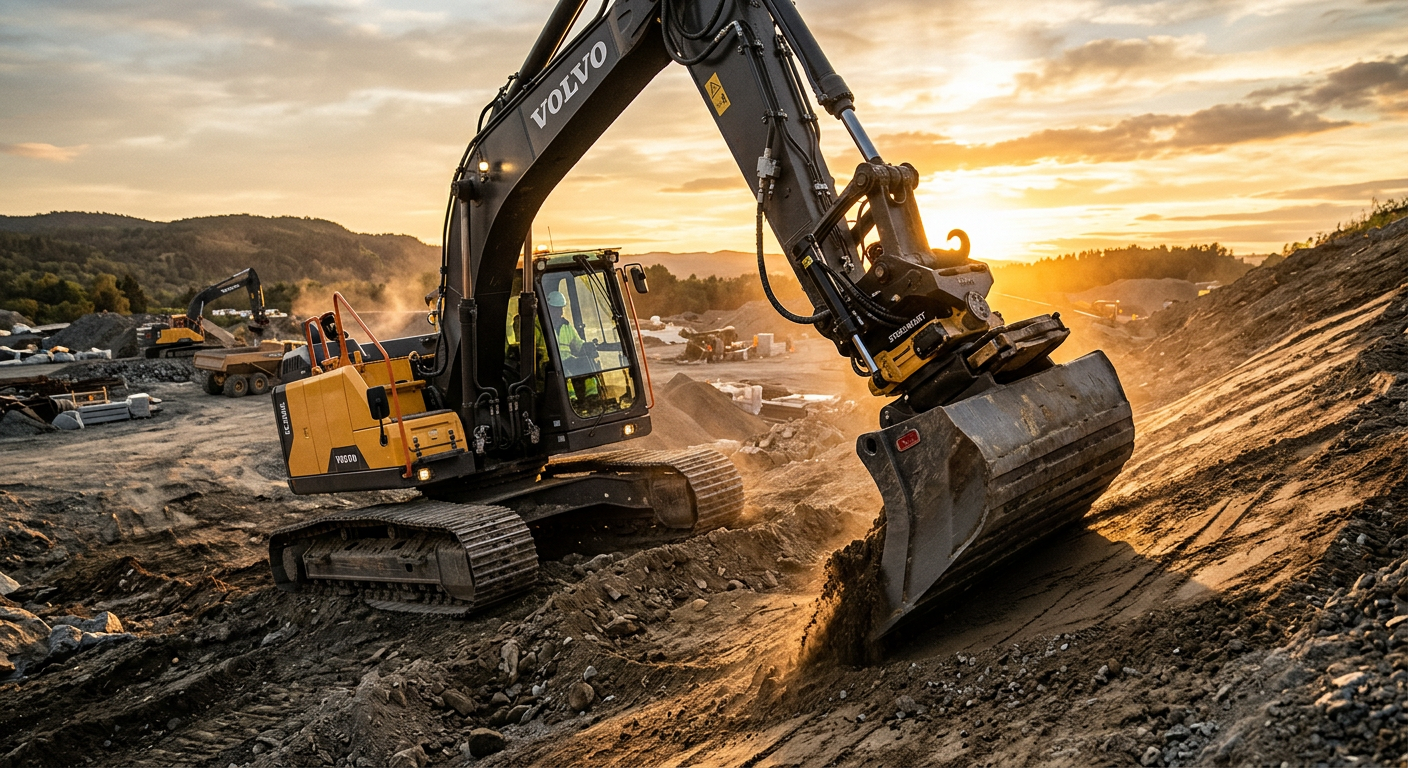
If you’ve spent any time watching European excavator operators on YouTube, you’ve probably noticed something weird: their machines move differently. The bucket doesn’t just dig and dump. It tilts, rotates, grabs, and repositions — all without the operator ever repositioning the carrier. The secret is a tiltrotator, and the company that’s done the most to bring that technology across the Atlantic is Steelwrist.
The Swedish attachment maker just expanded its North American headquarters in Newington, Connecticut, adding local assembly and product testing capabilities. They showed up to CONEXPO 2026 in Las Vegas with new products, a growing dealer network, and what looks like real momentum in a market that’s been slow to adopt what Europeans have used for decades.
FieldFix Editor’s Note: Adding a tiltrotator changes your excavator’s capability — and its maintenance profile. FieldFix tracks service intervals and cost-per-hour for every piece of equipment in your fleet, so you can see exactly how attachments like tiltrotators affect your operating costs over time.
What Steelwrist Actually Makes
For anyone not familiar: Steelwrist builds tiltrotators, quick couplers, and work tool packages for excavators. The company was founded in Rosersberg, Sweden, and has grown into one of the leading tiltrotator manufacturers globally.
A tiltrotator sits between the excavator arm and the bucket. It lets the operator tilt the attachment side to side (usually 40-45 degrees in each direction) and rotate it 360 degrees continuously. Pair that with a quick coupler that lets you swap between a bucket, a grapple, a compaction plate, and a grading beam without leaving the cab, and you’ve got an excavator that can do the work of two or three machines.
That’s not marketing fluff. In Scandinavia, tiltrotators have been standard equipment on excavators for over 20 years. Something like 80% of excavators in Sweden come equipped with one. Contractors there think of running an excavator without a tiltrotator the way American operators would think of running one without a thumb — technically possible, but why would you?
Steelwrist’s product line covers excavators from about 2 tons up to 40+ tons, with tiltrotator models designated by size class. Their current range includes everything from the compact X04 for mini excavators up to the X32 for the big iron.
The Connecticut Bet
Here’s where it gets interesting for the North American market. In February 2026, Steelwrist officially opened its expanded facility in Newington, Connecticut. This isn’t just a sales office with a warehouse. The company invested in machining, assembly, and product testing capabilities on-site, which means tiltrotators and couplers sold in North America are now assembled and tested in the U.S.
That matters for a couple of reasons.
Lead times are the obvious one. When everything had to ship finished from Sweden, American dealers and contractors were looking at longer delivery windows. Local assembly cuts that down significantly and makes it easier to manage inventory for both stock orders and OEM installations.
The other piece is support. Having technical staff, testing rigs, and parts inventory on this side of the Atlantic means faster turnaround on warranty work and better support for the dealer network as it grows. Steelwrist has been building out its dealer and service partner coverage across the U.S. and Canada, and having a real facility — not just a distribution point — gives those dealers more confidence in the brand.
The Connecticut location also creates jobs in assembly, testing, logistics, and technical support. It’s a pattern we’ve been seeing across the equipment industry: foreign manufacturers who are serious about the North American market are putting real money into local operations rather than trying to serve the continent from overseas.
New Products at CONEXPO 2026
Steelwrist came to CONEXPO with several new products aimed directly at the North American market.
The XTR10 is the newest model in their third-generation tiltrotator range, designed for excavators in the 6-10 ton class. That’s a popular size range in North America for utility work, landscaping, and residential construction — exactly the applications where a tiltrotator can make the biggest difference in productivity. The XTR10 is expected to start shipping to North American customers in the second half of 2026.
The SQ40 is a fully automatic quick coupler system for excavators in the 4-7 ton range. “Fully automatic” means the operator can switch between hydraulic attachments without getting out of the cab — the coupler handles both the mechanical and hydraulic connections. For contractors running multiple attachment types on compact excavators, this eliminates the time spent climbing down, manually connecting hydraulic lines, and climbing back up. On a busy job site, those minutes add up fast.
Steelwrist also showed its SQL quick coupler system for wheel loaders, which represents a push into a whole new carrier category for the company. Wheel loader attachments have traditionally used a different connection standard, but Steelwrist is applying the same quick-change philosophy they’ve proven on excavators.
All of these new products tie into the Open-S standard, which Steelwrist co-founded in 2020. Open-S is meant to be a global open standard for fully automatic couplers, so attachments from different manufacturers can work with couplers from different brands. It’s similar to what USB did for electronics — create interoperability so customers aren’t locked into one ecosystem. The standard has gained traction in Europe and is starting to get attention in North America.
Why North America Has Been Slow to Adopt
If tiltrotators are so great, why aren’t they on every excavator in the U.S. already?
Cost is part of it. A tiltrotator system for a mid-size excavator runs anywhere from $25,000 to $60,000 depending on the size class and options. That’s a real chunk of money on top of a machine that already costs six figures. For a contractor running tight margins on commodity dirt work, it’s a hard sell — even if the productivity math works out over time.
Familiarity is another factor. Most American excavator operators have never used a tiltrotator, and most contractors have never seen one on a job site. There’s a learning curve involved, both in operating the machine and in understanding which applications benefit most. In Sweden, kids grow up seeing tiltrotators on every construction site. In the U.S., it’s still an unfamiliar technology for most of the market.
The dealer and service infrastructure has also been a barrier. Until recently, if something went wrong with your tiltrotator, you might have been waiting on parts from Europe. That’s changing as Steelwrist and competitors like Rototilt build out their North American operations, but it’s been a legitimate concern for early adopters.
And then there’s the chicken-and-egg problem with general contractors and project specs. In Scandinavia, project managers spec tiltrotator-equipped machines because they know the capabilities. In North America, most project managers don’t know what a tiltrotator is, so they don’t ask for one, which means contractors don’t feel pressure to invest.
The Adoption Curve Is Bending
All of that said, the trend lines are moving in Steelwrist’s favor.
Social media has been a huge driver. YouTube videos of Scandinavian operators doing impossibly precise work with tiltrotators have racked up millions of views. American operators see what’s possible and start asking questions. The “how is that excavator doing that?” reaction is real, and it’s creating demand that didn’t exist five years ago.
Early adopters in the U.S. and Canada are posting their own content showing the productivity gains — trenching around utilities without repositioning, grading slopes in a single pass, setting stone and block with precision that used to require hand labor. Once contractors see the numbers on their own jobs, the ROI conversation changes.
OEM interest is also growing. Several major excavator manufacturers have started offering factory-installed tiltrotator packages or at least “tiltrotator ready” configurations. When Cat, Volvo, or Komatsu put something on their option sheet, it sends a signal to the market that the technology is real and here to stay.
The global tiltrotator market is projected to grow significantly through the end of the decade, with some analysts forecasting a compound annual growth rate above 12%. North America is expected to be one of the fastest-growing regions, which is exactly why Steelwrist is investing in local manufacturing capacity now rather than waiting.
What It Means for the Market
Steelwrist’s North American push is part of a bigger shift in how excavators get used on job sites. The traditional model — buy a machine, bolt on a bucket, dig holes — is evolving into something more flexible. Quick couplers, tiltrotators, and multi-tool setups turn an excavator from a single-purpose machine into a platform that can handle grading, material handling, compaction, and precision placement.
For contractors, the practical impact is fewer machines on the trailer, fewer trips between tasks, and more billable work per hour on site. For one-truck operations running a single excavator, a tiltrotator can be the difference between needing a second machine and not.
The competition in this space is also heating up. Rototilt (another Swedish manufacturer), Engcon (recently acquired by Volvo CE), and several smaller players are all eyeing the North American market. Steelwrist’s investment in Connecticut assembly and the Open-S standard is a play to establish themselves as the default choice before the market gets crowded.
Whether tiltrotators become as standard in the U.S. as they are in Scandinavia remains to be seen. The cost barrier is real, and old habits in construction die hard. But with local manufacturing, growing dealer networks, and a new generation of operators who learned about tiltrotators on YouTube before they ever sat in a cab, Steelwrist is positioned about as well as anyone to make it happen.
The question isn’t really “will tiltrotators catch on in North America?” anymore. It’s “how fast?” And Steelwrist is betting the answer is fast enough to justify a factory in Connecticut.