
Caterpillar Fires Back at Bobcat in Escalating Patent War
Caterpillar filed counterclaims against Doosan Bobcat on March 24, alleging infringement on six patents. The legal fight between two of construction's biggest names is getting ugly — and it could affect the equipment you buy.
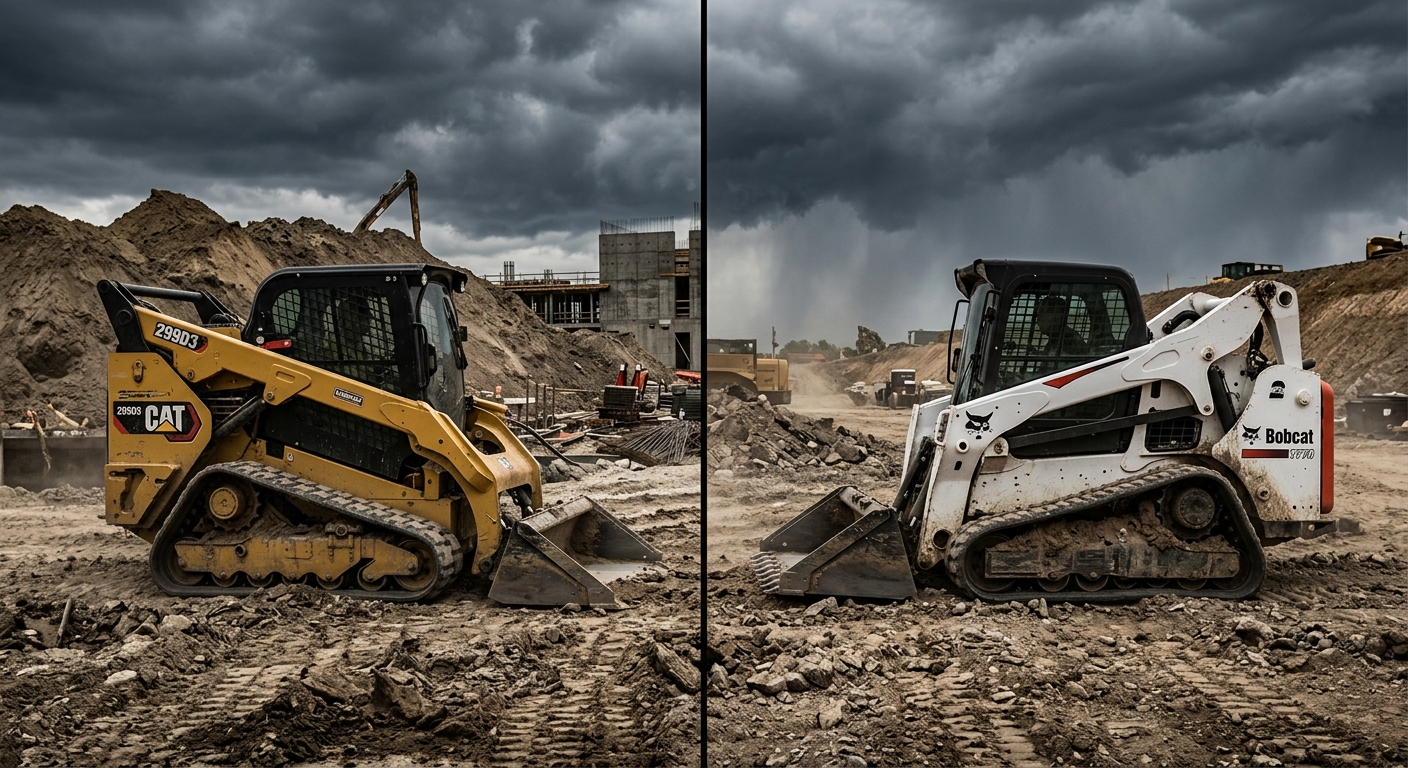
Two of the biggest names in construction equipment are locked in a full-blown legal war, and it just escalated.
On March 24, Caterpillar filed counterclaims against Doosan Bobcat North America and Berry Companies Inc. (a Bobcat of North Texas dealership owner) in U.S. District Court, Eastern District of Texas. Cat alleges Bobcat infringed on six of its patents covering loader attachment leveling systems, power distribution, fuel optimization, and machine throttle technology.
This comes barely four months after Bobcat sued Caterpillar in December, claiming Cat infringed on five of its own patents related to hydraulic drive systems, engine control, and power prioritization in skid steers, compact track loaders, excavators, wheel loaders, and dozers.
The stakes are enormous. Both companies are essentially arguing the other stole their core technology. And if you run compact equipment from either brand, the outcome could change what’s available on dealer lots in the coming years.
FieldFix Editor’s Note: Whether you’re running Cat or Bobcat machines, tracking maintenance and cost-per-hour across your fleet shouldn’t require a legal team. FieldFix handles service logs, expense tracking, and AI diagnostics for every machine you own — regardless of brand.
What Caterpillar Claims
Cat’s counterclaim targets six U.S. patents:
-
Patent 8,463,508 and 8,612,103 — Both titled “Implement Angle Correction System and Associated Loader.” These cover automatic systems that keep bucket and attachment angles level during lifting and lowering. If you’ve used a Cat loader where the bucket stays flat as the arms go up, that’s this technology.
-
Patent 8,948,998 — “Machine Throttle System.” Controls how the engine responds to operator inputs and load conditions.
-
Patent 7,795,752 — “System and Method for Integrated Power Control.” Covers how machines distribute power between hydraulic, drivetrain, and other systems.
-
Patent 7,962,768 and 8,374,755 — “Machine with Task-Adjusted Economy Modes” and “Machine with Task-Dependent Control.” These deal with how machines automatically optimize fuel consumption and performance based on the work being done.
Caterpillar’s filing makes an aggressive accusation: that Bobcat ran an “extensive competitive intelligence program” specifically focused on Cat products and technologies. As evidence, Cat points to a former “Bobcat Advantage” website that directly compared Bobcat machines against Caterpillar’s. According to the filing, that website “once prominently displayed Doosan’s extensive competitive analysis of Cat equipment” but “now conspicuously resolves to a blank page.”
Cat’s lawyers included underlying source code from the old webpage as evidence, arguing the competitive intelligence program gave Bobcat “detailed knowledge of Caterpillar’s products and technologies and, on information and belief, Caterpillar’s patents covering those products and technologies.”
That’s a pointed accusation. Cat is saying: you studied our machines, you knew our patents existed, and you copied us anyway.
What Bobcat Claims
Bobcat fired first in December with a federal lawsuit and a separate complaint with the U.S. International Trade Commission (ITC). The ITC complaint is the nuclear option — if granted, it could bar entry of infringing Cat products into the U.S. entirely and issue permanent cease-and-desist orders.
Bobcat’s five patents cover:
- Automated shifting of hydraulic drive systems
- Variable engine control speed
- Tracked utility vehicle technology
- Zone-of-operation systems for lift arms
- Hydraulic power prioritization
The Korean-owned company (Doosan Bobcat is a subsidiary of HD Hyundai) didn’t pull punches in its filing. The suit states that “CAT was a late arrival to the skid-steer loader market” and “did not begin manufacturing skid-steer loaders until 1999, roughly 40 years after Bobcat created the market.”
The filing continues: “Rather than innovate itself, CAT has chosen to take the innovations of Bobcat to attempt to unfairly compete with Bobcat in the skid-steer and broader compact equipment market.”
Bobcat says it has invested “hundreds of millions of dollars” domestically in the patented technologies and that the 14 patents at issue “enable functions like maneuverability, power, performance and efficiency.”
Why This Matters for Equipment Owners
This isn’t just corporate posturing. Patent disputes in the equipment world can have real consequences for the people buying and running machines.
Price increases are possible. If either company loses and owes licensing fees or damages, those costs get passed along eventually. Patent litigation at this scale runs into tens of millions of dollars in legal fees alone, before any damages are awarded.
Product availability could be affected. Bobcat’s ITC complaint, if successful, could theoretically restrict import or sale of certain Cat machines in the U.S. That’s a long shot — the ITC rarely grants that broad of an injunction against a company the size of Caterpillar — but it’s on the table.
Innovation could slow down. When companies spend resources fighting in court, that’s money and engineering time not going into R&D. Both Cat and Bobcat have been on aggressive innovation cycles, especially in compact equipment. A prolonged legal battle could take some air out of that.
Dealer relationships get complicated. The original Bobcat suit named Holt Texas Ltd., a Cat dealer. Cat’s counterclaim named Berry Companies Inc., a Bobcat dealer. Dragging dealers into patent fights is unusual and signals both sides are willing to make this uncomfortable for everyone in the distribution chain.
The Bigger Picture: A 100-Year-Old Company vs. A 70-Year-Old Innovator
Both companies have legitimate claims to innovation.
Caterpillar celebrated its centennial in 2025. The company traces its roots to the 1907 invention of the track-type tractor and has been a dominant force in heavy equipment for over a century. Cat’s entry into compact equipment came later — skid steers in 1999, compact track loaders shortly after — but the company invested heavily in catching up and now holds significant market share.
Bobcat’s history starts in 1957 in Minnesota, where Cyril and Louis Keller built a three-wheeled compact loader. That machine became the modern skid steer, and Bobcat has been the category leader since. The company pioneered the compact track loader market and has been aggressive about pushing new technology into its machines.
What makes this fight so bitter is that both companies genuinely believe the other is copying their work. Cat says Bobcat ran surveillance on their machines. Bobcat says Cat showed up 40 years late and stole what they built.
The ITC Wild Card
The International Trade Commission angle makes this different from a standard patent lawsuit. ITC proceedings move faster than federal court — typically 12 to 18 months versus years for traditional litigation. And ITC remedies are trade-based, meaning they can block products at the border.
Caterpillar responded to the ITC complaint by framing Bobcat as a “South Korean conglomerate” whose request, if granted, “would affect nearly all its construction equipment, harm the U.S. economy and undermine infrastructure projects.” That’s a calculated argument playing on current political tensions around trade and manufacturing.
The framing is somewhat misleading — Bobcat has massive U.S. operations, including its headquarters in West Fargo, North Dakota, and multiple manufacturing facilities in the States. But in an ITC proceeding, the domestic industry argument matters, and Cat is positioning itself as the American company under attack from a foreign parent.
What Happens Next
Doosan Bobcat hasn’t responded to Cat’s amended counterclaims yet. The federal case will likely take years to reach trial, though settlement is always possible. The ITC investigation will move faster and could produce preliminary findings within the next year.
For now, both companies are still selling machines, dealers are still stocking lots, and operators are still running equipment. Nothing changes immediately.
But this fight is worth watching. When the two dominant players in compact equipment go to war over the core technology in their machines — auto-leveling, power management, hydraulic control, engine optimization — it says something about how valuable and contested this market has become. Compact equipment is the fastest-growing segment in construction, and both Cat and Bobcat want to own it.
The courtroom is just another jobsite now.
Sources: Equipment World, U.S. District Court Eastern District of Texas filings, U.S. International Trade Commission