
Gradall Turns 80 by Still Refusing to Build a Normal Excavator
Gradall's 80th anniversary is more than an Ohio manufacturing milestone. It shows that the heavy equipment market still has room for odd, specialized machines that solve awkward jobs better than a conventional excavator.
Most equipment companies spend their lives trying to prove they can compete in the center of the market.
Gradall has spent 80 years doing almost the opposite.
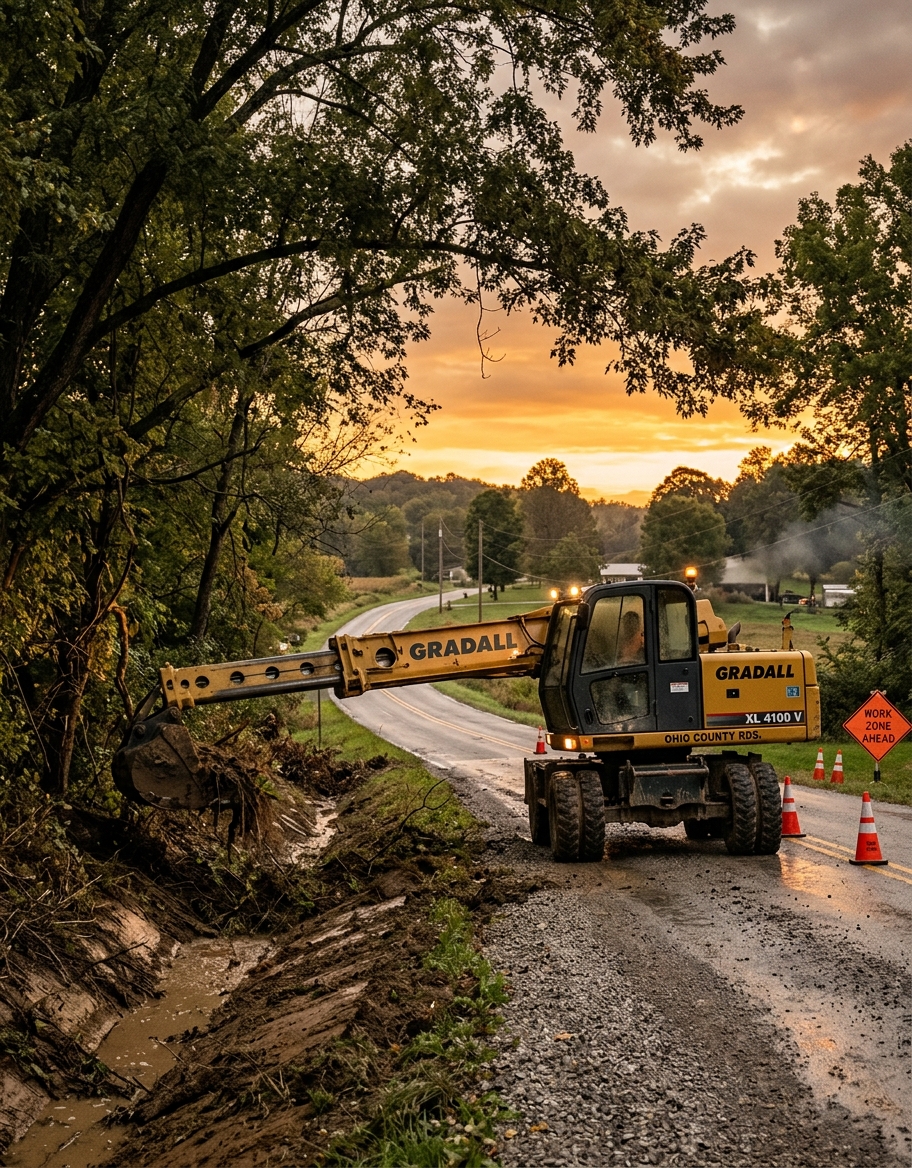
The New Philadelphia, Ohio manufacturer is not trying to build the most familiar excavator on the lot. Its signature machine has a telescoping, tilting boom, a low working profile, a carrier that can road at highway speed in some models, and a reputation for handling the kind of awkward municipal, roadside, rail, mill, and specialty jobs where a conventional knuckle-boom excavator starts to feel clumsy.
That oddness is the point. Gradall is one of those rare equipment brands where the product architecture is the brand. You do not need a decal to spot one. The boom gives it away.
The company is marking its 80th year of hydraulic excavator manufacturing in Ohio in 2026. Gradall said in an April company announcement that it received official proclamations from local, state, and federal officials, including Ohio Governor Mike DeWine, Lieutenant Governor Jim Tressel, U.S. Senator Jon Husted, U.S. Representative Michael Rulli, and New Philadelphia Mayor Joel Day. The announcement also states that Gradall now employs about 400 people in New Philadelphia and that every Gradall excavator has come out of that facility since production moved there in 1950.
That is worth paying attention to, not because anniversaries are automatically interesting, but because Gradall’s staying power says something useful about the equipment business in 2026. In a market obsessed with scale, dealer consolidation, financing pressure, and global sourcing, a specialized Ohio-built excavator still has a lane.
FieldFix Editor’s Note: Specialized machines are only good investments if their use and maintenance history back up the story. A Gradall, mulcher, crusher, paver, or rail machine can look expensive on paper and still be cheap per productive hour if it replaces labor, cuts setup time, or handles work a standard machine cannot. FieldFix helps fleets track service history, repair cost, downtime, and cost per hour so specialty equipment decisions are based on machine behavior, not brochure math.
A machine born from a labor problem
The Gradall origin story starts with a problem contractors still understand: too much hand work in a place where machines should be doing more.
According to Gradall’s company history timeline, Ray and Koop Ferwerda emigrated from Holland to Cleveland in 1920 and later started Ferwerda Brothers Construction Co. Their road and bridge work exposed a frustrating bottleneck. Finish grading roadside embankments still depended heavily on shovels, rakes, and hand labor. The shortage of available construction labor during the World War II era made that problem worse.
The brothers began working on a better answer in a Beachwood, Ohio garage. In 1944, the first Gradall machine rolled out. It used a hydraulically powered telescopic boom that could raise, lower, tilt left or right, and work a wrist-action bucket at the end of the boom. By late 1945, the early company had built five machines. Warner & Swasey acquired rights to the Gradall patents in 1945 and started production of the M-2400 model in Cleveland in 1946.
That matters because Gradall was not created as a styling exercise. It was created around a specific work problem: reach, precision, slope work, trenching, grading, and truck loading from positions where hand labor or conventional machines were inefficient.
The heavy equipment industry likes to talk about innovation in very clean terms. The better version is usually dirtier. A contractor gets tired of doing something the hard way. Someone builds an ugly prototype. If the machine saves enough labor, the market forgives the weird shape.
Gradall’s weird shape lasted.
The boom is still the whole argument
The current Gradall product line still revolves around the same basic premise: the boom should do things a normal excavator boom does not do.
On its Gradall Difference page, the company points to the full tilting, telescoping boom as the core advantage. The boom can work under trees, bridges, signs, building floors, and other low-clearance areas where a conventional excavator may not fit well. Gradall also says the telescoping design keeps full power through the dig cycle through its high-pressure, load-sensing hydraulics.
The rotation is another part of the argument. Gradall says the entire boom can rotate while it telescopes, which lets operators position buckets, mowers, hammers, and other attachments without relying only on a boom-end tilt attachment. That is not a small difference on roadside, ditching, vegetation, bridge, and municipal work. The job is often less about raw breakout force and more about getting the tool into a miserable angle without moving the whole machine five more times.
This is why Gradall has never fit neatly into the ordinary excavator conversation. A contractor shopping for a 20-ton crawler excavator may compare digging force, cab comfort, fuel burn, dealer support, and price. A Gradall buyer is usually asking a different question: can one operator and one machine do a set of awkward jobs that would otherwise require more setup, more traffic control, more labor, or more machines?
That makes the value harder to explain in a spec table, but easier to understand from the shoulder of a road.
Highway speed is not a gimmick when the job keeps moving
One of Gradall’s most practical advantages is mobility.
The company says its highway speed wheeled models can travel up to 60 mph. For municipalities, counties, utility contractors, road departments, and maintenance fleets, that changes the math. A machine that can drive to scattered jobs without a lowboy trailer is saving more than one transport cost. It is reducing friction between small jobs.
That matters because a lot of public works and infrastructure maintenance does not look like a single big dirt job. It looks like ditch cleaning in one place, culvert work somewhere else, shoulder repair after that, vegetation control down the road, and a small demolition or storm cleanup call before the day ends. If every move requires a truck, trailer, load, tie-down, and unload, the machine’s useful day shrinks.
Gradall’s carrier story is aimed directly at that problem. Its product pages describe highway speed models, rough terrain wheeled machines, crawler excavators, railway maintenance machines, mine scalers, and metal mill machines. That range is narrower than a full-line OEM catalog, but it is not random. It is built around mobility, reach, confined-space work, and job-to-job versatility.
That also explains why municipal buyers keep showing up in Gradall’s recent news. In its XE 4100 announcement, Gradall said the new 6x4 highway speed excavator was engineered with state, county, municipal, and specialty contractor budgets in mind. The company lists a 27-foot boom reach, 20-foot dig depth, 220-degree boom rotation, 60 mph highway speed from the carrier cab, and 7 mph repositioning from the upper cab.
Those numbers are not trying to win a conventional excavator spec-sheet contest. They are trying to solve the daily headache of a crew that needs to work under bridges, along ditches, beside traffic, and across multiple sites without turning transport into half the job.
Made in Ohio still has teeth
Gradall’s anniversary release makes a claim that is unusually direct for the equipment industry: Gradall says it is the only excavator produced only in the United States.
That claim lands differently in 2026 than it would have five years ago. Tariffs, sourcing risk, shipping volatility, and parts availability have made manufacturing location a real buying factor again. Nobody buys a machine only because of a flag on the brochure. Contractors are too practical for that. But domestic production can matter when it affects lead times, pricing exposure, parts support, and confidence in the supply chain.
The XE 4100 announcement leans into this point. Gradall says the machine is designed and manufactured in the U.S. and describes its pricing as tariff-free. That is not a sentimental pitch. It is a budget pitch.
For government fleets, the appeal is obvious. Public buyers live inside procurement rules, budget cycles, bid thresholds, and political scrutiny. A machine that can fit a tighter price target, avoid some tariff exposure, and still handle the core jobs has an easier story to tell at the purchasing table.
For contractors, the calculation is more direct. If a specialty machine saves labor and mobilization, it has a case. If the purchase price and support story are cleaner because the machine is built domestically, the case gets easier.
Gradall also benefits from being tied to one place. New Philadelphia is a real part in the company’s history. It is part of the product story. The plant has been the center of Gradall manufacturing, engineering, sales, parts, and support for decades. In a market where many brands feel increasingly financialized, that kind of continuity still counts.
Specialty equipment survives when it owns a painful job
The lesson from Gradall’s 80-year run is not that every manufacturer should build stranger machines. The market does not need weird for weird’s sake.
The lesson is that specialty equipment survives when it owns a painful job clearly enough.
Gradall does not need every excavator buyer. It needs the buyers who care about reach, slope work, low-profile boom movement, job-to-job mobility, municipal versatility, rail maintenance, mining scaling, mill work, and attachment positioning in tight spaces. That is a smaller market than general excavation, but smaller markets can be good markets when the machine is hard to replace.
That is why the company is still interesting after 80 years. The product has never been generic. It asks buyers to see the job differently. For some fleets, that will never make sense. For others, it is exactly the point.
The broader equipment market is full of pressure right now. Contractors are stretching replacement cycles. Dealers are fighting for margin. Rental is absorbing risk. Manufacturers are trying to balance technology, emissions, pricing, tariffs, and inventory discipline. In that environment, the safest-looking product is often the one that resembles everything else.
Gradall shows that tthis is another path. Build a machine around a problem that refuses to go away. Keep refining it. Stay close to the customers who actually understand why it exists.
Eighty years later, that is still a pretty good business model.