Electric Compact Equipment Has a Charging Problem Before It Has a Demand Problem
Battery-powered compact machines are getting better fast, but the real test is not whether contractors like them. It is whether the jobsite can keep them working.
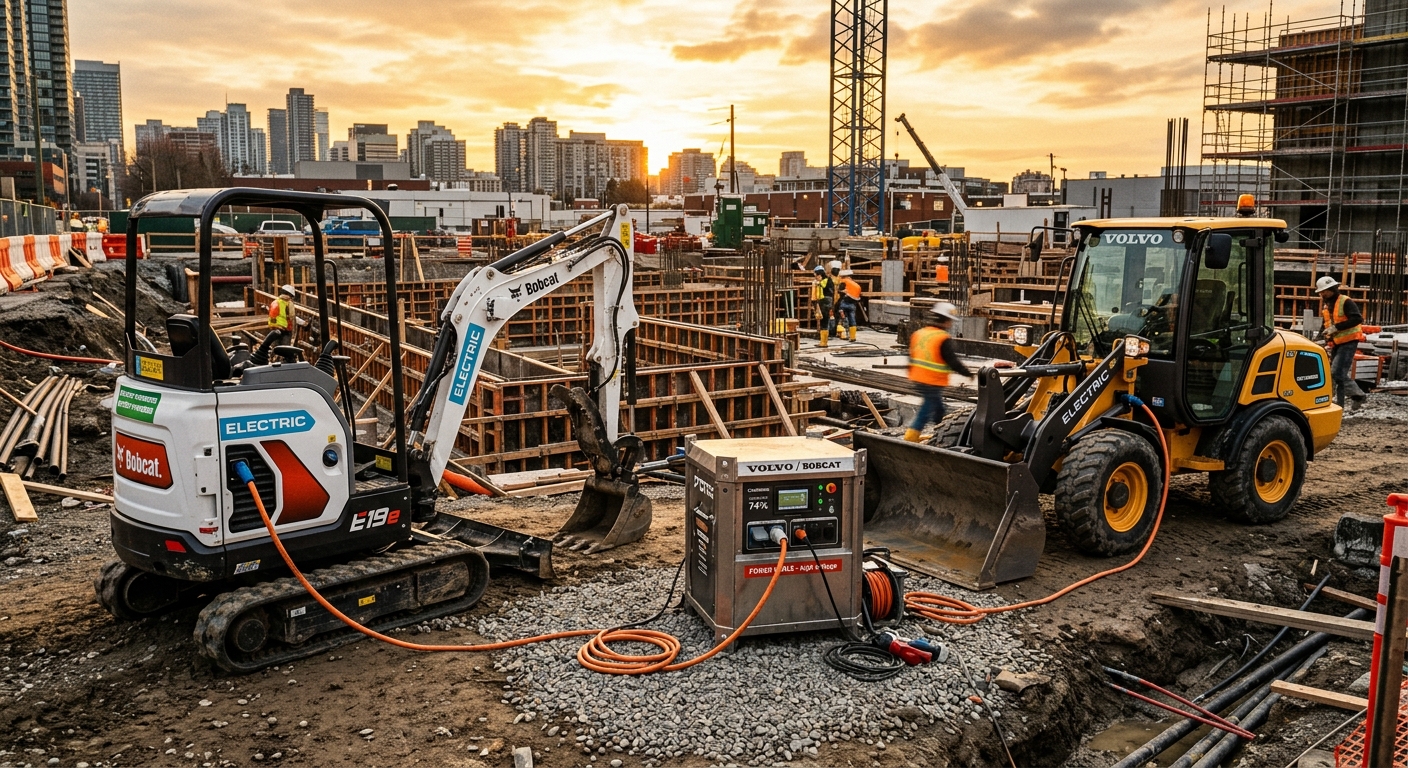
Electric construction equipment has moved past the novelty stage. That does not mean it has moved past the hard part.
The market numbers look aggressive. Global Market Insights pegs the electric construction equipment market at $17.1 billion in 2026, up from $15.8 billion in 2025, and projects it could reach $93.2 billion by 2035. Fortune Business Insights puts the broader off-highway electric vehicle market at $17.84 billion in 2026, with a path to $59.51 billion by 2034. Mordor Intelligence is even more specific on compact machines, estimating the compact electric construction equipment market at $69.49 billion in 2026 and forecasting $140.49 billion by 2031.
Those forecasts are worth paying attention to. They are also easy to misunderstand. A fast-growing market does not mean every contractor should start swapping diesel machines for battery machines tomorrow morning.
For compact equipment, the question is not whether electric machines are useful. Many are. Quiet operation, low local emissions, fewer fluid concerns, and strong low-speed torque all make sense in the right work. Indoor demolition, municipal work, warehouse sites, dense urban jobs, utility work, schools, hospitals, and noise-sensitive neighborhoods are obvious fits.
The harder question is whether the charging plan is as real as the machine purchase.
Charging is the part of electrification contractors cannot hand-wave
The machine is the visible investment. The charger is the operational investment. That second part is where a lot of the market will sort itself out.
Coherent Market Insights lists charging infrastructure and site electrification complexity as one of the barriers for compact electric construction equipment. That sounds dry, but on a jobsite it turns into simple questions. Where does the machine charge? Who owns the charger? Is there enough power on site? Is the machine parked near that power at the end of the shift? What happens when the crew gets moved to a different site tomorrow? Who pays for the downtime if charging goes sideways?
Those are not anti-electric arguments. They are fleet management questions. Contractors already ask the same kind of questions about diesel deliveries, service intervals, DEF, hydraulic leaks, cold starts, theft, and transport. Electric machines just move some of that friction into a different column.
FieldFix Editor’s Note: Electric equipment does not remove the need for fleet discipline. It changes what needs to be tracked. Runtime, charge cycles, charger location, idle time, transport time, and jobsite power access belong in the same conversation as fuel burn, service intervals, and repair history. If a machine cannot stay available when the crew needs it, the powertrain is not the main issue. The fleet plan is.
The risk for contractors is buying the headline and underbuilding the workflow. A battery skid steer that works beautifully for four hours in a warehouse can be the wrong machine for a scattered site with no power, a long haul from the yard, and a crew that cannot afford to babysit charging.
That does not make the machine bad. It makes the application wrong.
Compact equipment is the logical starting point
Electrification makes more sense at the compact end of the equipment market than it does in heavy production work, at least for now.
Compact machines tend to work shorter duty cycles. They often operate closer to buildings, people, and power. They are more likely to run in places where noise and exhaust matter. They are easier to transport, easier to charge overnight, and easier to match to specific jobs.
That is why mini excavators, compact wheel loaders, compact track loaders, small dumpers, and utility machines keep getting attention. The economics are not only about fuel savings. For some buyers, the bigger value is access. A quiet zero-emission machine can get work in places a diesel machine struggles to justify, especially indoors or near occupied buildings.
The market data points the same direction. Global Market Insights says excavators held the largest share of the electric construction equipment market in 2025. Mordor Intelligence’s compact equipment forecast also points to fast growth through 2031. That tracks with what contractors are actually likely to adopt first: smaller machines with repeatable work patterns.
Heavy earthmoving is a different fight. A dozer pushing hard all day, a large excavator loading trucks, or a loader feeding a plant does not have the same tolerance for charging gaps. In that world, diesel still has a brutal advantage: energy density, refueling speed, and familiar support.
That does not mean heavy electric machines will not arrive. Some already exist. But the first broad adoption curve is more likely to come from machines that can finish a shift, return to a known charging point, and repeat the next day.
Runtime is not one number
Contractors should be careful with any electric equipment conversation that treats runtime like a fixed spec.
Runtime depends on the work. A compact loader moving light material on flat ground is not the same as one grinding through heavy pushing, cold weather, attachments, travel, and stop-start cycles. A mini excavator trenching shallow utility lines is not doing the same job as one hammering concrete all afternoon.
Diesel machines have the same problem, but contractors are used to it. Nobody believes a skid steer burns the same fuel every day regardless of load. With electric machines, buyers still get pulled toward clean brochure numbers because the category is newer.
The practical question is not, “How many hours does it run?” The better question is, “Will it run long enough for this work pattern, with enough reserve that the crew does not have to change how it works?”
That last part matters. If a crew has to slow down, stage work around charging, or stop early to protect battery life, the machine cost is only part of the bill. The bigger cost may show up in labor.
For owner-operators, the math can be different. A one-machine operator doing predictable work may be able to plan charging tightly and benefit from lower noise, fewer fluids, and less engine maintenance. For a larger contractor moving crews across multiple jobs, charging uncertainty gets harder to absorb.
This is where rental companies could become the real adoption channel. A contractor can test an electric mini excavator or loader on a job that fits, learn the charging pattern, and avoid owning a machine that only makes sense for part of the calendar.
Rental will expose the truth faster than sales decks
Rental fleets are probably the cleanest proving ground for electric compact equipment.
Rental companies already manage utilization, service, transport, damage, and customer education. Electric machines add charger logistics, state-of-charge planning, and customer site readiness. That sounds like extra work because it is. But rental also lets the industry find the best-fit jobs without asking every contractor to become an early adopter.
There is another reason rental matters: it will separate real use cases from marketing use cases.
If customers keep renting an electric compact loader for indoor work, night work, municipal jobs, or sites with strict emissions rules, that says something. If the same unit sits because customers do not want to deal with charging, that says something too. Rental utilization is unforgiving. It does not care whether a machine photographs well.
Rental also lets dealers and OEMs learn where support has to improve. Maybe customers need charger bundles. Maybe they need jobsite readiness checklists. Maybe they need better training on attachments and power draw. Maybe they need a hybrid rental model where electric machines cover certain scopes and diesel machines remain the production backbone.
The market is likely to grow unevenly. Dense cities, municipal fleets, indoor contractors, large campuses, ports, warehouses, and regulated jobsites will move faster. Rural contractors, land clearing crews, road builders, and production excavation outfits will be more selective. That is not resistance. It is economics.
The best electric equipment buyers will be boring
The smartest buyers will not be the ones making the loudest sustainability claims. They will be the ones with boring spreadsheets.
They will know which machines return to the yard every night. They will know which crews work near power. They will know which customers will pay for quiet, low-emission work. They will know how many hours each machine actually works under load. They will know whether a charger in the yard solves the problem or just moves the problem to the trailer.
They will also know where diesel still wins.
That is important because the equipment market does not need a religious war over powertrains. Diesel, hybrid, battery-electric, hydrogen, renewable fuels, and lower-emission engines will all have places where they make sense. AEM’s 2026 construction outlook makes a similar point, noting that manufacturers are working on lower-emission engines, alternative fuels, electrification, and efficiency gains while contractors remain focused on productivity.
That is the right frame. Contractors are not buying morality. They are buying uptime, access, labor efficiency, operating cost control, and fewer headaches.
Electric compact machines can deliver that in the right work. They can be quieter. They can be cleaner. They can reduce some service tasks. They can make indoor and urban jobs easier. They can help contractors win scopes where diesel equipment is a bad fit.
But they do not forgive sloppy planning. If anything, they punish it faster.
The next bottleneck is process, not product
Battery machines will keep improving. Packs will get better. Chargers will get faster. OEMs will add models. Rental houses will gain experience. Contractors will get more comfortable with the category.
The real bottleneck over the next few years may be less about whether the machines exist and more about whether the industry builds the process around them.
That process is not glamorous. It looks like charger specs, extension policy, yard layout, operator training, route planning, theft prevention, utilization tracking, and maintenance records that include battery health instead of only engine hours.
For contractors, the takeaway is simple: do not ask whether electric equipment is ready. Ask which jobs are ready for electric equipment.
That flips the conversation into something useful. A contractor with indoor demolition work, utility trenching in a noise-sensitive area, or a municipal maintenance contract may find a real advantage in a battery-powered compact machine. A contractor clearing remote acreage with long transport legs and no site power probably has better places to spend money.
Electric equipment is coming. In some segments, it is already here. But the winners will not be the contractors who buy the first shiny machine they see. The winners will be the ones who match the machine to the job, build the charging plan before delivery day, and track the numbers honestly after the honeymoon wears off.
That is not as exciting as a market forecast. It is a lot more useful.
Sources: Global Market Insights electric construction equipment market, Fortune Business Insights off-highway electric vehicle market, Mordor Intelligence compact electric construction equipment market, Coherent Market Insights compact electric construction equipment market, AEM 2026 construction outlook via OEM Off-Highway.