Electric Construction Equipment in 2026: Market Forces, Adoption Barriers, and What's Actually Changing on Jobsites
The electric construction equipment market is projected to grow at 22%+ CAGR through 2030—but adoption remains uneven. We break down where the industry actually stands, what's driving change, and the real obstacles contractors face.

The construction equipment industry stands at an inflection point. Electric machines that were curiosities at trade shows five years ago are now appearing on jobsites from Oslo to Oakland. Market research firms are projecting growth rates that would make tech startups envious—22% to 23% compound annual growth through the early 2030s. But behind the optimistic forecasts lies a more complicated reality: adoption remains uneven, infrastructure challenges persist, and many contractors are still waiting on the sidelines.
This analysis examines where the electric construction equipment market actually stands in early 2026, separating the hype from the genuine market forces reshaping the industry.
Editor’s Note: For contractors managing mixed fleets of diesel and electric equipment, tracking total cost of ownership becomes critical. FieldFix helps operators monitor maintenance costs, fuel savings, and equipment utilization across all power sources—giving you the data to make informed decisions about when (or whether) to electrify.
The Numbers: What Market Research Actually Shows
The global electric construction equipment market tells a story of rapid but uneven growth. According to multiple market research reports, the sector was valued at approximately $13.6 billion in 2024 and is expected to reach between $41.9 billion and $106.9 billion by the early 2030s, depending on which research firm you ask and how broadly they define “construction equipment.”
The U.S. market specifically was valued at $3.45 billion in 2024, with projections suggesting 22-23% compound annual growth through 2034. Europe leads in adoption rates, driven by stringent emission regulations and low-emission zones in major cities. Asia-Pacific represents the largest growth opportunity by volume, though adoption varies dramatically between developed and developing markets.
What these numbers obscure is the segment breakdown. Compact equipment—mini excavators, skid steers, compact track loaders—accounts for the vast majority of electric units sold. Larger equipment categories lag significantly behind, constrained by battery energy density limitations and the operational demands of heavy earthmoving.
Regulatory Pressure: The Primary Market Driver
Make no mistake: the primary force driving electric equipment adoption isn’t contractor enthusiasm—it’s regulation. Cities across Europe and increasingly in North America are implementing low-emission zones (LEZs) and zero-emission zones (ZEZs) that restrict or outright ban diesel-powered equipment.
Europe leads the regulatory push:
- Amsterdam aims to ban all diesel construction equipment in the city center by 2030
- London’s Ultra Low Emission Zone charges affect construction vehicles and equipment
- Oslo has implemented strict requirements for public construction contracts
- Germany’s major cities have emission-based equipment requirements for municipal projects
North America is following:
- California’s CARB regulations continue tightening, with increasingly strict Tier 4 Final enforcement and incentives for zero-emission equipment
- Several major U.S. cities are piloting low-emission zones
- Federal infrastructure funding increasingly includes sustainability requirements
For contractors bidding on public projects or working in urban cores, electric equipment is transitioning from a “nice-to-have” to a prerequisite for certain work.
The Real Adoption Barriers: Why Contractors Hesitate
Despite market projections and regulatory pressure, many contractors remain cautious about electrification. The barriers are real and practical:
1. Upfront Cost Premium
Electric excavators and loaders typically carry a 30-50% price premium over comparable diesel models. For a small contractor running three or four machines, that premium can represent a significant capital allocation—money that could otherwise go toward additional equipment or working capital.
The total cost of ownership calculation favors electric over time, but “over time” matters. A contractor who needs equipment today for a six-month project can’t wait years to recoup the premium through fuel and maintenance savings.
2. Charging Infrastructure Realities
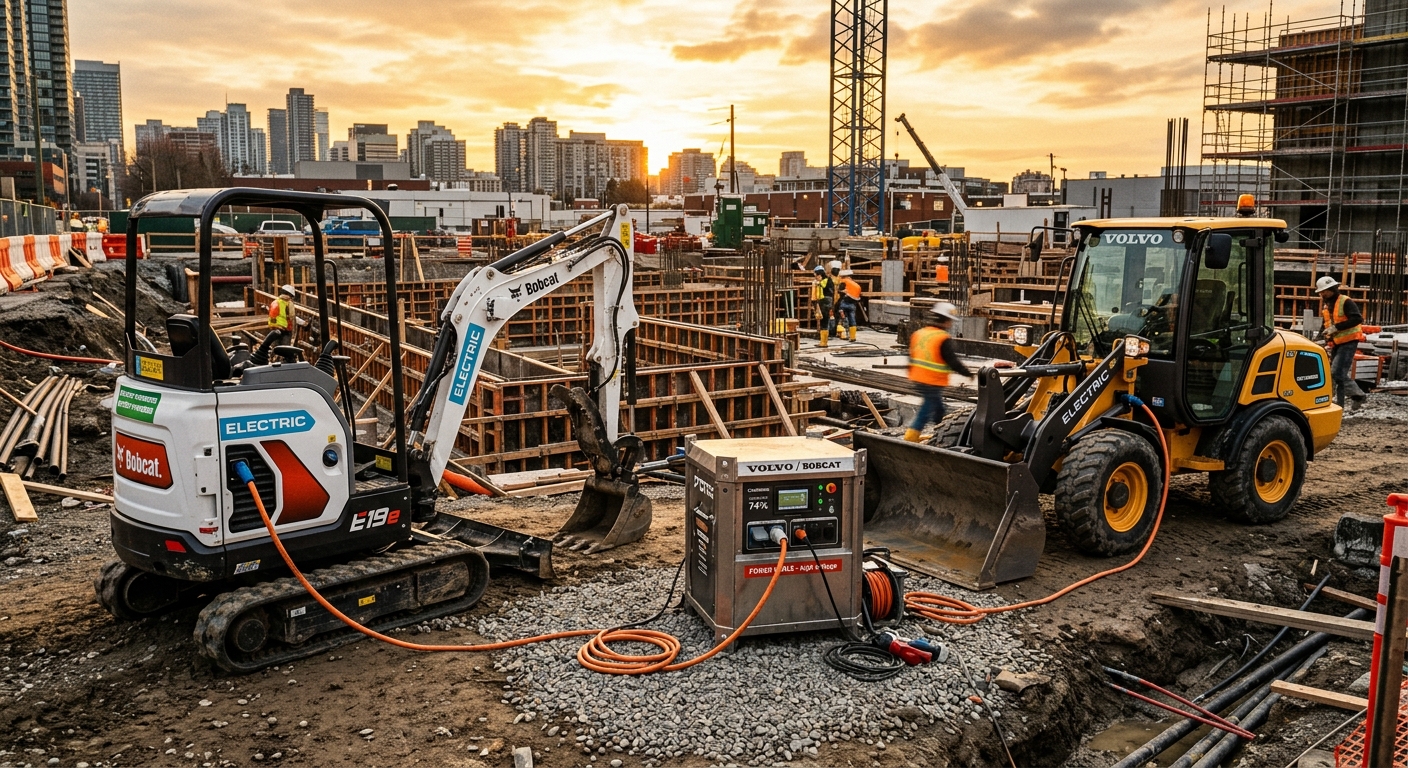
This is perhaps the most underappreciated challenge. Unlike passenger vehicles, construction equipment doesn’t return to a centralized depot every night. Machines move between jobsites, work in remote locations, and operate on tight schedules.
Installing charging infrastructure at a construction site requires:
- Electrical service that may not exist or may require expensive upgrades
- Charging equipment that must be weather-resistant and able to handle jobsite conditions
- Grid capacity that may be limited in developing areas where construction is happening
For contractors working on rural land clearing, remote utility installations, or sites without developed electrical service, electric equipment remains impractical regardless of its technical capabilities.
3. Runtime and Utilization Constraints
Current battery technology limits continuous operation compared to diesel equipment. A diesel excavator can run 10-12 hours on a tank of fuel that takes minutes to refill. Electric excavators typically offer 4-8 hours of operation depending on workload intensity, followed by charging time that can range from 1-4 hours depending on charger capacity.
For high-utilization operations running equipment across multiple shifts, this constraint is significant. The math doesn’t work if your machine spends four hours charging during what should be productive time.
4. Battery Durability and Replacement Costs
Construction equipment operates in harsh conditions—dust, vibration, temperature extremes, impacts. Battery degradation under these conditions remains a concern, and battery replacement costs are substantial. A battery pack for a mid-size excavator can cost $30,000-$60,000 or more, representing a significant ownership expense that doesn’t exist with diesel engines.
Long-term reliability data for electric construction equipment remains limited simply because the technology hasn’t been deployed at scale for long enough. Contractors are understandably cautious about being early adopters of expensive equipment with unknown long-term durability.
5. Residual Value Uncertainty
The used equipment market for electric machines barely exists. Contractors making purchase decisions don’t know what their equipment will be worth in five or seven years. Will battery technology advance so quickly that today’s machines become obsolete? Will residual values hold comparable to diesel equipment? This uncertainty affects financing decisions and total cost of ownership calculations.
Where Electric Equipment Makes Sense Today
Despite these barriers, specific applications already favor electric equipment:
Indoor and Enclosed Work
Demolition, renovation, and construction work inside existing buildings eliminates the ventilation challenges of diesel exhaust. Electric equipment is inherently quieter and produces zero local emissions, making it ideal for work in occupied buildings, hospitals, schools, and similar sensitive environments.
Urban Core Construction
In cities with emission restrictions or noise ordinances, electric equipment may be the only option for certain work. Early morning or late evening work in residential areas becomes feasible when equipment doesn’t produce diesel noise and exhaust.
Predictable Duty Cycles
Operations with predictable schedules and return-to-base patterns—material handling at fixed facilities, certain mining operations, port equipment—can plan around charging requirements. The math works when you know your equipment will be stationary overnight anyway.
Operations with Existing Electrical Infrastructure
Contractors working on utility projects, solar installations, or other work with robust electrical service can more easily accommodate charging requirements. The infrastructure barrier disappears when you’re already working alongside significant electrical capacity.
The Hydrogen Question: Alternative Path or Distraction?
Hydrogen fuel cell technology offers a potential answer to the range and refueling limitations of battery-electric equipment. Several manufacturers have completed testing or announced development programs for hydrogen-powered construction equipment, including large wheel loaders and excavators where battery limitations are most constraining.
The appeal is obvious: hydrogen refueling takes minutes rather than hours, and hydrogen fuel cells can power larger equipment for full shifts without the weight penalty of massive battery packs.
But hydrogen faces its own challenges:
- Infrastructure is nearly non-existent. Green hydrogen production and distribution infrastructure barely exists outside industrial applications.
- Fuel costs remain high. Hydrogen is currently more expensive per unit of work than either diesel or electricity.
- The technology is less mature. Battery-electric equipment has years of commercial deployment experience; hydrogen fuel cell construction equipment remains largely in pilot and demonstration phases.
The most likely scenario is a bifurcated market: battery-electric dominating compact equipment and lower-utilization applications, while hydrogen (or hybrid solutions) eventually addresses the heavy equipment categories where batteries face fundamental limitations.
What This Means for Fleet Managers
For contractors and fleet managers making decisions today, the strategic calculus involves several considerations:
Monitor your exposure to regulation. If you’re bidding on public projects in major metros or working in cities moving toward emission restrictions, electric equipment capability may become a competitive requirement. Understanding where regulations are headed in your market is essential planning.
Evaluate specific applications, not entire fleets. The question isn’t “should I go electric?” but rather “which applications in my operation could benefit from electric equipment today?” A contractor might electrify urban compact equipment while keeping diesel machines for rural or heavy-utilization work.
Track total cost of ownership data. As electric equipment deployment expands, real-world data on maintenance costs, battery degradation, productivity, and residual values will emerge. Contractors making decisions in 2027 or 2028 will have much better information than those buying today.
Plan infrastructure requirements. If electric equipment is in your future, start thinking about charging infrastructure now. Understand what your typical jobsites can accommodate and what upgrades might be required.
Consider hybrid transition strategies. Some manufacturers offer hybrid equipment that combines diesel and electric power, providing emission reduction without full dependence on charging infrastructure. These machines may offer a middle path for contractors not ready for full electrification.
The Manufacturer Landscape
Virtually every major construction equipment manufacturer has introduced or announced electric models, though commitment levels and product breadth vary significantly:
Aggressive electrification strategies: Some European manufacturers have announced timelines for comprehensive electric product lines and carbon neutrality commitments. These companies are investing heavily in battery technology, electric drivetrains, and charging infrastructure partnerships.
Selective electrification: Other manufacturers are introducing electric versions of compact equipment while maintaining traditional diesel focus for larger machines. This approach hedges against technology uncertainty while meeting market demand in specific segments.
Wait-and-see positioning: Some manufacturers, particularly those focused on heavy equipment and mining applications, are investing in research while maintaining production focus on diesel and Tier 4 Final engines. These companies are betting that battery limitations will persist for heavy applications and that the transition will be slower than projections suggest.
For buyers, this diversity means options—but also complexity. Equipment decisions increasingly involve not just evaluating the machine itself but assessing the manufacturer’s commitment to the technology and the support ecosystem they’re building.
The 2026 Reality Check
Where does this leave the market in early 2026? Several observations:
Electric compact equipment is mainstream for certain applications. In regulated urban markets and for indoor work, electric mini excavators, compact loaders, and similar machines are proven technology with established use cases.
Mid-size equipment is transitioning. Electric excavators in the 13-25 ton class are available and increasingly capable, though adoption remains limited by infrastructure and cost considerations.
Large equipment electrification remains early-stage. Battery-electric solutions for large excavators, dozers, and loaders face fundamental physics limitations. Hydrogen or hybrid solutions may eventually address these categories, but they’re not commercially ready at scale.
The adoption curve will be uneven. Geographic variation (regulation-driven), application variation (indoor vs. outdoor, urban vs. rural), and economic variation (contract types, financing access) will create a patchwork of adoption rather than a uniform transition.
Infrastructure is the binding constraint. More than equipment cost or technology capability, charging infrastructure availability will determine how quickly electrification proceeds. Solving the infrastructure problem—through grid investment, onsite generation, or mobile charging solutions—is as important as improving the equipment itself.
Looking Ahead
The construction equipment industry is changing, but the pace and pattern of that change remains uncertain. Market research projections of 22%+ growth suggest rapid transformation; ground-level adoption data suggests a more gradual transition with significant variation by segment and geography.
For industry participants—contractors, dealers, manufacturers, and investors—the strategic imperative is monitoring the trends while making pragmatic decisions based on today’s realities. Electric equipment offers genuine advantages for specific applications. It also faces genuine limitations that won’t disappear with the next battery chemistry improvement.
The contractors who navigate this transition most successfully will be those who evaluate their specific operations, understand their regulatory exposure, and make equipment decisions based on rigorous total cost analysis rather than either enthusiasm for new technology or reflexive attachment to proven diesel platforms.
The electric future is coming to construction equipment. It’s just arriving on different timelines in different places—and the smart money is on those who understand the nuances rather than betting everything on a single trajectory.
Equipment Insider provides analysis and reporting on the heavy equipment industry. For coverage of emerging technology, market trends, and industry developments, follow us on LinkedIn and X/Twitter.