Rockland Manufacturing: Engineering Attachments That Outperform the Competition
This Pennsylvania-based attachment manufacturer has built a reputation for innovative designs and indestructible construction. Here's how they do it.
Walk through any demolition site, aggregate operation, or heavy civil project, and you’ll likely spot equipment wearing Rockland attachments. The distinctive purple paint has become synonymous with heavy-duty performance in applications where ordinary attachments fail.
Based in Bedford, Pennsylvania, Rockland Manufacturing has spent over four decades engineering and manufacturing attachments that tackle the toughest jobs. Equipment Insider visited Rockland’s facilities to understand how this American manufacturer competes against low-cost imports and larger competitors.
Company Foundation
Rockland Manufacturing emerged in 1981 when founder Dave Rock saw an opportunity to build better excavator buckets. Rock, a civil engineer with experience in heavy construction, was frustrated with the inadequate buckets supplied with new excavators.
“The OEM buckets were designed for average conditions,” explains current CEO Michael Rock, Dave’s son. “They’d last maybe a thousand hours in tough applications—rock, demolition, frozen ground. Contractors needed buckets built for their actual work, not catalog specifications.”
Dave Rock started building custom buckets in a small shop, designing each one for specific applications and customers. Word spread among contractors that Rockland buckets outlasted competitors by multiples, and the company grew through reputation rather than marketing.
Today, Rockland operates 180,000 square feet of manufacturing space in Bedford, employing over 200 workers. The company produces thousands of attachments annually—buckets, grapples, thumbs, rippers, and specialty tools—shipped worldwide.
Engineering Philosophy
Rockland’s competitive advantage begins with engineering that prioritizes durability over cost:
Over-Engineering
Where competitors optimize for minimum material usage, Rockland designs for maximum service life:
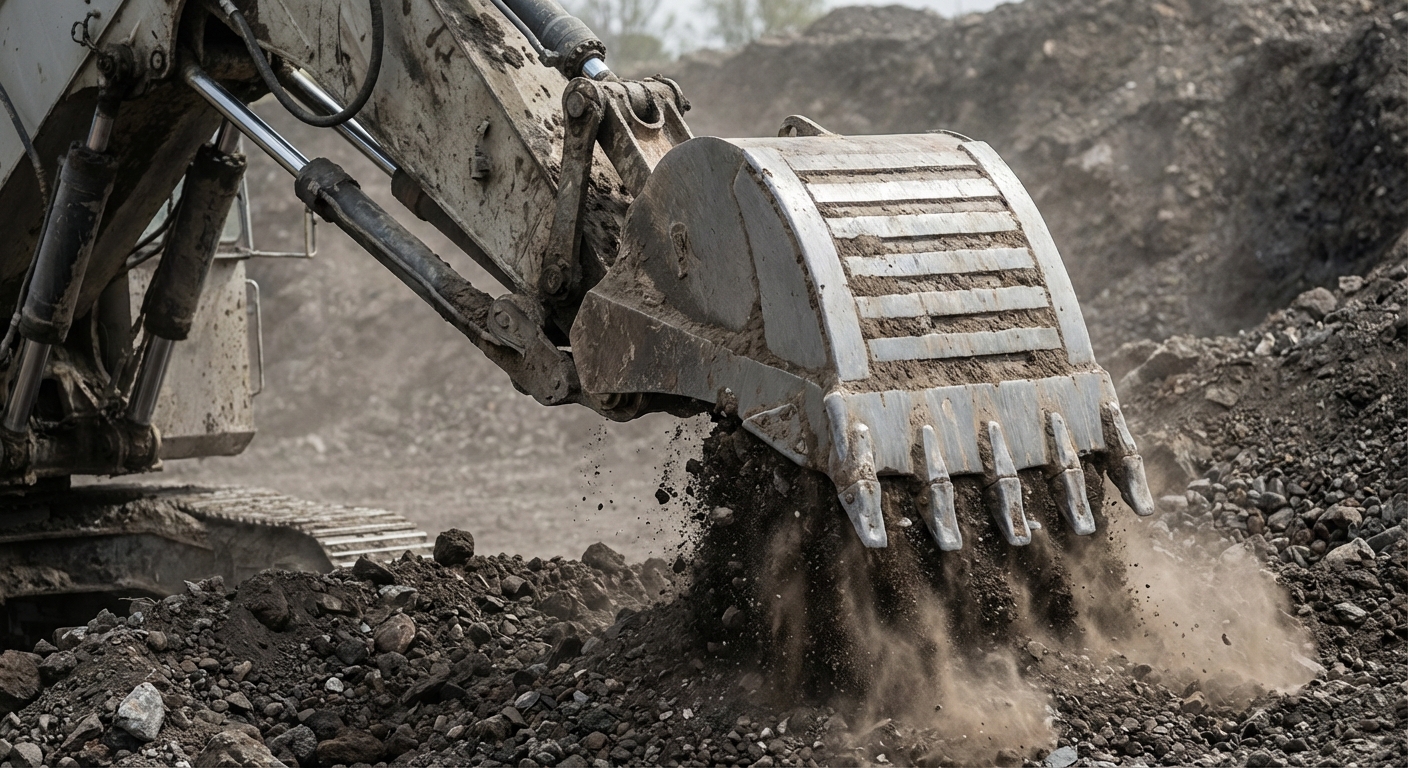
- Shell plate: Rockland uses steel plate 25-50% heavier than typical OEM specifications
- Wear bars: Multiple wear bars protect high-impact areas that competitors leave exposed
- Cutting edges: Hardened, bolt-on cutting edges enable easy replacement without structural welding
- Structural reinforcement: Internal ribbing and gusseting exceed industry norms
“We calculate what a bucket needs to survive, then we add margin,” explains Engineering Director Sarah Williams. “Our customers work in applications where failure costs thousands per hour. Marginal cost savings on attachments don’t make sense.”
Application-Specific Design
Rather than offering standardized product lines, Rockland designs attachments for specific applications:
- Rock buckets: Narrow profiles, enhanced penetration, extreme abrasion resistance
- Demolition buckets: Reinforced for impact loading and debris handling
- Dredging buckets: Perforation patterns optimized for specific material retention
- Processing buckets: Configurations for material separation and classification
“Generic buckets are compromises that don’t excel anywhere,” Williams notes. “We design for how customers actually use equipment, not theoretical average conditions.”
Material Science
Rockland invests in material selection that supports durability:
- High-strength steel: AR400 and AR500 wear plate for extreme abrasion resistance
- Hardened components: Heat-treated wear components for extended service life
- Weld quality: Strict welding procedures and quality control ensure structural integrity
- Hardware selection: Heavy-duty fasteners rated for actual load conditions
“Material costs are small compared to downtime costs,” Rock emphasizes. “We specify materials for performance, not price optimization.”
Manufacturing Capabilities
Rockland’s Bedford facility integrates multiple manufacturing processes:
Metal Fabrication
The company operates extensive cutting, bending, and forming equipment:
- Laser cutting systems for precision component production
- Heavy plate shears for shell plate processing
- Press brakes for complex forming operations
- Plasma cutting for thick materials and structural shapes
Welding Operations
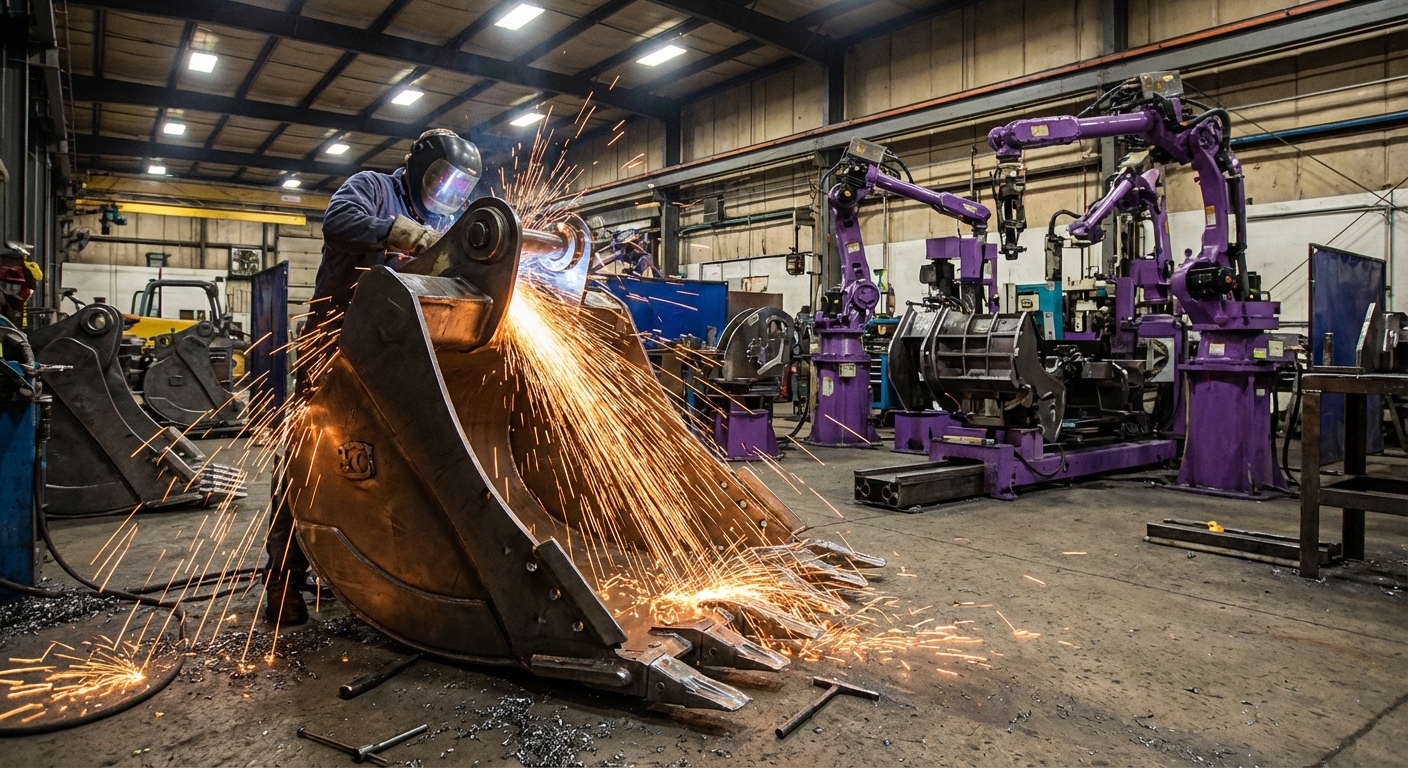
Welding represents the core of Rockland’s manufacturing:
- Robotic welding cells for high-volume consistent production
- Manual welding stations for custom and complex assemblies
- Specialized welding for wear-resistant overlays
- Comprehensive weld inspection and testing
“Welding quality determines attachment longevity,” notes Manufacturing Manager Tom Henderson. “Our welders are extensively trained, and every critical weld is inspected. We don’t ship defects.”
Assembly and Finishing
Completed attachments undergo:
- Fit verification against customer equipment specifications
- Surface preparation and painting
- Hardware installation and quality verification
- Packaging for damage-free delivery
The signature purple paint, originally chosen for visibility and distinctiveness, has become a brand identifier. “Customers recognize Rockland purple from across a job site,” Rock notes. “That visibility reinforces our reputation.”
Product Lines
Rockland manufactures attachments across multiple categories:
Buckets
The core product line includes:
- Excavator buckets: General purpose, rock, severe-duty, ditch cleaning
- Loader buckets: General purpose, rock, coal, rehandling, foundry
- Specialty buckets: Demolition, dredging, grading, skeleton
Each category offers multiple configurations for specific applications. Custom designs for unique requirements are common.
Material Handling
Beyond buckets, Rockland produces:
- Grapples: Sorting, demolition, log, and scrap handling configurations
- Thumbs: Hydraulic and fixed thumbs for material manipulation
- Clamps: Various configurations for material securing and handling
Ground Engagement
Tools for breaking and moving material include:
- Rippers: Single and multi-shank configurations for rock and frozen ground
- Compaction wheels: Various patterns for trench and area compaction
- Specialty tools: Custom tools for specific applications
Customer Relationships
Rockland serves customers through both dealer networks and direct sales:
Dealer Network
Approximately 60% of Rockland sales flow through equipment dealers who carry Rockland as their attachment line. These relationships provide:
- Local customer access and support
- Application consultation and specification assistance
- Inventory availability for common configurations
- Warranty service and parts support
Rockland works with dealers who share its quality philosophy and maintain technical capability to support customers effectively.
Direct Sales
For specialized applications and large accounts, Rockland sells direct:
- Custom engineering for unique requirements
- Volume pricing for fleet operators
- Technical consultation for complex applications
- Project-specific solutions
“Direct relationships make sense for complex applications requiring engineering involvement,” Rock explains. “We can provide detailed technical support that distributors may not offer.”
Customer Support
Rockland maintains engineering staff available for customer consultation:
- Application analysis and attachment recommendation
- Custom design for unique requirements
- Specification assistance for equipment compatibility
- Problem-solving for performance issues
“We don’t just sell attachments—we help customers solve problems,” Williams emphasizes. “When a customer struggles with an application, our engineers work with them to develop solutions.”
Competitive Position
Rockland competes against several categories:
OEM Attachments
Equipment manufacturers offer attachments matched to their machines. Rockland competes by offering:
- Superior durability for demanding applications
- Application-specific designs versus generic configurations
- Pricing competitive with or better than OEM for comparable quality
“OEM attachments work fine for average applications,” Rock acknowledges. “For tough applications, customers need specialized solutions we provide.”
Import Competition
Low-cost imported attachments have captured significant market share on price. Rockland counters by emphasizing:
- Total cost of ownership including service life and downtime
- Application engineering versus commodity products
- American manufacturing quality and support
- Rapid turnaround for custom and urgent orders
“Import buckets might cost half as much but last a quarter as long,” Henderson notes. “Contractors doing the math usually choose Rockland.”
Domestic Competitors
Other American attachment manufacturers compete for similar customers. Rockland differentiates through:
- Engineering capability for complex custom applications
- Manufacturing quality and consistency
- Reputation established over four decades
- Technical support and customer service
For similar American-made attachment innovation, see our profiles of Paladin Attachments and Werk-Brau.
Looking Forward
Rockland sees continued opportunity in premium attachments:
“Equipment is becoming more capable and more expensive,” Rock observes. “Matching that equipment with quality attachments makes economic sense. Cheap buckets on expensive excavators waste the machine’s capability.”
The company is expanding product lines to address emerging applications:
- Material processing: Attachments for on-site processing and recycling
- Specialty handling: Custom solutions for specific industries
- Technology integration: Compatibility with machine control and monitoring systems
Manufacturing investment continues as Rockland expands capacity to meet demand:
- Automation of repetitive production steps
- Expanded engineering capability for custom work
- Additional production capacity for growth
“American manufacturing can compete,” Rock concludes. “We compete on quality, engineering, and service rather than price alone. That’s a sustainable strategy.”
For contractors evaluating attachment purchases, our analysis of equipment valuations provides context on how attachment quality affects equipment residual value.