Electric Construction Equipment: 2025 in Review and 2026 Outlook
From niche curiosity to practical option—electric equipment crossed important thresholds in 2025. We assess progress and what's coming next.
Electric construction equipment crossed from curiosity to credible option during 2025. Major OEMs expanded electric model offerings, early adopters moved from trials to fleet deployments, and the supporting infrastructure—charging, service, operator training—matured meaningfully.
This review examines where electric equipment stands as we enter 2026, assessing current capabilities, adoption patterns, and what contractors should expect in the coming year.
2025 Progress
Expanded Model Availability
Every major OEM now offers electric equipment options, with significant model introductions during 2025:
Caterpillar expanded its battery-electric compact equipment lineup and announced production plans for larger electric excavators.
Volvo CE delivered increasing volumes of electric compact excavators and wheel loaders, with European operations leading adoption.
Komatsu continued development of electric and hybrid excavators, with production models available in select markets.
John Deere introduced electric compact track loaders and announced electric excavator development programs.
Bobcat/Doosan expanded electric compact equipment offerings, targeting the landscape and indoor construction markets.
Chinese manufacturers including Sany and XCMG brought electric models to Western markets, often at aggressive price points.
The equipment available has expanded beyond compact equipment into mid-size categories where electrification was once considered impractical.
Real-World Adoption
Electric equipment moved from demonstration projects to actual production use:
Indoor construction has embraced electric equipment most enthusiastically. Zero emissions enable work in enclosed spaces without ventilation requirements or air quality concerns.
Urban projects in emission-restricted zones represent growing adoption. Cities with clean construction requirements—particularly in Europe—have driven demand for electric options.
Sustainability-driven customers including certain developers, government agencies, and contractors with emissions commitments have adopted electric equipment despite cost premiums.
Specialty applications where noise reduction is valuable—night work in residential areas, hospital construction, and similar settings—have found electric equipment advantageous.
Infrastructure Development
Charging infrastructure development accelerated:
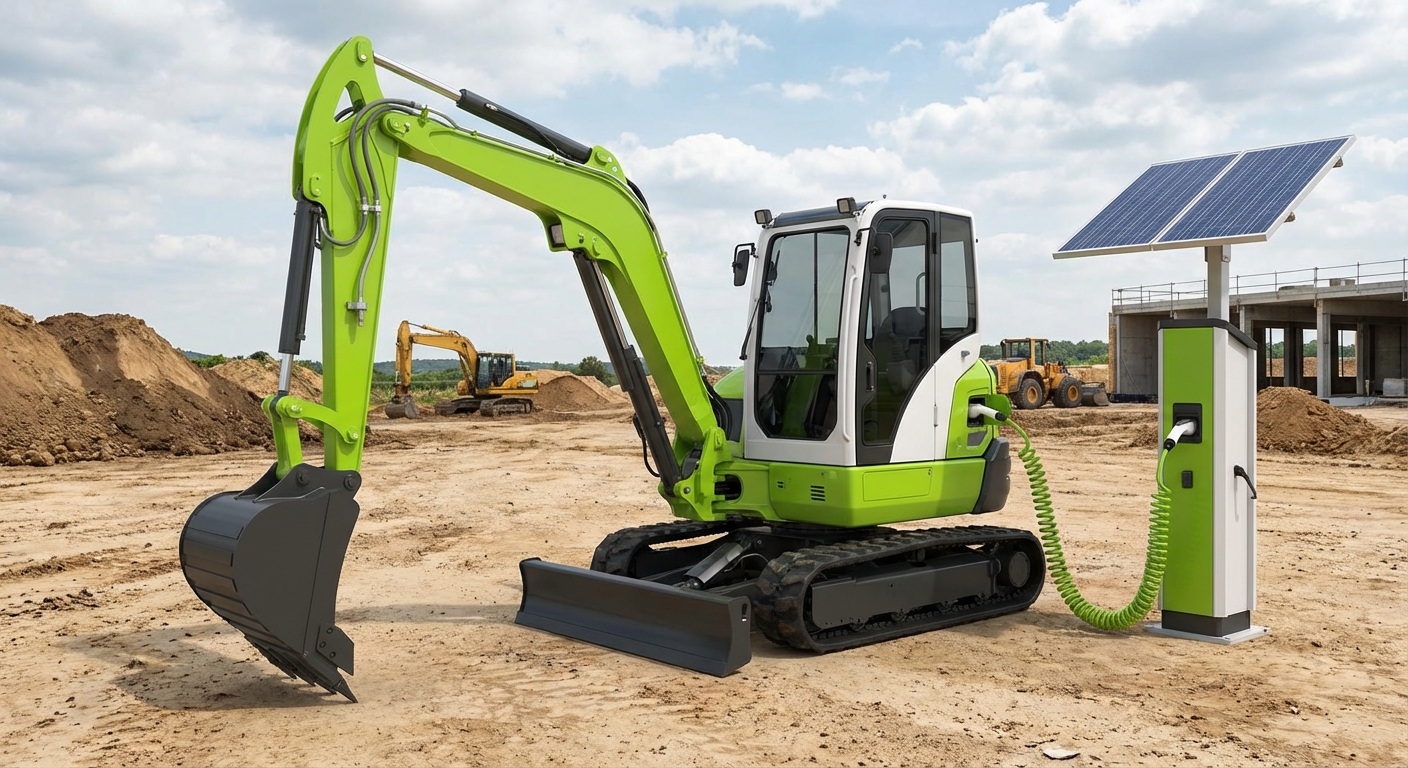
Jobsite charging solutions have matured, including portable fast-charging units designed for construction environments. These systems can operate from generators or grid connections.
Dealer charging capabilities expanded as equipment dealers prepared to service and charge electric equipment.
Grid connection services emerged to help contractors navigate utility requirements for high-power charging installations.
Battery swapping gained traction for certain equipment categories, enabling rapid “refueling” without extended charging stops.
Current Capabilities
What Works Well
Electric equipment excels in specific applications:
Compact equipment (under 20,000 lbs) has reached practical capability for most applications. Battery capacity supports full shift operation for typical compact equipment duty cycles, with charging during breaks or overnight.
Light to moderate duty cycles suit current battery technology. Equipment that runs at partial load with frequent pauses can operate effectively on battery power.
Operations with predictable scheduling where charging can be planned work better than on-call applications requiring immediate availability.
Applications valuing reduced noise, emissions, or operating costs justify the current price premiums over diesel alternatives.
Current Limitations
Honest assessment requires acknowledging limitations:
Large equipment above 30-40 tons remains challenging for battery-electric propulsion. Energy density limitations require either enormous battery packs or frequent charging that interrupts productivity.
Heavy continuous duty like mass excavation or quarry loading tests battery capacity. Equipment running at high loads for extended periods may require mid-shift charging.
Remote operations far from grid power present charging challenges. Generator-based charging eliminates many environmental benefits of electrification.
Cold weather reduces battery capacity and increases cabin heating demands. Operations in northern climates see reduced range during winter months.
Purchase price remains 50-100% above diesel equivalents for most categories, requiring strong operational benefits to justify investment.
Total Cost of Ownership
The economic case for electric equipment depends heavily on specific circumstances:
Favorable Economics
- High-utilization operations that can capture fuel savings (electricity typically costs 30-50% less than diesel per work unit)
- Applications where noise or emission restrictions otherwise limit working hours
- Operations with access to low-cost electricity or renewable power
- Long equipment ownership cycles that allow time for fuel savings to offset purchase premiums
- Jurisdictions with electric equipment incentives
Challenging Economics
- Low-utilization equipment where fuel savings are minimal
- Operations without reliable charging infrastructure
- Applications requiring extended continuous operation
- Short ownership cycles or rental applications where purchase premium can’t be recovered
- Operations in areas with high electricity costs
For many contractors, the decision remains marginal—electric equipment can work operationally, but the economics don’t yet clearly favor it over diesel alternatives.
Market Outlook for 2026
Model Expansion
Expect continued electric model introductions:
- More mid-size excavators (10-25 ton class) from major OEMs
- Electric wheel loaders in larger size classes
- Electric dozers in compact and small categories
- Continued expansion of compact equipment lines
Technology Improvements
Battery technology continues advancing:
- Higher energy density batteries enabling smaller, lighter battery packs
- Faster charging capabilities reducing downtime
- Better battery management extending service life
- Improved cold-weather performance
Infrastructure Growth
Charging infrastructure will become less of an obstacle:
- More contractors deploying dedicated charging equipment
- Dealers expanding charging and service capabilities
- Utility programs simplifying high-power connections
- Portable charging solutions becoming more robust
Cost Trajectory
Prices will remain elevated but should moderate:
- Battery costs continue declining, though slowly
- Manufacturing scale improving as volumes increase
- Competition intensifying, particularly from Chinese manufacturers
- Government incentives varying by jurisdiction but often available
Recommendations for Contractors
Evaluation Framework
Contractors considering electric equipment should evaluate:
Application fit — Does the application suit current electric equipment capabilities? Light-duty, predictable operations near charging infrastructure work best.
Economic analysis — Model total cost of ownership including purchase price, fuel/electricity costs, maintenance differences, and potential incentives.
Infrastructure requirements — Assess charging needs and costs for your operations.
Workforce readiness — Operators and technicians need training on electric equipment operation and safety.
Resale considerations — Used equipment markets for electric equipment remain developing; residual value uncertainty should factor into decisions.
Getting Started
For contractors interested in electric equipment:
Start with compact equipment where electric options are most mature and capable.
Select appropriate applications that suit current technology capabilities rather than forcing electric equipment into challenging roles.
Work with dealers who can support electric equipment service and charging needs.
Track and document results to inform future electric equipment decisions.
Monitor developments as technology continues advancing rapidly.
Conclusion
Electric construction equipment has become a legitimate option for appropriate applications. The technology works, adoption is growing, and the ecosystem is maturing.
But electrification isn’t yet a universal solution. Current limitations around energy density, charging infrastructure, and cost make diesel remain the practical choice for many applications.
The trajectory is clear—electric equipment will capture increasing market share as technology improves and costs decline. Forward-thinking contractors should be gaining experience with electric equipment now, positioning themselves for a more electric future while making pragmatic decisions about where today’s technology makes sense.
For more on equipment technology trends, see our coverage of hybrid excavators and autonomous equipment.