Bobcat Unveils AI-Powered Voice Assistant and Autonomous Concept Machine at CES 2026
Bobcat's Jobsite Companion AI and RogueX3 concept machine signal a radical shift in how operators will interact with compact equipment
Bobcat Unveils AI-Powered Voice Assistant and Autonomous Concept Machine at CES 2026
In what the company calls “the most significant interface evolution in nearly two decades,” Bobcat has announced a suite of AI-powered technologies at CES 2026 that could fundamentally change how operators interact with compact construction equipment. The centerpiece announcements—the Jobsite Companion AI voice assistant and the RogueX3 autonomous concept machine—represent a bold bet that the future of construction equipment lies in artificial intelligence and radical machine adaptability.
Editor’s Note: Managing equipment data and maintenance across your fleet? FieldFix helps contractors track service intervals, log repairs, and calculate true cost-per-hour—the kind of operational intelligence that pairs perfectly with AI-enhanced equipment.
Jobsite Companion: Your Equipment Now Talks Back
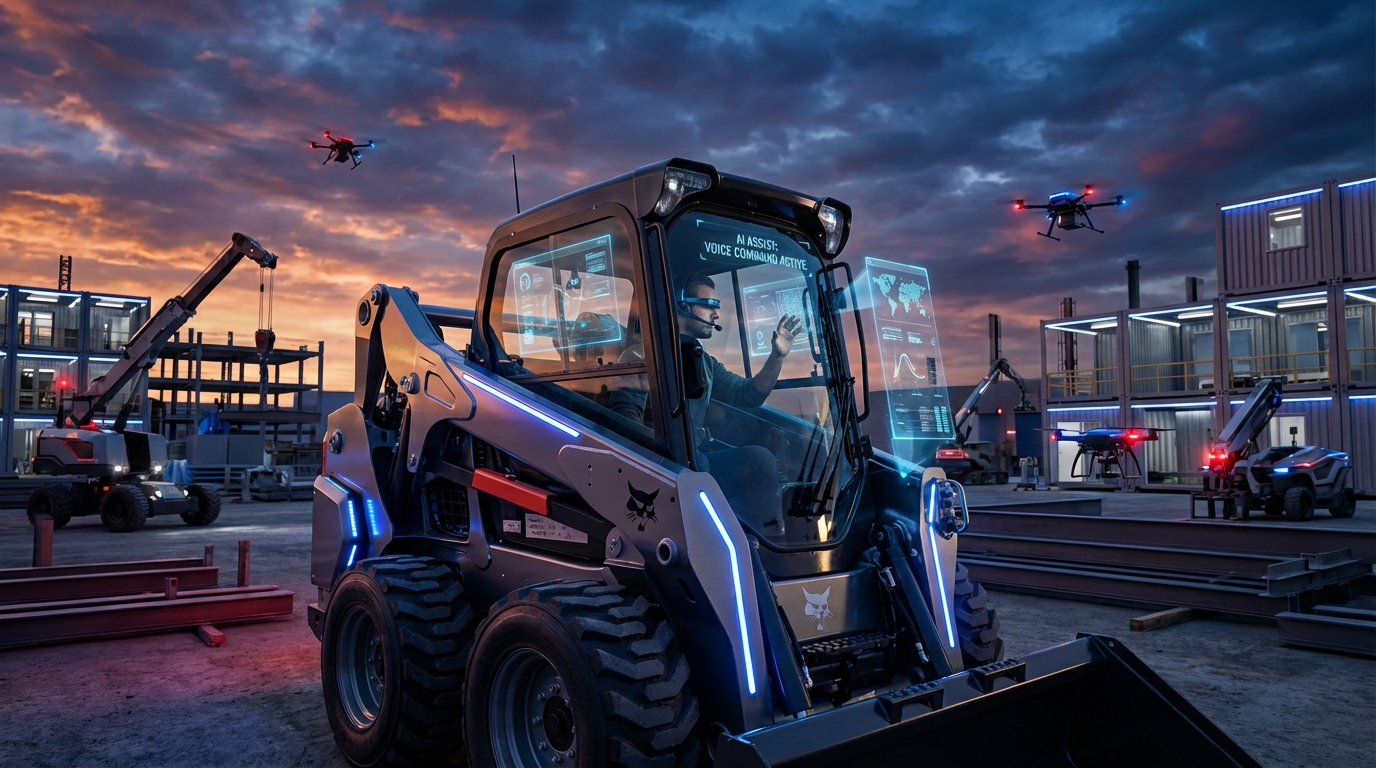
The Bobcat Jobsite Companion is an AI-enabled voice control system that runs entirely onboard the machine, requiring no cloud connectivity for real-time responsiveness. According to Bobcat, the system provides support and automation for over 50 standard machine functions through natural voice commands.
The implications for daily operations are significant. Operators can now verbally request hydraulic setting adjustments, diagnostic information, and machine function controls like lighting—all while keeping their hands on the controls. The system is powered by Bobcat’s proprietary AI large language model, developed specifically for construction equipment operations.
What Jobsite Companion Can Do
The voice assistant handles a range of tasks that would traditionally require operators to stop work, consult manuals, or call support:
- Attachment Configuration: The system can automatically adjust hydraulic settings based on the attachment being used and environmental conditions
- Diagnostic Support: When fault codes appear, operators can ask the AI to explain the issue and provide troubleshooting steps
- Operational Recommendations: Based on the current task and conditions, Jobsite Companion can suggest optimal machine settings
- Real-Time Function Control: Voice commands for lights, HVAC, and other auxiliary functions
The technology targets both ends of the operator experience spectrum. For new operators facing the industry’s well-documented labor shortage, the voice assistant lowers the barrier to entry by providing on-demand guidance. For experienced professionals, it eliminates the interruptions of manual setting adjustments and diagnostic lookups.
RogueX3: A Glimpse at Equipment’s Modular Future
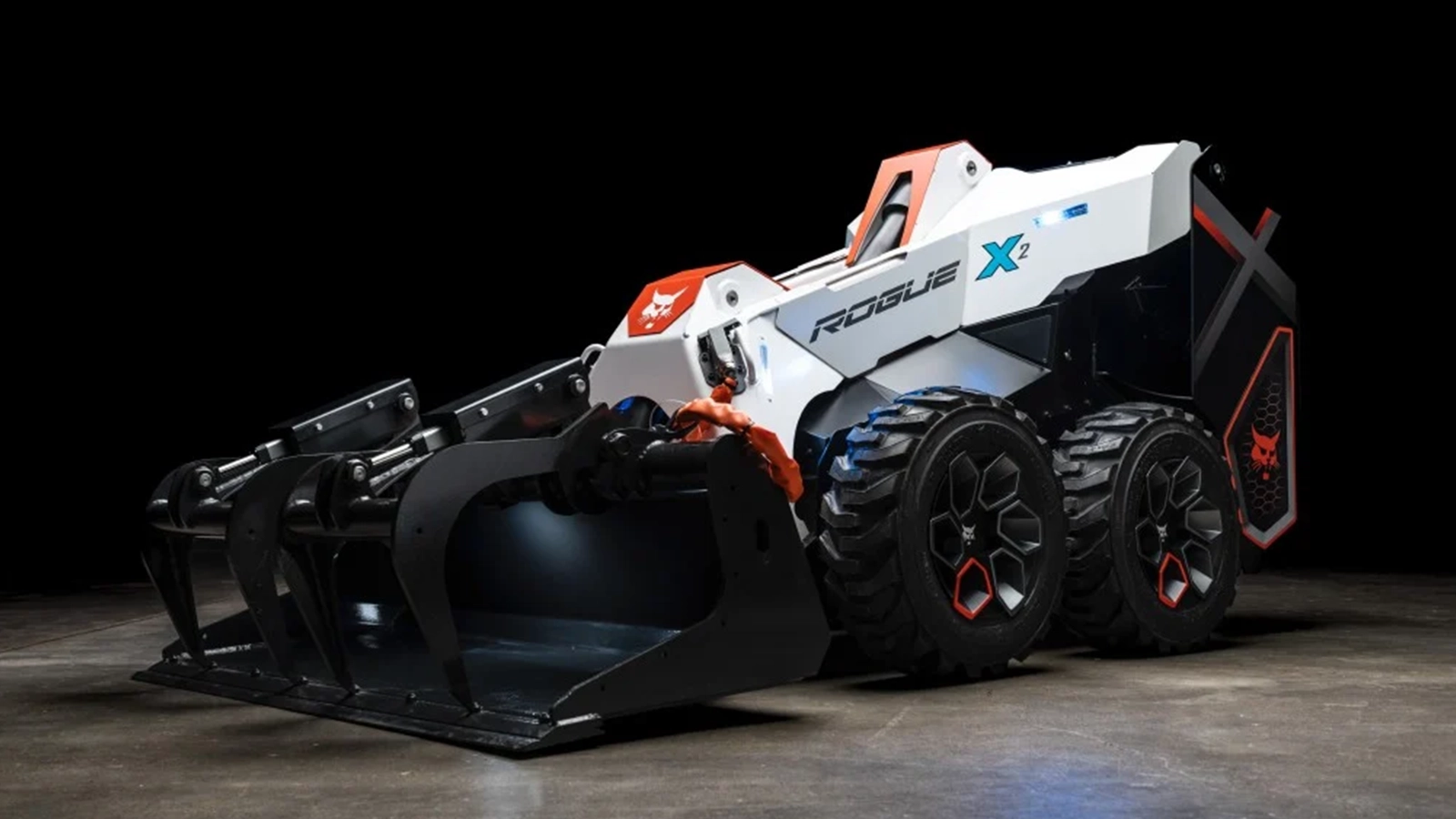
While Jobsite Companion addresses immediate operational needs, the RogueX3 concept machine represents Bobcat’s vision for where compact equipment is headed over the next decade. The platform is fully electric, capable of autonomous operation, and—perhaps most significantly—modular in a way no production equipment has attempted.
The RogueX3’s design allows for interchangeable components including cabs, wheels, tracks, and configurable lift arms. An operator could theoretically swap between wheeled and tracked configurations depending on terrain, or remove the cab entirely for remote-controlled operation in hazardous environments.
Powertrain Flexibility Built Into the Design
Rather than committing to a single power source, Bobcat has engineered the RogueX3 architecture to accommodate multiple powertrain options:
- Electric (as shown at CES)
- Diesel (for customers who need it)
- Hybrid configurations
- Hydrogen fuel cell (future-proofing for emissions regulations)
This modularity acknowledges the reality that the transition to zero-emission equipment will happen at different speeds across regions and applications. A contractor working in California’s strict emissions environment has different needs than one operating in a state with minimal regulations.
Bobcat indicates the RogueX3’s design has generated multiple pending patents that will influence future production models. While no timeline for commercialization has been announced, the technology demonstrated at CES appears production-intent rather than purely conceptual.
Service.AI: Reducing Downtime Through Artificial Intelligence
Equipment downtime is one of the most expensive problems in construction. A machine sitting idle while waiting for a diagnosis or parts can cost hundreds or thousands of dollars per day in lost productivity. Bobcat’s Service.AI platform aims to address this through AI-powered service and support.
The system provides dealers and technicians with instant access to Bobcat’s repair expertise, essentially encoding decades of service knowledge into a queryable AI system. Rather than waiting for a factory technical support callback, technicians can describe symptoms and receive diagnostic guidance immediately.
For fleet managers, Service.AI represents a potential shift in how maintenance decisions get made. The platform can analyze equipment data to predict component failures before they occur, enabling proactive maintenance scheduling rather than reactive repairs.
Collision Warning and Avoidance: Safety Through Sensing
The fourth major technology announcement at CES addresses one of construction’s persistent challenges: collisions between equipment and workers, vehicles, or other machines. Bobcat’s new collision warning and avoidance system uses advanced imaging radar to track the position, direction, and speed of surrounding objects in real-time.
When the system detects a potential collision, it can automatically alert the operator and—if necessary—slow or stop the machine to prevent contact. This represents an evolution from warning-only systems, which rely on operator reaction time, to active intervention.
The technology has obvious implications for crowded jobsites where compact equipment operates in close proximity to foot traffic and other machines. It also addresses insurance and liability concerns that increasingly influence purchasing decisions.
Advanced Display Technology: The Transparent Future
Perhaps the most visually striking announcement was Bobcat’s concept for next-generation operator displays. The system uses MicroLED technology in a transparent, auto-tinting, touch-enabled format that integrates directly into the cab door or machine window.
Rather than forcing operators to look away from the work area to check gauges or camera feeds, the display overlays critical operational data directly onto the operator’s field of view—similar to automotive heads-up displays but more comprehensive.
The transparent display maintains visibility while adding information layers. Machine vitals, attachment status, and even camera feeds from blind spots can appear in the operator’s natural line of sight.
What This Means for the Industry
Bobcat’s announcements at CES 2026 represent more than incremental improvements—they signal where the industry’s largest players believe compact equipment is heading. Several themes emerge:
AI Is Coming to the Cab
The Jobsite Companion isn’t a gimmick; it’s a response to real operational challenges. The construction industry’s labor shortage means equipment needs to be accessible to operators with less training. AI-powered guidance could help bridge that gap while also making experienced operators more productive.
The on-device processing—no cloud required—addresses connectivity concerns that have plagued other smart equipment implementations. A skid steer working in a rural area with no cellular coverage can still access full AI functionality.
Modular Design Could Reshape Fleet Management
If the RogueX3’s modularity translates to production models, fleet managers may eventually purchase base platforms and configure them for specific tasks rather than maintaining multiple single-purpose machines. The economics would depend on how quickly configurations can be swapped, but the potential for reduced capital investment and increased utilization is significant.
Active Safety Systems Are Becoming Expected
The collision avoidance system follows a trajectory seen in the automotive industry, where advanced driver assistance systems moved from luxury features to standard equipment. Construction equipment appears to be following a similar path, driven by a combination of regulatory pressure, insurance considerations, and workforce expectations.
The Competitive Landscape
Bobcat’s aggressive technology push doesn’t exist in a vacuum. Caterpillar, John Deere, and Komatsu have all made significant investments in autonomous operation and AI-enhanced controls. Volvo Construction Equipment recently launched the EC950 High Reach, demonstrating that established players are also pushing technological boundaries.
What distinguishes Bobcat’s approach is the integration of multiple technologies into a coherent vision for the future. Rather than announcing autonomous operation or AI assistance as standalone features, the company presented them as components of a unified platform that addresses training, productivity, safety, and sustainability simultaneously.
Looking Ahead to ConExpo
Many of these technologies will get their first public demonstrations at ConExpo 2026, where Bobcat has indicated it will show how AI, electrification, autonomy, and connectivity integrate in practice. For contractors evaluating equipment purchases, the show will provide an opportunity to assess whether Bobcat’s vision aligns with their operational realities.
The construction industry has historically been slow to adopt new technologies, but the combination of labor shortages, emissions regulations, and productivity pressures may accelerate the timeline for these innovations. Bobcat is betting that contractors are ready for machines that can talk, think, and adapt—and that early movers will gain a competitive advantage.
Equipment Insider covers the heavy equipment industry with a focus on technology, operations, and market trends. Follow @equipinsiderhq for breaking news and analysis.