Autonomous Construction Equipment: From Mining to Mainstream
Autonomous technology proven in mining is migrating to construction sites. We examine current capabilities, adoption barriers, and what's coming next.
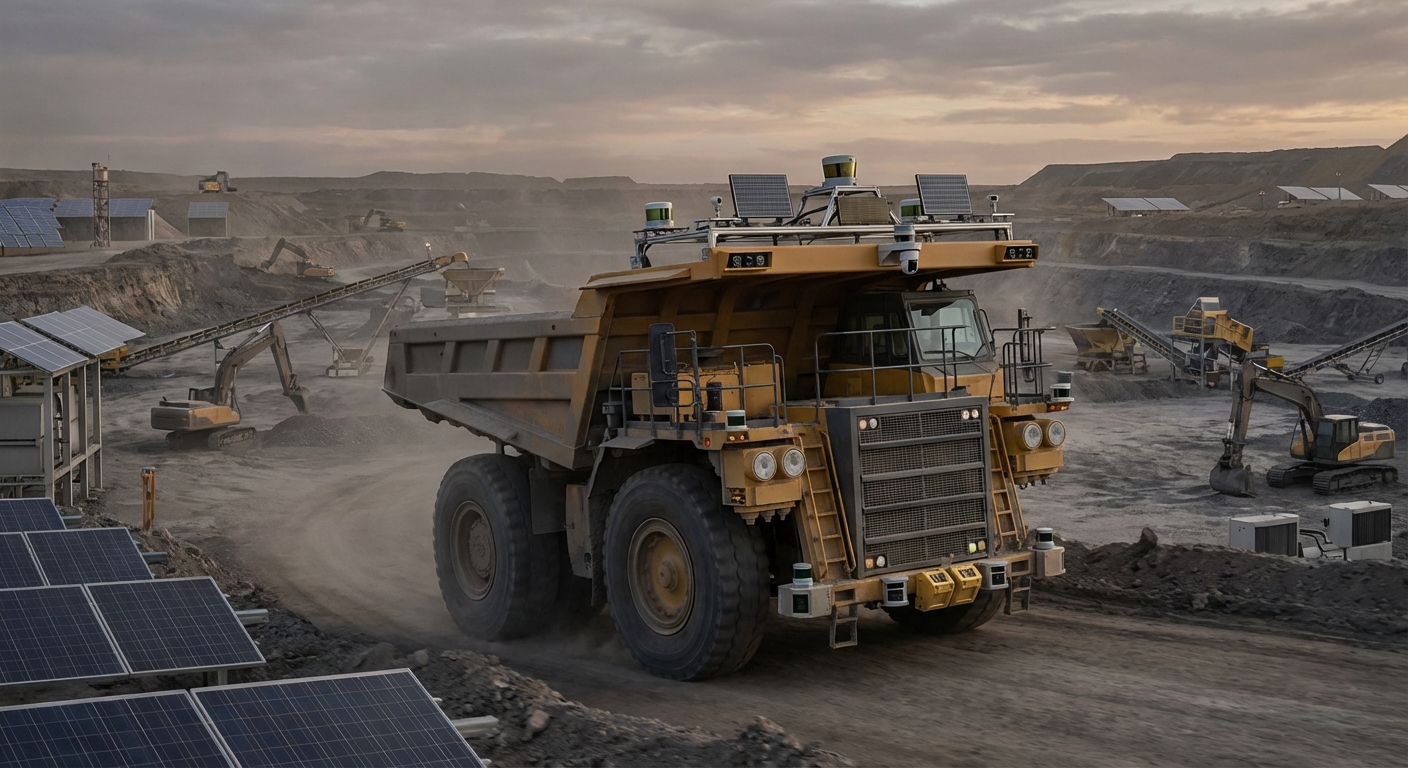
Autonomous haul trucks have operated in mines for over a decade, moving millions of tons of material with minimal human intervention. Now that proven technology is beginning to migrate into construction applications, promising to reshape how projects are executed.
This report examines the current state of autonomous construction equipment, the barriers to broader adoption, and the timeline for mainstream deployment.
Mining: The Proving Ground
Mining operations have served as the laboratory for autonomous equipment technology. The results have been compelling:
Caterpillar’s autonomous haul truck fleet has moved over 5 billion tons of material across mining operations globally. Their Command for hauling system operates trucks around the clock with safety records exceeding human-operated fleets.
Komatsu’s FrontRunner autonomous system operates at major mines in Australia, Canada, and South America, demonstrating consistent productivity improvements.
Other manufacturers including Hitachi and Volvo are developing or deploying autonomous mining systems.
The mining environment suits autonomy: controlled access, defined routes, predictable conditions, and high utilization that justifies technology investment. Mines have achieved:
- 15-25% productivity improvements
- Near-zero safety incidents
- Reduced fuel consumption
- 24/7 operation without shift changes
These results establish that autonomous equipment technology works. The question is how quickly it translates to construction environments.
Current Construction Applications
Autonomous technology is entering construction through several pathways:
Grade Control and Automated Functions
The most widespread “autonomous” construction technology is GPS grade control with automated blade and bucket control. These systems allow dozers and excavators to achieve precise grades with minimal operator input.
While operators remain in the cab, the machine performs grading functions autonomously—the operator monitors rather than controls. This represents a stepping stone toward full autonomy.
Compaction
Autonomous compaction has advanced rapidly. Several manufacturers offer compaction equipment that can operate without operators, following defined patterns and achieving specified density.
Confined areas like parking lots and building pads suit autonomous compaction: defined boundaries, repetitive patterns, and limited interaction with other operations.
Dozers
Autonomous and semi-autonomous dozers are entering limited production:
Caterpillar’s D11 dozers with Cat Command remote operation and autonomous functions have deployed at mining and large earthmoving sites.
Komatsu’s D155AXi and D65PXi dozers offer semi-autonomous capability with intelligent machine control.
Built Robotics offers an autonomous upgrade system that can be retrofitted to existing dozers for specific applications.
Excavators
Autonomous excavators remain earlier in development than dozers, reflecting the greater complexity of excavation tasks. However, progress is accelerating:
Caterpillar has demonstrated autonomous excavator loading in controlled environments.
Kobelco and other manufacturers are developing autonomous excavation capability.
Startups including SafeAI and others offer autonomous retrofit systems for specific excavation applications.
Barriers to Adoption
Despite proven technology, several barriers slow construction adoption:
Environment Complexity
Construction sites are more chaotic than mines: varying conditions, multiple concurrent activities, unexpected obstacles, and irregular schedules. Autonomous systems must handle this complexity safely and productively.
Regulatory Uncertainty
No clear regulatory framework governs autonomous construction equipment operation. Questions about liability, safety certification, and operator requirements remain unresolved in most jurisdictions.
Workforce Concerns
Labor organizations and workers have legitimate concerns about job displacement. While operators may transition to supervisory and monitoring roles, the path isn’t always clear.
Cost Justification
Autonomous systems add substantial cost to equipment. Mining operations with multi-shift, year-round utilization can justify this investment. Construction projects with shorter durations and varied utilization present different economics.
Integration Challenges
Autonomous equipment must integrate with other project activities, equipment, and workers. Managing this integration safely and productively requires new processes and technologies.
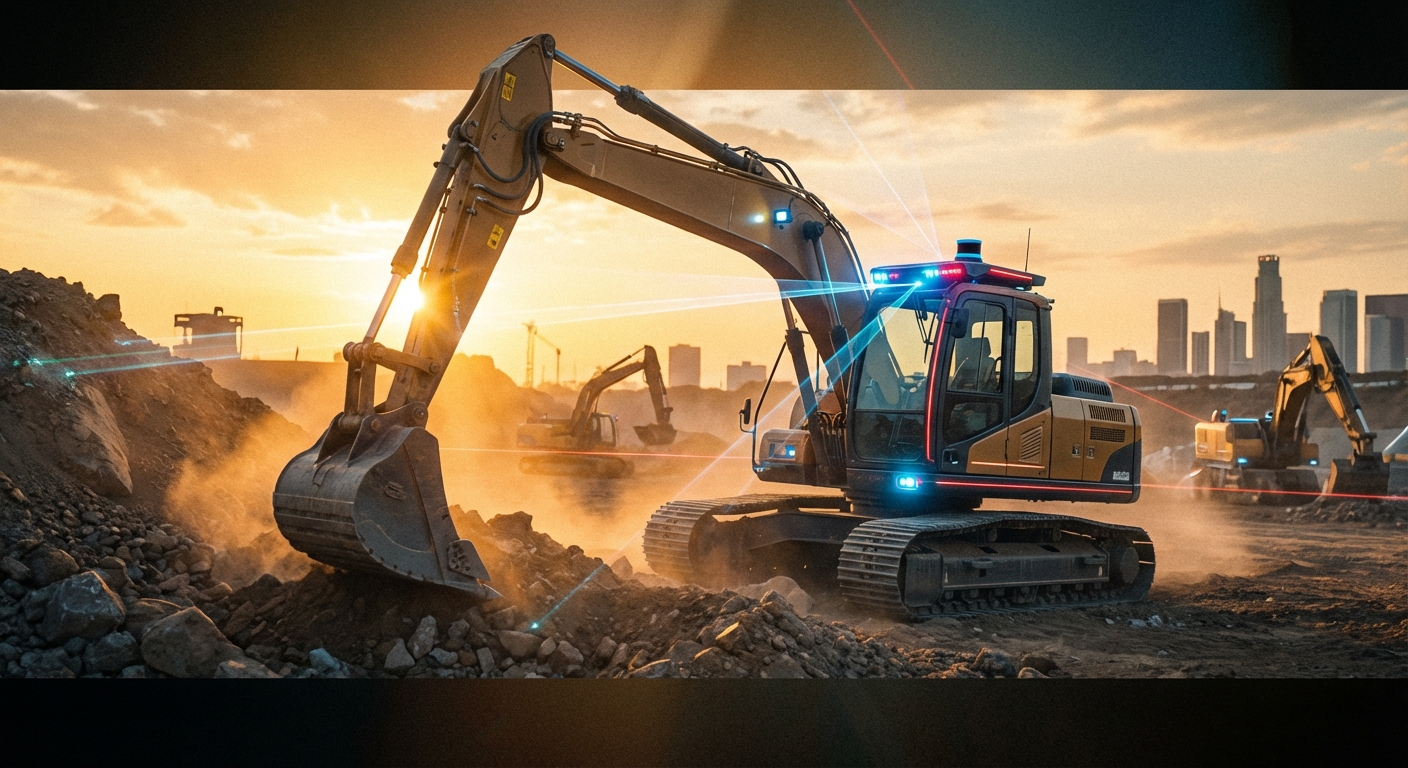
The Technology Stack
Modern autonomous construction equipment combines multiple technologies:
Sensing
- LiDAR provides 3D mapping of surroundings
- Radar detects objects and movement
- Cameras enable visual recognition and monitoring
- GPS/GNSS provides positioning
- IMU sensors track orientation and movement
Processing
Advanced processors and AI algorithms interpret sensor data, recognize objects and conditions, and make operational decisions in real time.
Communication
Autonomous equipment communicates with:
- Central control systems
- Other autonomous equipment
- Non-autonomous equipment and workers
- Fleet management systems
Safety Systems
Multiple redundant safety systems ensure safe operation:
- Object detection and avoidance
- Geofencing to constrain operating areas
- Emergency stop capabilities
- Human detection and protection
Deployment Models
Several deployment models are emerging:
Fully Autonomous Operations
Certain operations may run fully autonomously in defined areas: night grading, continuous compaction, and repetitive tasks where human presence is unnecessary.
Supervised Autonomy
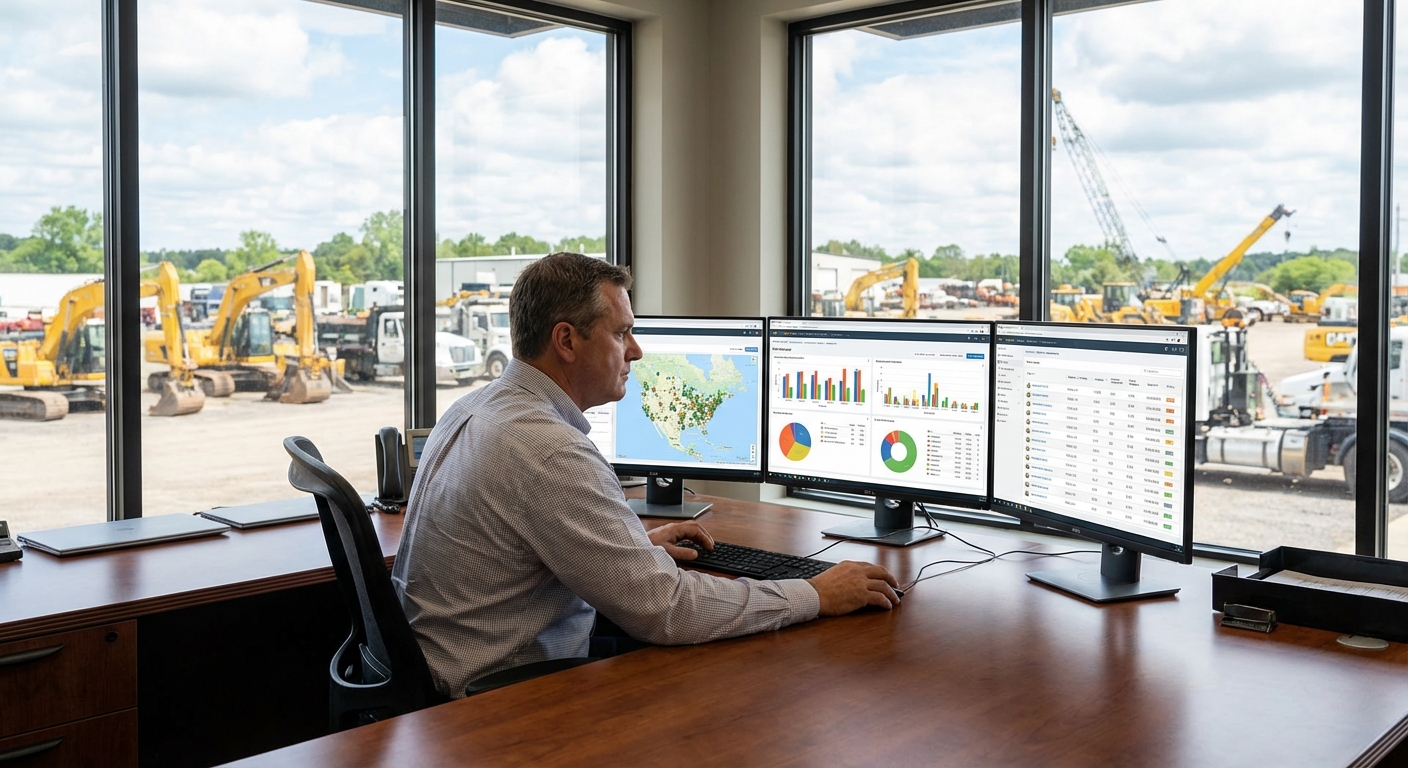
Operators supervise multiple autonomous machines from control stations, intervening only when needed. One operator might monitor 3-5 machines, dramatically improving productivity per operator.
Assisted Operation
Autonomous functions assist human operators, handling routine tasks while operators manage exceptions. This model builds on current semi-autonomous capabilities.
Fleet Integration
Mixed fleets of autonomous and operated equipment work together, with coordination systems managing interaction safely.
Timeline Expectations
Based on current development and deployment patterns:
2026-2027: Expanded semi-autonomous capability across equipment categories. Limited full-autonomous deployment in controlled applications.
2028-2030: Broader autonomous capability for specific tasks (compaction, repetitive grading). More contractors experimenting with autonomous operations.
2030-2035: Autonomous equipment becomes standard option across major categories. Mainstream adoption in applications suited to current technology.
Beyond 2035: Full autonomy for complex tasks. Autonomous-first equipment design rather than autonomy added to traditional designs.
This timeline reflects both technology development and the slower pace of industry change, regulatory development, and workforce transition.
Implications for Contractors
Near-Term (2026-2028)
- Evaluate semi-autonomous and grade control technology for current fleet
- Monitor autonomous developments for future planning
- Consider autonomous potential when acquiring new equipment
- Begin workforce conversations about technology evolution
Medium-Term (2028-2032)
- Plan for autonomous capability in fleet strategy
- Develop expertise in autonomous equipment operation and supervision
- Evaluate specific applications suited to autonomous operation
- Invest in supporting infrastructure and processes
Long-Term
- Autonomous capability will become competitive necessity for many applications
- Business models may shift as labor content changes
- Equipment ownership models may evolve (autonomous-as-a-service)
- Workforce skills will transform toward supervision and technology management
Conclusion
Autonomous construction equipment is not science fiction—it’s proven technology moving toward mainstream deployment. The question isn’t whether autonomous equipment will transform construction, but when and how quickly.
Contractors who engage now—building knowledge, evaluating applications, preparing workforce—will be better positioned than those who wait for technology to be forced upon them.
The workforce challenges plaguing the industry may accelerate autonomous adoption as contractors seek alternatives to scarce human operators. Technology that seemed “nice to have” may become essential when qualified operators simply aren’t available.
The mining industry proved the technology works. Now construction is adapting it to more complex environments. The decade ahead will determine how fundamental this transformation becomes.
For more on construction technology trends, see our coverage of telematics adoption and electric equipment.