The $475 Billion Question: How the Data Center Construction Boom Is Reshaping Heavy Equipment Demand
Tech giants are pouring hundreds of billions into AI infrastructure. For heavy equipment operators, dealers, and manufacturers, this is the biggest demand signal since the post-2008 infrastructure buildout.
Something unprecedented is happening in the heavy equipment market right now, and it has almost nothing to do with traditional construction.
The four largest technology companies in the world — Meta, Amazon, Microsoft, and Google — are projected to spend approximately $475 billion in combined capital expenditures in 2026, more than double the $230 billion they spent just two years ago. The vast majority of that money is flowing into one thing: data center construction. And for heavy equipment operators, dealers, and manufacturers, this represents a demand wave unlike anything the industry has seen in a generation.
Editor’s Note: Whether you’re running machines on a data center pad or maintaining a fleet across multiple job sites, tracking equipment hours and costs matters. FieldFix helps contractors and operators log maintenance, monitor expenses, and calculate true cost-per-hour — free for fleets up to three machines.
The Numbers Behind the Boom
The global data center construction market is projected to reach $300.38 billion in 2026, growing at a compound annual growth rate of 7.51% through 2031, when it’s expected to hit $431.39 billion. But those topline numbers obscure just how concentrated — and how sudden — the spending surge has been.
Meta alone has forecast capital expenditures between $115 billion and $135 billion for 2026, driven by its push to develop what the company calls a “Superintelligence Unit.” That single line item is larger than the GDP of most countries and represents an order of magnitude increase from the company’s spending just three years ago.
Amazon, while not disclosing a precise figure for 2026, has signaled that its capital expenditures will exceed its 2025 projection of $125 billion, with the bulk going to AWS infrastructure. Microsoft plans to double its data center footprint over the next two years. Google is building three data centers totaling nearly one million square feet in Botetourt, Virginia, alone.
What does this mean for dirt movers? Everything.
From Silicon to Sitework: Where the Equipment Demand Lives
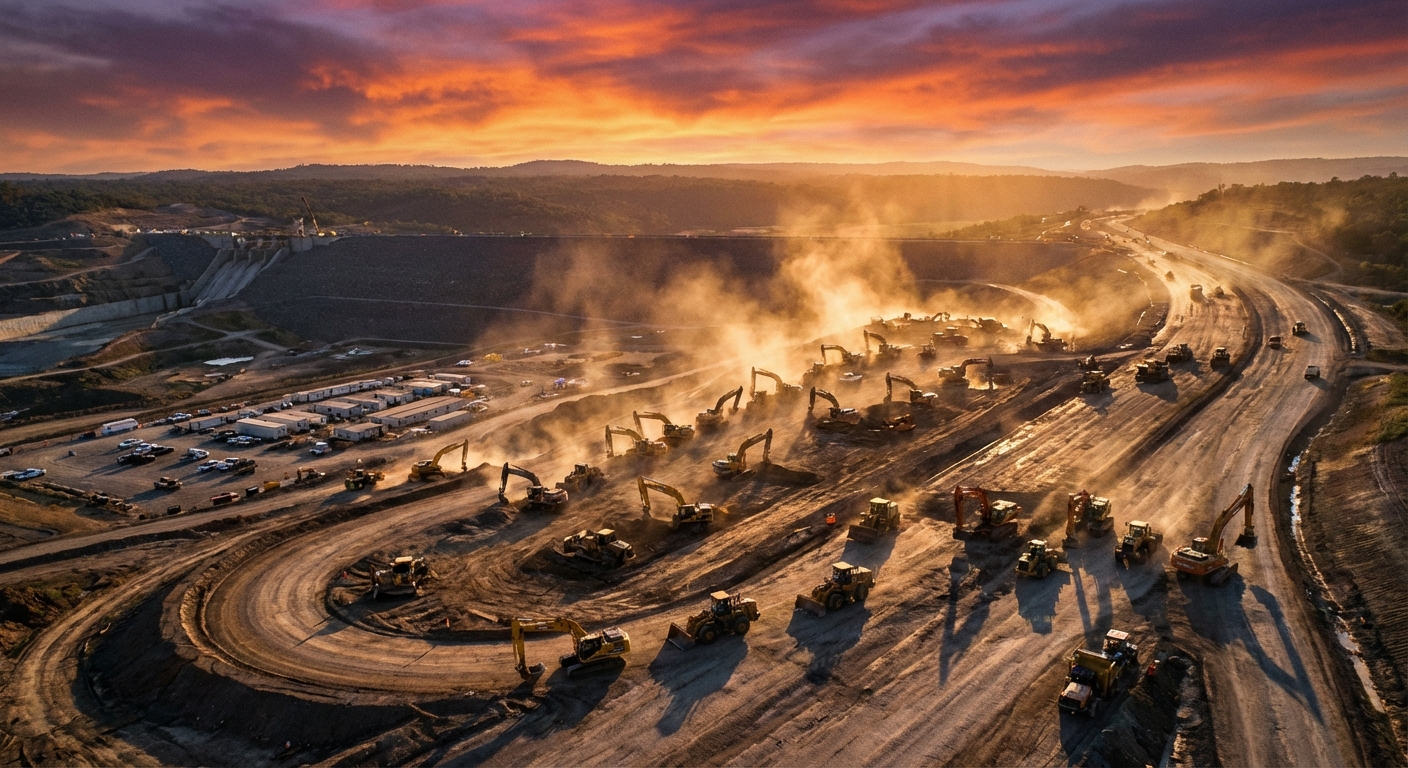
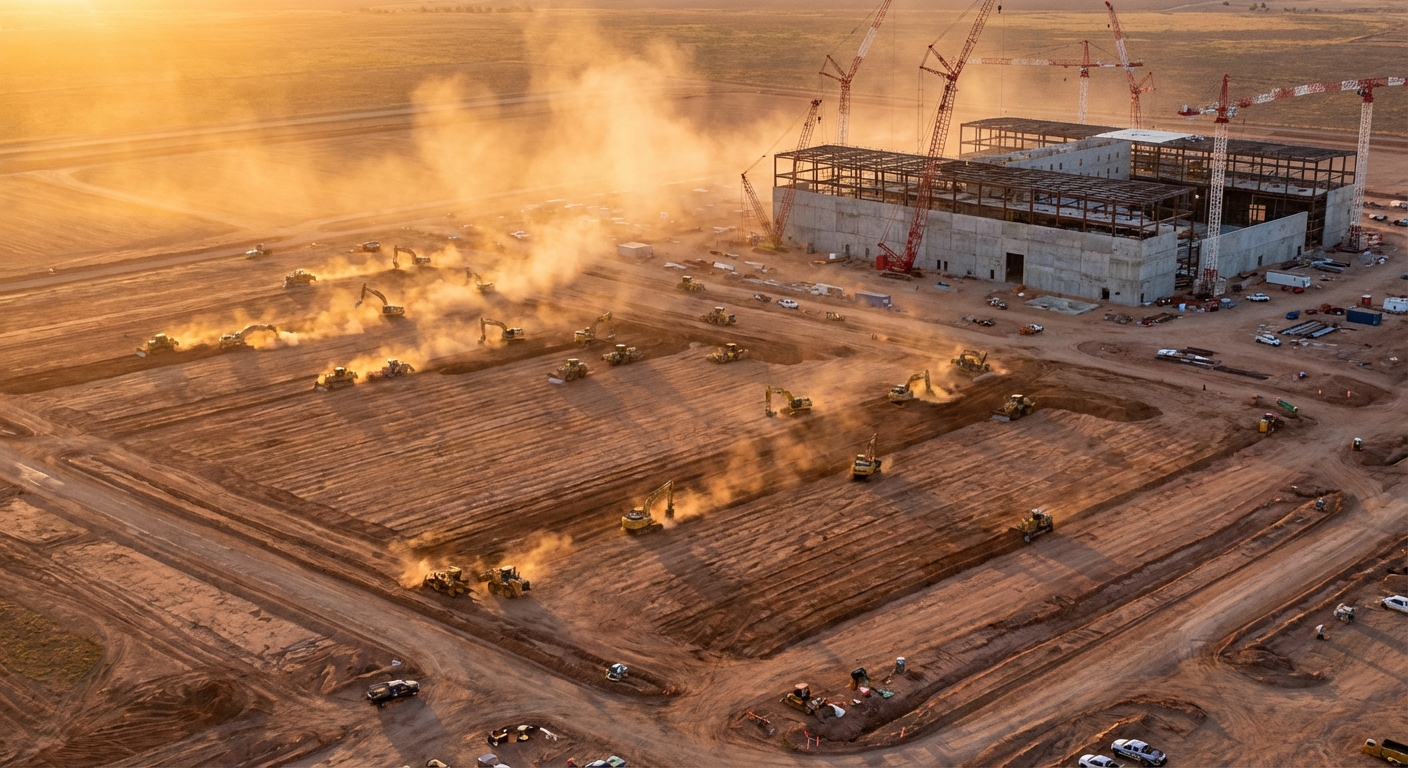
A hyperscale data center is, at its core, a massive construction project. Before a single server rack gets bolted to the floor, somebody has to clear the land, grade the site, dig foundations, install underground utilities, and move thousands of cubic yards of earth. The scale of these facilities — some covering 50 to 100 acres or more — means the sitework alone can take months and require dozens of machines running simultaneously.
The equipment demand breaks down across several key categories:
Earthmoving and Excavation
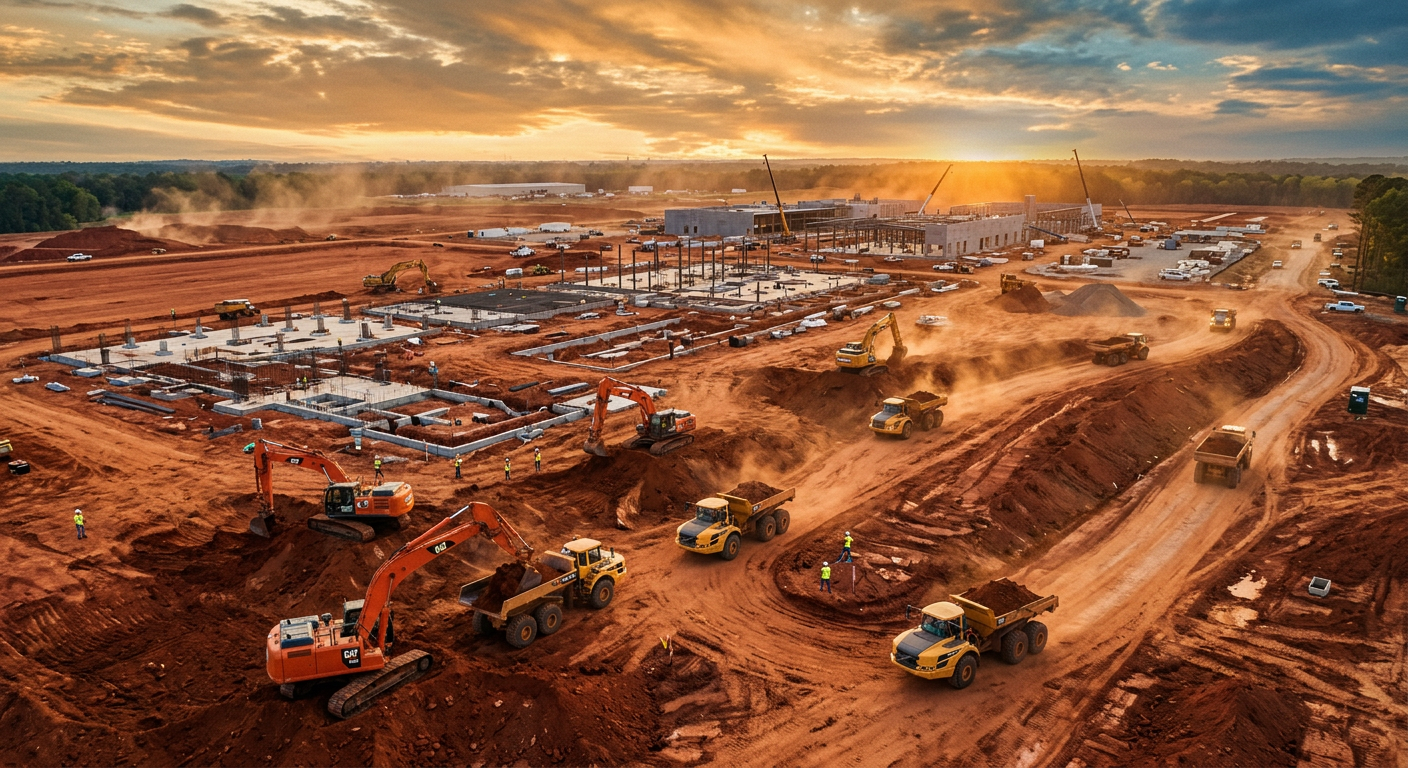
Excavators, bulldozers, and wheel loaders are the backbone of data center site preparation. These facilities require massive foundation systems to support the weight of server infrastructure and cooling equipment. Excavators handle foundation digging, rock removal, and utility trenching. Bulldozers clear and level sites that often span dozens of acres. Articulated dump trucks move the material.
For operators running earthmoving fleets, data center projects represent some of the most consistent, high-volume work available right now. Unlike residential or commercial projects that can stall due to permitting delays or financing issues, hyperscale data centers are being funded by companies with effectively unlimited capital and intense urgency to build.
Underground Utilities and Infrastructure
Data centers require extensive underground infrastructure — fiber optic conduits, electrical distribution systems, water lines for cooling, and stormwater management. This drives demand for trenching equipment, compact excavators, and utility-class machines. The electrical infrastructure alone is staggering: a single hyperscale facility can draw more power than a small city.
Concrete and Structural
The structural demands of data centers are unique in commercial construction. Server floors must support extraordinary load concentrations. Cooling systems require specialized mechanical infrastructure. This translates to significant demand for concrete pumps, cranes, and material handling equipment throughout the build cycle.
Geographic Expansion Is Creating New Markets
One of the most significant aspects of the data center boom for equipment operators is its geographic spread. While Northern Virginia, Dallas-Fort Worth, and Phoenix have traditionally dominated the data center market, capacity constraints and power availability issues are pushing development into non-traditional markets.
States like North Dakota, Wyoming, and Missouri are emerging as data center destinations, attracted by available land, favorable energy costs, and cooperative regulatory environments. This geographic dispersal is creating equipment demand in markets that haven’t seen major commercial construction activity in years — or ever, in some cases.
For regional equipment dealers and rental companies, this represents an opportunity to capture business from contractors mobilizing to build in areas with limited existing equipment infrastructure. It’s also creating logistics challenges: getting machines to remote build sites in states that don’t have established heavy equipment rental fleets is non-trivial.
The Caterpillar Effect
No company illustrates the data center impact on heavy equipment more clearly than Caterpillar. The company posted record Q4 sales heading into 2026, and while traditional construction and mining remain important segments, the data center market has become a significant revenue driver.
Caterpillar’s large diesel and natural gas generator sets — the Cat 3500 and 3600 series — are the default backup power solution for hyperscale data centers. A single large facility might require dozens of generator sets, each capable of producing multiple megawatts of backup power. At seven figures per unit, the generator business alone represents billions in revenue opportunity.
But it’s not just generators. Caterpillar’s earthmoving and construction equipment is heavily represented on data center job sites across the country. The company’s dealer network provides the kind of support infrastructure — parts availability, field service, financing — that contractors working on tight timelines require.
The broader signal here is clear: data center construction has become a top-tier demand driver for the entire equipment ecosystem, from OEMs to dealers to independent operators.
What This Means for Small and Mid-Size Operators
If you’re running a two-crew earthmoving operation in central Ohio or a site prep company in the Carolinas, the data center boom might feel abstract — something happening in Virginia and Texas that doesn’t affect your day-to-day. But the downstream effects are already showing up in ways that matter.
Equipment Availability and Pricing
When hyperscale projects absorb large quantities of excavators, dozers, and loaders — whether through purchase or long-term rental — it tightens supply for everyone else. Rental rates for mid-size excavators and dozers have been climbing steadily in markets adjacent to major data center construction zones. If you’re planning to add capacity to your fleet in 2026, factor in longer lead times and potentially higher acquisition costs.
Labor Competition
Data center general contractors are hiring aggressively, and they’re paying above-market rates to attract experienced operators, grading crews, and utility installers. If you’re already struggling to find and retain good operators — and nearly everyone is — expect the competition to intensify in regions where data center construction is active.
Subcontracting Opportunities
On the flip side, there’s real opportunity for established operators to pick up subcontract work on data center projects. These builds move fast and require significant earthmoving capacity. General contractors running hyperscale projects can’t always self-perform all the sitework, and they’re actively looking for reliable subs with the equipment and crews to handle volume.
The key qualification is usually scale: can you mobilize enough machines and operators to move material at the pace a hyperscale timeline demands? If the answer is yes, the margins on data center subcontracting work tend to be solid.
The Power Problem Nobody’s Talking About
There’s a constraint lurking behind the data center boom that could have significant implications for the heavy equipment industry: power.
Data center electricity consumption is projected to triple by 2030, reaching 400 to 600 terawatt-hours annually — roughly 8% to 12% of total U.S. electricity demand. That’s an enormous increase, and the electrical grid simply isn’t ready for it.
This is creating a secondary construction boom in power generation and transmission infrastructure. Substations, transmission lines, natural gas plants, solar farms, and battery storage facilities all need to be built to support the data centers that are being built. Every one of those projects requires heavy equipment.
For operators and contractors, this means the data center opportunity isn’t limited to the data center pad itself. The supporting infrastructure buildout — power generation, transmission, water systems, road improvements — could sustain equipment demand in data center markets for years beyond the initial facility construction.
Market Risks and Reality Checks
It would be irresponsible to write about the data center boom without acknowledging the risks. Technology investment cycles have a history of dramatic acceleration followed by sharp corrections. The dot-com bust, the 2008 financial crisis, and the crypto collapse all demonstrated that capital-intensive buildouts can reverse course quickly when market conditions change.
Several factors could cool the data center construction market:
AI revenue realization. Tech companies are spending hundreds of billions on AI infrastructure based on projections about future AI revenue that haven’t fully materialized. If AI monetization disappoints relative to the capital deployed, spending could contract.
Power constraints. If utilities can’t deliver the electrical capacity that data centers require, some projects will be delayed or relocated. This is already happening in parts of Northern Virginia, where grid capacity has become a binding constraint.
Interest rates and capital costs. While the tech giants funding hyperscale builds have strong balance sheets, smaller data center developers rely on financing. Persistent elevated interest rates could slow the mid-market segment.
Regulatory pushback. Communities near data center developments are increasingly raising concerns about noise, water usage, and visual impact. Regulatory friction could slow permitting in some markets.
None of these risks are likely to derail the overall trend in the near term. The AI infrastructure buildout has too much momentum and too many committed dollars behind it. But operators and dealers making long-term capital allocation decisions should be aware that the current pace of construction is, by any historical standard, extraordinary — and extraordinary doesn’t always mean permanent.
The Bottom Line
The data center construction boom is the most significant new demand driver in the heavy equipment market since the post-recession infrastructure spending surge. An estimated $475 billion in combined tech company capital expenditures in 2026, a $300 billion global data center construction market, and a geographic expansion into new regions are creating opportunities for equipment operators, dealers, and manufacturers across the value chain.
For operators, the immediate implications are higher rental rates, tighter equipment availability, increased labor competition, and potential subcontracting opportunities. For dealers, it means stronger demand for large earthmoving equipment, generators, and support services. For the industry as a whole, it represents a demand floor that could sustain elevated equipment utilization for years.
The question isn’t whether the data center boom matters to heavy equipment. It already does. The question is how aggressively you position your business to capture the opportunity — and how carefully you plan for the possibility that the extraordinary eventually normalizes.
Equipment Insider provides market analysis and industry coverage for the heavy equipment sector. Follow us on X and LinkedIn for daily updates.