John Deere Construction & Forestry Segment Surges 34% as Equipment Market Recovery Takes Hold
Deere & Company reports Q1 2026 results showing robust construction equipment demand with operating profit more than doubling year-over-year, signaling broader industry recovery.
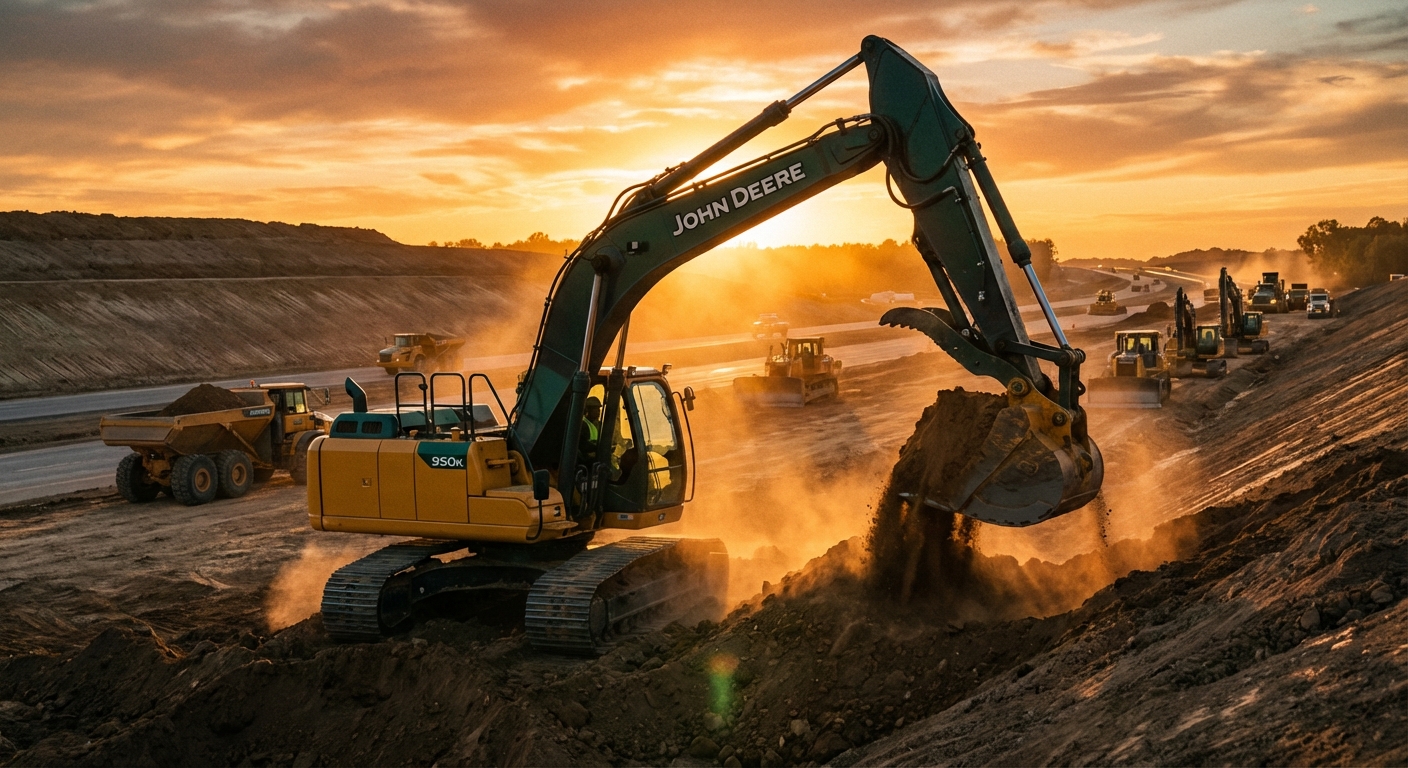
John Deere’s Construction & Forestry division delivered a standout performance in the company’s fiscal first quarter, posting a 34% surge in net sales and more than doubling operating profit as the North American equipment market continues its cyclical recovery.
The results, released February 19, 2026, paint a picture of an industry emerging from a prolonged downturn, with contractor demand for earthmoving, compact equipment, and forestry machinery driving substantial gains across Deere’s construction portfolio.
📊 Manage Your Fleet Like the Pros
Tracking equipment hours, maintenance schedules, and operating costs shouldn’t require a spreadsheet nightmare. FieldFix gives contractors the fleet management tools that dealerships use—without the enterprise price tag. Start your free trial today.
By the Numbers: Construction Leads the Charge
Deere & Company (NYSE: DE) reported consolidated net income of $656 million for the quarter ended February 1, 2026, down 25% from $869 million in the prior-year period. However, beneath the headline number lies a tale of two markets—one struggling, one thriving.
The Construction & Forestry segment delivered:
- Net sales of $2.67 billion, up 34% from $1.99 billion year-over-year
- Operating profit of $137 million, up 111% from $65 million
- Operating margin of 5.1%, expanding from 3.3%
The dramatic improvement came from higher shipment volumes, favorable sales mix, and production efficiencies, according to the company’s earnings release. While tariffs created headwinds, strong demand more than offset the impact.
CEO Points to Cyclical Bottom
John May, Deere’s chairman and chief executive officer, framed the results as confirmation that the construction equipment market has turned a corner.
“While the global large agriculture industry continues to experience challenges, we’re encouraged by the ongoing recovery in demand within both the construction and small agriculture segments,” the company stated in its earnings release. “These positive developments reinforce our belief that 2026 represents the bottom of the current cycle and provides us with a strong foundation for accelerated growth going forward.”
The company raised its full-year net income guidance to a range of $4.5 billion to $5.0 billion, reflecting improved confidence across its business segments.
Industry Outlook: Growth Across Construction Categories
Deere provided granular guidance for the construction equipment market through fiscal 2026, projecting broad-based growth:
| Segment | Outlook |
|---|---|
| U.S. & Canada Construction Equipment | Up ~5% |
| U.S. & Canada Compact Construction Equipment | Up ~5% |
| Global Forestry | Flat |
| Global Roadbuilding | Up ~5% |
The company expects its Construction & Forestry segment to deliver approximately 15% sales growth for the full fiscal year, with 2.5% price realization and favorable currency translation adding tailwinds.
What’s Driving the Recovery?
Several factors are converging to fuel construction equipment demand:
Infrastructure Investment Flows Through
The federal infrastructure spending authorized under the Infrastructure Investment and Jobs Act continues to work through the system, with state DOTs and municipal agencies finally deploying capital after years of planning and permitting. Highway, bridge, and utility projects are creating sustained demand for earthmoving and roadbuilding equipment.
Housing and Commercial Construction Stabilize
After a sharp pullback in 2024 and early 2025, residential and commercial construction activity has stabilized. Compact construction equipment—skid steers, compact track loaders, and mini excavators—has been particularly strong as contractors tackle smaller projects and urban infill development.
Rental Fleet Replacement
Equipment rental companies, which had paused fleet expansion during the downturn, are now returning to the market to replace aging units and position for expected utilization improvements. This creates steady baseline demand for manufacturers like Deere.
Technology Adoption Accelerates
Deere noted that sustained R&D investment throughout the cycle is now yielding results. The company referenced “a wide range of innovative products and solutions across all business segments,” suggesting that technology-equipped machinery is commanding premium pricing and driving upgrade cycles.
Forestry Holds Steady Despite Headwinds
While construction equipment surged, the forestry portion of the segment showed more modest performance. Deere projects global forestry equipment demand to remain flat through fiscal 2026.
The forestry market faces unique challenges, including volatile lumber prices, environmental regulations affecting timber harvests, and the shift toward sustainable forestry practices that can reduce equipment utilization. However, demand from biomass energy production and land-clearing applications continues to provide baseline support.
Financial Services: A Hidden Strength
Often overlooked in equipment industry analysis, Deere’s Financial Services arm posted net income of $244 million for the quarter, up 6% year-over-year. The division benefits from favorable financing spreads and an improving credit environment.
For contractors, the health of captive finance operations matters because it affects equipment availability and financing terms. A strong John Deere Financial means easier access to capital for equipment purchases and leases.
Tariff Pressures Remain a Wild Card
The earnings report acknowledged that tariffs continue to create cost pressures across all business segments. The company included tariff impacts in its “production costs” category, noting higher expenses that partially offset operational improvements.
With trade policy remaining uncertain, equipment manufacturers face ongoing challenges in supply chain planning and pricing strategies. Deere’s diversified global manufacturing footprint provides some insulation, but the company isn’t immune to tariff impacts on components and materials.
Competitive Implications
Deere’s strong construction results will likely be mirrored—at least directionally—by competitors when they report earnings. The company’s positive outlook suggests:
For Caterpillar: As the construction equipment market leader, Cat should see similar demand patterns in North America. The company reports later this quarter.
For Kubota and KIOTI: Compact equipment demand strength bodes well for the compact tractor and compact construction equipment segments where these manufacturers compete.
For Regional Dealers: Improved manufacturer confidence typically translates to better inventory availability and support programs for dealer networks.
Market Context: Where We Are in the Cycle
The construction equipment industry operates on roughly seven-year cycles, influenced by economic conditions, infrastructure spending, and fleet age. The 2020-2022 period saw elevated demand driven by pandemic-related stimulus and catch-up spending, followed by a correction in 2023-2025.
Deere’s assertion that 2026 represents “the bottom of the current cycle” aligns with broader industry analysis. Equipment age is increasing, rental utilization is improving, and infrastructure spending is finally translating to equipment demand.
For contractors considering equipment purchases, the cyclical bottom often represents an opportune time. Manufacturers and dealers are more willing to negotiate, trade-in values have stabilized, and lead times have normalized after years of supply chain disruption.
Looking Ahead to CONEXPO
The timing of Deere’s results—just weeks before CONEXPO-CON/AGG 2026 in Las Vegas (March 3-7)—sets an optimistic tone for the industry’s premier trade show. Manufacturers typically use CONEXPO to launch new products and gauge customer sentiment.
With Deere projecting 15% segment growth and competitors likely to echo positive outlooks, the show could mark a turning point in industry psychology after years of uncertainty.
The Bottom Line
John Deere’s Q1 2026 results confirm what many in the construction industry have sensed: the market is recovering. A 34% sales increase and 111% profit growth in the Construction & Forestry segment aren’t statistical noise—they’re evidence of real demand returning.
For contractors, equipment managers, and industry observers, the message is clear: the equipment market cycle has turned. Those who positioned for recovery during the downturn are now seeing returns, while those still on the sidelines face a narrowing window of opportunity.
The next few quarters will reveal whether this recovery has legs or proves to be another false start. But for now, Deere’s results offer the most concrete evidence yet that construction equipment demand is back.
John Deere (NYSE: DE) is one of the world’s largest manufacturers of agricultural, construction, and forestry equipment. The company reported these results for its fiscal first quarter ended February 1, 2026.
Source: Deere & Company Q1 FY2026 Earnings Release, February 19, 2026