Husco Just Won CONEXPO's Top Award — And Most Contractors Have Never Heard of Them
The Wisconsin hydraulics company behind the GenSteer steer-by-wire system has been building the guts of your equipment for 80 years. Now they're changing how it steers.
Walk into any equipment dealer in North America and ask about Husco. You’ll probably get a blank stare. But there’s a very good chance the loader, grader, or tractor sitting on that dealer’s lot has Husco hydraulic valves inside it.
The Waukesha, Wisconsin company has been building precision hydraulic components for construction, agriculture, and mining equipment since 1946. They do about $500 million a year in revenue, employ over 1,500 people across facilities in Wisconsin, Iowa, Michigan, England, China, India, Brazil, and Germany. They supply some of the biggest OEMs in the world. And at CONEXPO 2026 in Las Vegas, contractors voted their GenSteer steer-by-wire platform the Contractors’ Choice for best equipment — beating out products from companies with ten times their name recognition.
For a company most end users have never heard of, that’s a big deal.
FieldFix Editor’s Note: New steering technology changes maintenance routines. Steer-by-wire systems eliminate some hydraulic steering components but introduce electronic modules that need monitoring. FieldFix helps you track service intervals and log maintenance for every system on every machine — hydraulic or electronic — so nothing falls through the cracks when your fleet starts running new technology.
Eighty Years of Building What You Can’t See
Husco’s story starts in 1946 when Dana Schneider founded the Hydraulic Unit Specialties COmpany in Waukesha. The name was a mouthful, so it became Husco pretty fast. For decades, the company built precision hydraulic control valves — the components that translate an operator’s lever movements into the controlled force that lifts a boom, tilts a bucket, or swings a turret.
These aren’t parts you ever see. They’re buried deep inside the machine, behind sheet metal and under hoses. But they’re the reason a $200,000 excavator can place a pipe with millimeter precision or a $500,000 loader can feather its way through a sensitive grading job. Bad hydraulic valves make an expensive machine feel cheap. Good ones make the operator forget the hydraulics are even there.
In 1985, Agustin “Gus” Ramirez Jr. led a management buyout of Husco from AMCA International, turning it into an independent, privately held company. The Ramirez family has run it since — Gus as Chairman, his son Austin as CEO. That ownership continuity matters in an industry where most component suppliers have been acquired, merged, spun off, or absorbed into conglomerates multiple times over. Husco has had one ownership change in 80 years.
That stability shows up in how they do business. When you’re not answering to quarterly earnings calls, you can invest in long-term R&D programs that won’t pay off for five or ten years. GenSteer is the latest proof of that approach.
What GenSteer Actually Is
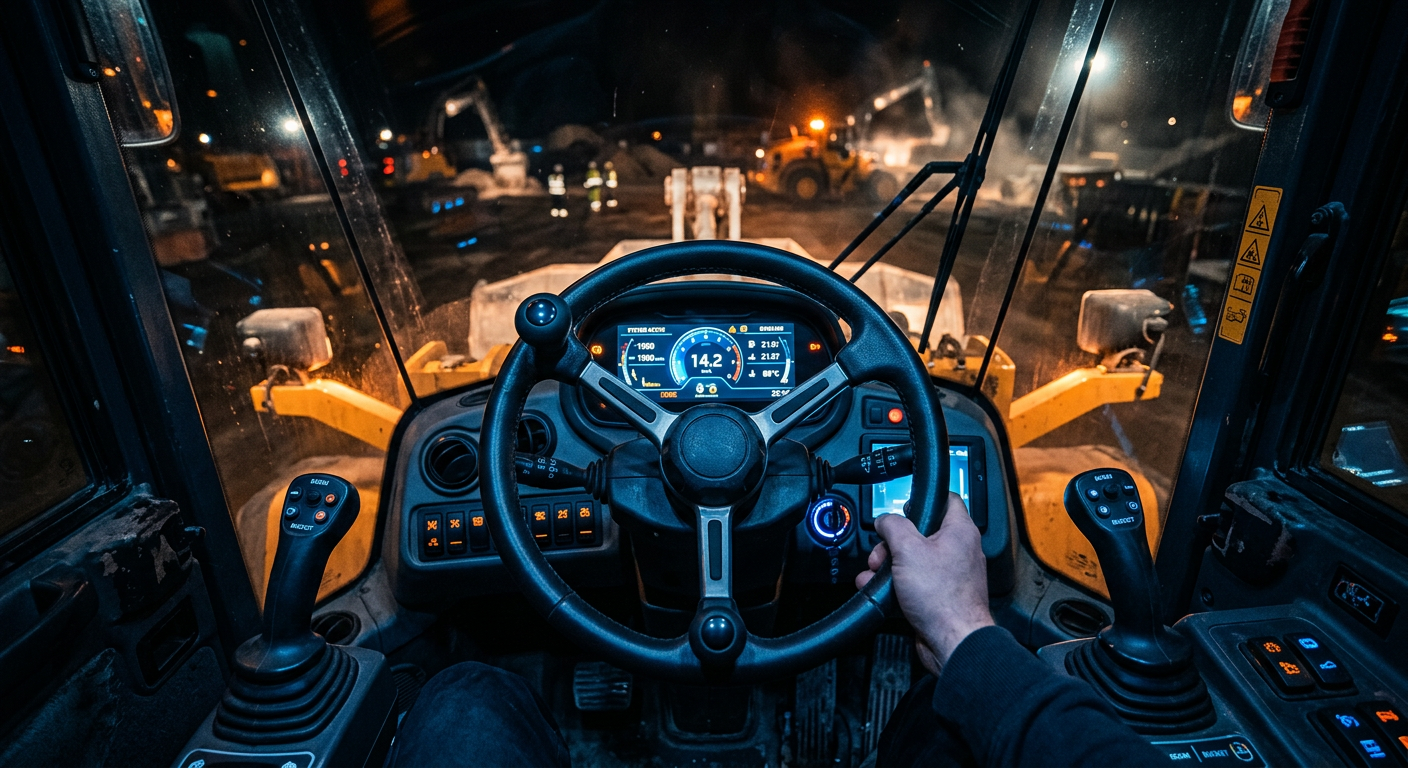
Steer-by-wire eliminates the mechanical and hydraulic linkage between the steering wheel and the wheels or articulation joint. Instead, the operator turns a steering wheel connected to sensors and a force-feedback motor. Those electronic signals tell valves how to direct hydraulic flow to the steering cylinders. The machine steers. The operator feels resistance through the wheel via programmed force feedback. But there’s no physical column, no orbital valve, no direct mechanical connection.
If that sounds like how a modern car works, you’re on the right track. Passenger vehicles have been moving toward steer-by-wire for years. But off-highway equipment has been slower to adopt it, and for good reason: the consequences of a steering failure on a 40-ton wheel loader are different from a steering failure on a sedan doing 35 mph in a suburb.
That’s the problem GenSteer is designed to solve. Most steer-by-wire approaches rely on redundant electronics — if the primary system fails, a backup takes over. Husco took a different path. GenSteer uses the operator’s physical input as the fail-functional power source. If the electronics fault, the system transitions seamlessly to operator-powered control. No lag, no loss of steering, no emergency shutdown. The operator might notice the wheel gets heavier, but the machine keeps going where they point it.
That fail-functional approach means fewer components overall. No redundant ECUs, no backup power supplies for the steering system. Husco says GenSteer fits standard machine envelopes for existing hydraulic steering systems, which means OEMs can integrate it without redesigning their frames or compartments.
Why OEMs Care
The pitch to equipment manufacturers goes beyond just replacing a steering column with electronics. GenSteer is a software-defined platform, which means features can be added, tuned, or updated without changing hardware.
Lane guidance for graders. Return-to-center for loaders working in tight spaces. Haptic feedback that pushes back on the operator’s hands when the machine approaches a boundary or another piece of equipment. Variable steering ratios that change based on speed or working mode. All of these are software features that the same hardware can deliver.
For OEMs thinking about autonomy, steer-by-wire is a prerequisite. You can’t build an autonomous loader if the steering still requires a mechanical column with a human attached to it. GenSteer gives OEMs a path from manual operation to assisted steering to full autonomy using the same base platform. Start with a conventional machine, add lane guidance via software update, progress to supervised autonomy as the technology and regulations mature.
Husco says GenSteer delivers this at roughly the same cost as a current orbital steering system plus automation electronics. That’s the kind of claim that gets purchasing departments to return phone calls.
The system is designed for loaders, haulers, tractors, graders, combines, and other wheeled equipment across construction, agriculture, mining, and material handling. The first OEM integrations are in progress, though Husco hasn’t publicly named which manufacturers will be first to market with GenSteer-equipped machines.
The CONEXPO Moment
CONEXPO-CON/AGG 2026 drew over 140,000 people and more than 2,000 exhibitors. The Next Level Awards program received over 230 submissions. A panel of judges narrowed that to 20 finalists in equipment and technology categories, and then show attendees voted for their favorites.
GenSteer won Contractors’ Choice for best equipment. That’s notable because contractors — the people who actually run machines every day — picked a steering system component over finished machines, attachments, and other more visible products. They understood what steer-by-wire means for their day-to-day operations: smoother control, less fatigue, programmable feel, and a path toward features that make their jobs easier and their equipment more productive.
The technology category went to Gravis Robotics for the Gravis Rack, an autonomous machine control platform. Both winners point toward the same trend: the construction industry is getting serious about intelligent machine control, and the companies building the foundational technology for it are getting recognized.
The Bigger Picture
Husco sits at an interesting point in the equipment industry supply chain. They’re big enough to invest in serious R&D — $500 million in revenue and 1,500 employees is not a small operation. But they’re not an OEM. They don’t build finished machines. They sell to the companies that do.
That positioning has advantages. Husco doesn’t compete with its customers. A wheel loader manufacturer buying GenSteer from Husco isn’t giving market share to a rival. They’re buying a best-in-class component from a specialist, the same way they buy transmissions from ZF or engines from Cummins.
The Ramirez family ownership means Husco can play the long game in ways that publicly traded component suppliers can’t. When you’re investing in technology that won’t hit production volumes for three to five years, having patient capital matters.
And the broader market is moving in Husco’s direction. Infrastructure spending is driving equipment sales. Labor shortages are pushing OEMs toward automation and operator-assist features. Environmental regulations favor more efficient hydraulic systems with electronic control. Every one of these trends benefits a company that builds the smart hydraulic and electro-mechanical components that make modern equipment work.
From Waukesha to the World
Husco’s global footprint — with facilities in the U.S., U.K., China, India, Brazil, and Germany — reflects the reality that equipment OEMs build machines on every continent and expect their suppliers to deliver everywhere. Having manufacturing in multiple regions also provides supply chain resilience, which has become a major priority since 2020 taught everyone what happens when a single-source supply chain breaks.
In January 2026, Husco named Tom Hunter as the new President of the Off-Highway Division, signaling fresh leadership for the division responsible for GenSteer and the company’s core construction and agriculture products. The timing, just ahead of CONEXPO, suggests Husco is gearing up for a growth phase as steer-by-wire moves from prototype to production.
The company has also been on a hiring push. In late 2024, Husco announced plans to hire 250 workers on the back of new contracts with U.S. and global automakers and suppliers. Their automotive division builds active body control systems and cam phasing valves, meaning Husco’s engineering talent works across both on-road and off-road applications — cross-pollination that accelerates development in both sectors.
Why It Matters
The equipment industry tends to celebrate the machines — the biggest excavator, the fastest loader, the toughest dozer. But the companies that build the components inside those machines are often where the real innovation happens. Husco has been doing that for 80 years from Waukesha, Wisconsin, owned by the same family, building technology that most operators will never see and wouldn’t recognize if they did.
GenSteer changes that equation a bit. Steer-by-wire is the kind of technology operators will feel every time they turn the wheel. And if Husco is right about the platform’s potential, it could be one of the foundational technologies that takes construction equipment from “machines with computers” to genuinely intelligent tools.
The contractors at CONEXPO seem to think so. They gave it their top award.
For more information, visit husco.com.