John Deere Lays Off 610 Midwest Workers as Production Moves to Mexico
While Deere posts billions in profit and raises its 2026 forecast, 610 production workers in Iowa and Illinois got pink slips. Their jobs are heading south of the border.
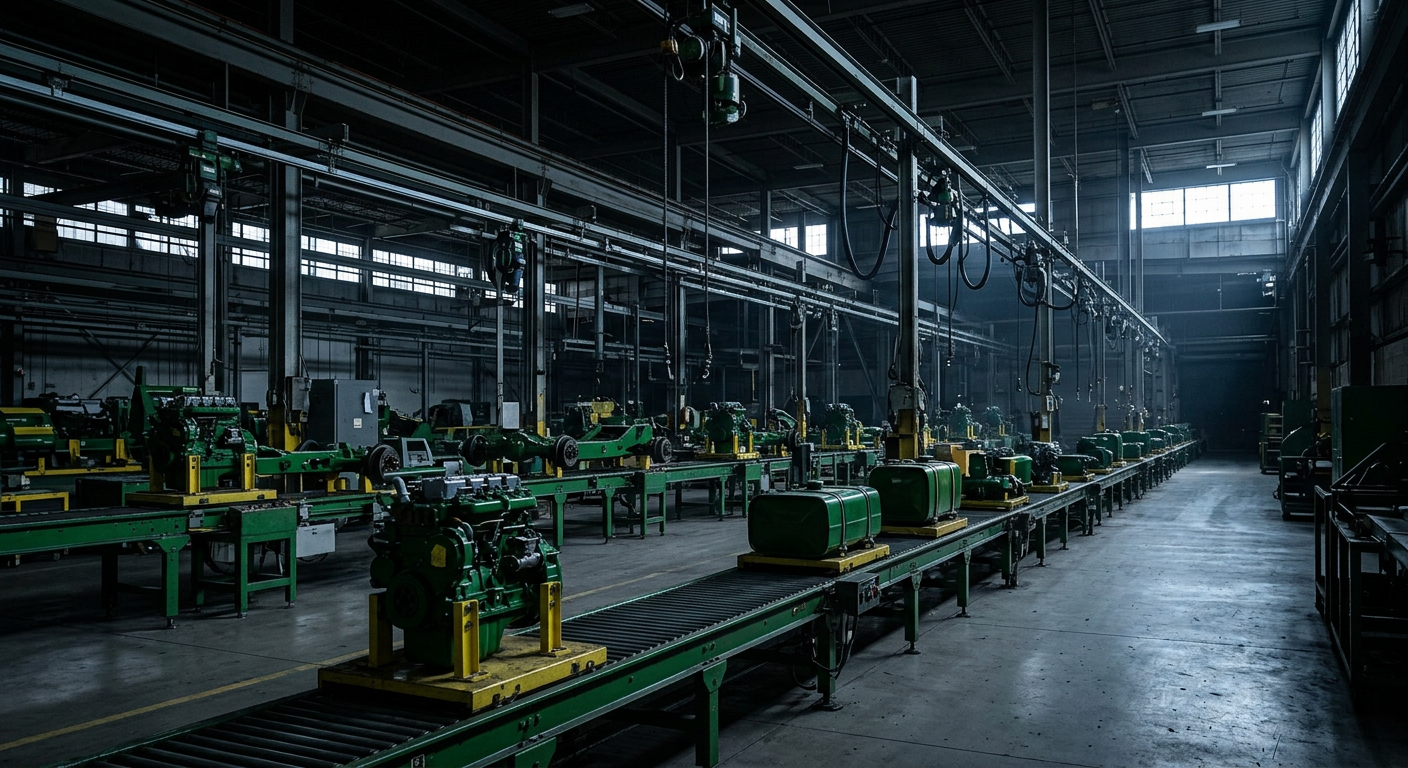
If you work in a John Deere plant in the Midwest, the last two years have been a masterclass in corporate doublespeak. The company tells you it’s “committed to U.S. manufacturing.” Then it hands you a layoff notice and ships your production line to Mexico.
The numbers
In late June 2024, Deere cut approximately 610 production workers across three facilities in Illinois and Iowa. The breakdown: 280 at East Moline, Illinois. 230 at Davenport, Iowa. About 100 at the Dubuque, Iowa plant.
Those weren’t the first cuts, and they sure as hell weren’t the last.
Since January 2024 alone, Deere had already laid off 650 workers between central and eastern Iowa locations before the 610 hit. Then in August 2025, another 238 went — 115 at Harvester Works in East Moline, 52 at the Seeding and Cylinder facility in Moline, and 71 at the Waterloo foundry.
September 2025 brought 141 more: 101 in Waterloo, 40 in Des Moines.
Add it up. More than 3,500 Deere employees have lost their jobs between October 2023 and September 2025. That’s not a restructuring. That’s an evacuation.
Where the work is going
Here’s the part that stings: while Midwest families figure out their next move, Deere is building — just not where those families live.
The company is relocating mid-frame skid steer loader and compact track loader production from its Dubuque Works facility to a new plant in Ramos Arizpe, Mexico. That facility is expected to be operational by the end of 2026.
On top of that, Deere is investing $55 million in a brand-new plant in Nuevo León, Mexico, dedicated exclusively to manufacturing mini track loaders and mini wheel loaders for the construction sector.
The official line? “Optimizing manufacturing efficiency” and “addressing rising operational costs.” Translation: labor is cheaper across the border, and nobody in Monterrey is going to complain about it.
The profit problem
This might be easier to swallow if Deere were struggling. They’re not.
The company raised its full-year 2026 profit forecast to between $4.5 billion and $5.0 billion. That’s not a company fighting for survival. That’s a company deciding where it wants to make money and who it wants to make it with.
Deere declared a quarterly dividend of $1.62 per share. Shareholders are doing fine. The people who bolted skid steers together in Dubuque for 20 years? They got a severance package and a pamphlet about supplemental unemployment benefits.
The token callback
In February 2026, Deere announced it was bringing back 99 workers to eastern Iowa construction and forestry facilities — 75 at Davenport Works, 25 at Dubuque Works.
Ninety-nine.
Out of more than 3,500 cut. That’s a 2.8% callback rate. It’s not a recovery. It’s a press release.
The political theater
This isn’t happening in a vacuum. During the 2024 campaign, Donald Trump threatened to impose a 200% tariff on Deere equipment manufactured in Mexico if the company went through with its production shift.
That threat got a lot of applause. What it didn’t get was follow-through. The Mexico plants are being built. The Iowa jobs are leaving. The tariff talk moved on to steel and aluminum — which, ironically, is making it even more expensive to manufacture equipment domestically, giving companies like Deere more justification to move production offshore.
What this means for the equipment market
If you’re a Deere customer, your skid steer will probably still show up green and yellow. The nameplate won’t say “Made in Mexico” in bigger letters. The dealer experience probably won’t change overnight.
But the supply chain is shifting under your feet. When production moves to a new facility, there’s always a transition period — new workers, new processes, new quality control baselines. If you’re spec’ing machines in late 2026 or early 2027, pay attention to build quality on compact equipment. Transition periods have a way of showing up in warranty claims.
Editor’s Note: Knowing your true cost per machine hour matters more than ever when equipment costs shift. FieldFix tracks maintenance, fuel, and expenses against actual hours — so your bids reflect reality, not guesswork. Free for up to 3 machines.
For the broader market, this is the same trend we’ve been watching across every major OEM. Manufacturing goes where labor costs less. The PR department says “optimization.” The workers who built the brand say something less polished.
The bottom line
John Deere isn’t broken. It’s making a calculated decision to prioritize margins over the Midwest workforce that helped build the company into a $150+ billion enterprise. That’s their right. It’s a publicly traded company answering to shareholders.
But let’s not pretend it’s anything other than what it is: 3,500 Americans lost their jobs so the stock price could tick up another point. The machines will get built. They’ll just get built somewhere else.
That’s the story. No amount of green paint changes it.