Volvo Kills Rokbak. Now the ADT Market Gets Interesting.
The closure of Rokbak's Motherwell factory marks the end of a Scottish hauling legacy — and the beginning of a new chapter in articulated dump truck competition. Here's what it means for the market, for fleet owners, and for the brands fighting over Rokbak's share.
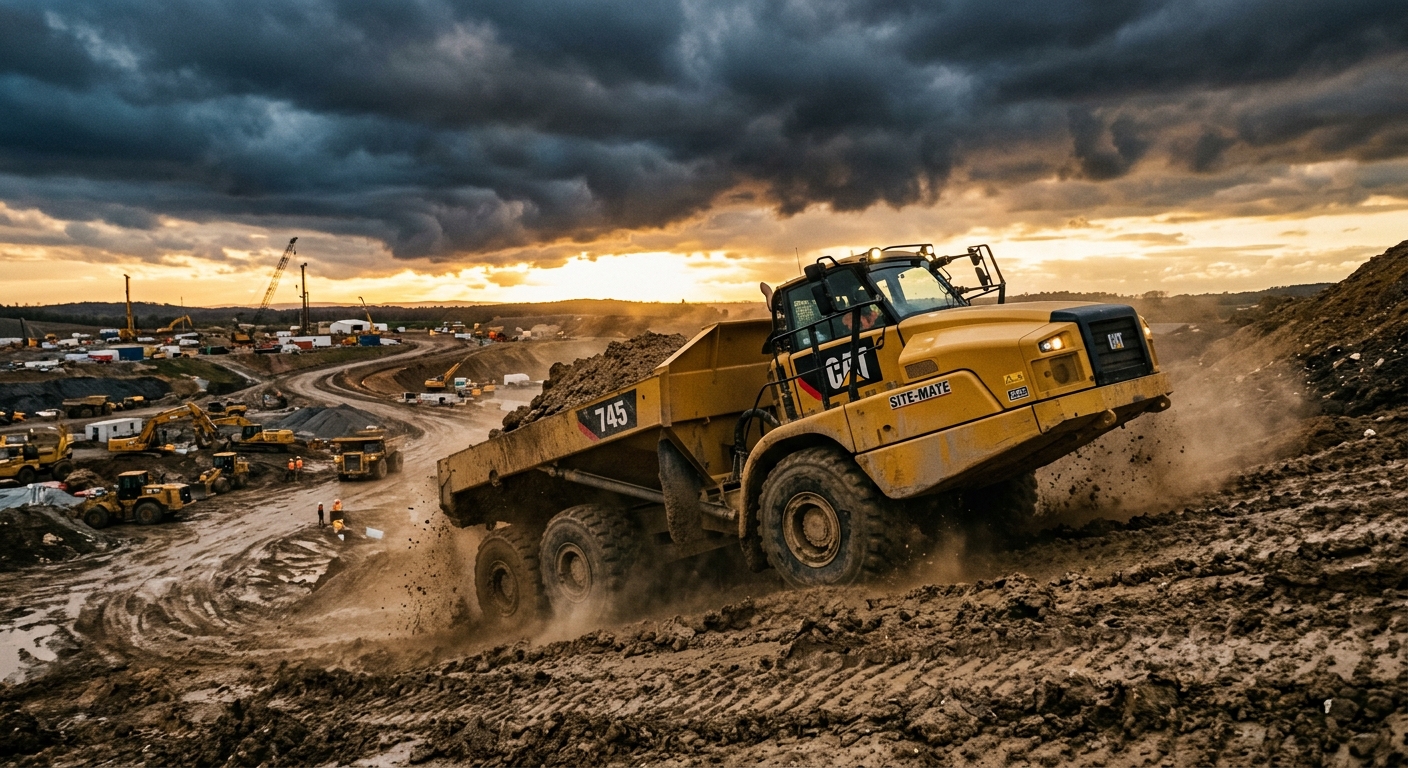
Rokbak is done. Volvo Construction Equipment confirmed in March that it’s shutting down the Rokbak articulated hauler business, ending production at the Motherwell, Scotland factory that has been building dump trucks since 1934. Production is expected to stop in the second half of 2026, pending completion of a collective consultation process with employees.
The financial picture made the decision almost inevitable. Rokbak posted sales of approximately SEK 1.0 billion in 2025 and was loss-making. Volvo CE is taking a SEK 0.7 billion hit to operating income in Q1 2026 to cover the closure costs. Rising operational and supply chain expenses, compounded by the escalating impact of U.S. tariffs on imported equipment, created a financial position that Volvo’s leadership deemed unsustainable.
For the broader construction equipment industry, this isn’t just a brand disappearing. It’s a signal about what happens when cost pressures, trade policy, and strategic prioritization collide — and it’s reshaping the articulated dump truck market in real time.
The End of a Legacy
The Motherwell factory has a lineage that runs deeper than most people in the industry realize. The facility produced haulers under the Euclid name, then as Terex Trucks after Volvo sold the brand to Terex in 2014. When Volvo reacquired the business in 2014 and rebranded it as Rokbak in 2021, the goal was to carve out a distinct identity for a two-model ADT lineup — the RA30 (28 tons) and RA40 (38 tons) — that competed on reliability, simplicity, and operator-friendliness rather than trying to match the full-line OEMs on technology or range.
That positioning worked for a while. Rokbak machines earned a loyal following among operators who valued their straightforward design and solid performance in demanding conditions. But in a market where Caterpillar offers twelve ADT models and Volvo’s own CE division was simultaneously investing in next-generation haulers like the A50 and the updated A60, Rokbak’s two-model portfolio became increasingly difficult to justify as a standalone brand.
The closure doesn’t mean Volvo is leaving the hauling business. Far from it. Volvo CE is redirecting resources toward its own articulated hauler lineup and expanding into rigid haulers, where it sees stronger growth potential in mining and large-scale earthmoving. The company has explicitly stated that closing Rokbak enables it to concentrate resources on advancing other hauling solutions.
What Killed Rokbak
Three forces converged to make this closure unavoidable.
Tariff exposure was the accelerant. U.S. tariffs on imported equipment have been tightening since 2025, and for a Scottish-manufactured product shipping into the North American market, the math got progressively worse. Every RA30 and RA40 crossing the Atlantic carried a cost burden that domestically produced competitors didn’t face. When your two biggest competitors in the U.S. market — Caterpillar and John Deere — are building machines domestically, tariff exposure becomes an existential disadvantage, not just a margin squeeze.
Scale economics worked against the brand. Rokbak was a two-model operation competing against full-line manufacturers that could spread R&D, manufacturing, and dealer network costs across dozens of machine categories. Caterpillar’s ADT business is a line item within a product portfolio that spans mining trucks, excavators, dozers, loaders, and everything in between. Rokbak’s entire existence depended on the commercial viability of two machines. When volumes dip even modestly, the fixed-cost burden becomes crushing.
Volvo’s internal competition sealed the deal. This is the part that doesn’t get discussed enough. Volvo CE was running two separate hauler brands — Rokbak and its own Volvo-badged articulated trucks — that competed in overlapping segments. The Volvo A30 and Rokbak RA30 were essentially competing for the same customer in the same payload class. When Volvo launched its completely overhauled ADT lineup, including the new A50 with a 50-ton payload and 8% better fuel efficiency, the strategic rationale for maintaining a separate, smaller brand evaporated.
The ADT Market Without Rokbak
The articulated dump truck market in the U.S. is a roughly $7.5 billion global segment, and Rokbak held a modest but meaningful slice of it. Last year, approximately 1,898 new financed ADTs were sold in the U.S. market. Caterpillar led with about 30% market share, followed by Volvo CE at 28%, Komatsu at roughly 13%, and Deere at about 12%. Rokbak’s share, while smaller, represented real machines on real jobsites that now need a succession plan.
The brands best positioned to absorb Rokbak’s former customers are the ones that can match its value proposition — reliable, no-nonsense haulers at competitive price points — while offering the dealer support and parts availability that Rokbak customers are about to lose.
Caterpillar is the obvious beneficiary. With twelve ADT models spanning 23 to 46 tons, Cat has a machine for virtually every application that a Rokbak RA30 or RA40 served. The company’s domestic manufacturing footprint eliminates the tariff disadvantage, and its dealer network is unmatched in North America. For fleet managers who need to replace Rokbak machines, Cat is the path of least resistance.
Bell Equipment deserves close attention. The South African manufacturer has been steadily building its North American presence and offers seven E-Series ADT models, with the B45E as its flagship at 41 metric tons. Bell’s reputation for building purpose-built ADTs — it’s one of the few manufacturers where articulated haulers are the core business rather than a product line extension — positions it well to capture customers who valued Rokbak’s hauler-specialist identity.
John Deere has four ADT models ranging from 26 to 46 tons and the dealer network to support aggressive pursuit of former Rokbak accounts. Deere’s strength is in the mid-range payloads where the RA30 competed, and the company’s brand loyalty among construction contractors runs deep.
Komatsu rounds out the major contenders with its HM-series articulated trucks, backed by strong dealer support and a growing technology platform that includes fleet management integration.
What Rokbak Owners Should Do Now
If you’re running Rokbak machines in your fleet, the closure doesn’t mean your equipment becomes worthless overnight. But it does mean you need to start planning now.
Parts availability. Volvo has committed to maintaining a core Rokbak team for aftermarket support, including parts sales, technical support, and training. That commitment is real, but history shows that aftermarket support for discontinued brands tends to degrade over time. The immediate supply will be fine. Five years out, you may be sourcing critical components from aftermarket suppliers and rebuilders rather than OEM channels. Start documenting every part number and service interval for your Rokbak machines now, while the institutional knowledge still exists.
Residual values are going to take a hit. There’s no way around this. A discontinued brand with a shrinking support network commands lower resale prices than an active one. If you were planning to trade in your Rokbak haulers in the next 12-18 months, the window for getting reasonable value is closing. Wait two years and the discount will steepen. The smart move is to run a total cost of ownership analysis now — factor in the declining residual value against the cost of replacement — and make a data-driven decision about your fleet transition timeline.
Negotiate from strength. Every major ADT manufacturer knows that Rokbak customers are in play. That means you have leverage. If you’re evaluating replacements, get quotes from multiple brands, make it clear that you’re a Rokbak conversion opportunity, and push for favorable pricing, extended warranties, or service agreements. Manufacturers and dealers are motivated to capture these accounts, and the contractors who negotiate aggressively will get the best deals.
The Bigger Picture
Rokbak’s closure is a data point in a larger pattern. The construction equipment industry is entering a period where mid-tier brands face existential pressure from multiple directions simultaneously. R&D costs for electrification and autonomy are rising. Trade barriers are increasing manufacturing cost complexity. And the major OEMs are investing billions in next-generation technology that smaller competitors simply cannot match.
The CNH Industrial restructuring that has dominated headlines in early 2026 is another manifestation of the same forces. When a company the size of CNH is evaluating partnerships and divestitures to optimize its construction equipment business, it tells you something about the scale required to compete effectively in this market going forward.
For contractors, the takeaway is straightforward but important: brand loyalty is a luxury that depends on the brand’s continued viability. The equipment you buy today needs to be supported for 15-20 years of useful life. When evaluating your next ADT purchase, the manufacturer’s long-term strategic commitment to the product category matters as much as the spec sheet.
Rokbak built good machines. The operators who ran them will tell you that. But good machines weren’t enough to overcome the structural disadvantages of limited scale, tariff exposure, and internal brand competition. In 2026, the ADT market belongs to the manufacturers who can combine product quality with the financial and strategic muscle to sustain it.
The question isn’t whether other brands will face the same pressures. They will. The question is which ones are positioned to survive them.