
Komatsu's Malwa Acquisition Is a Bet That Forestry's Future Is Smaller, Not Bigger
Komatsu Forest closed on Sweden's Malwa Forest AB on April 1. The deal lands lightweight, sub-2-meter cut-to-length harvesters and forwarders into Komatsu's lineup at exactly the moment thinning, fuel-load reduction, and soil-impact rules are reshaping where forestry contractors actually make money.
While the rest of the heavy-equipment world spent April watching CTL horsepower numbers creep up, Komatsu quietly closed on something that points the other direction.
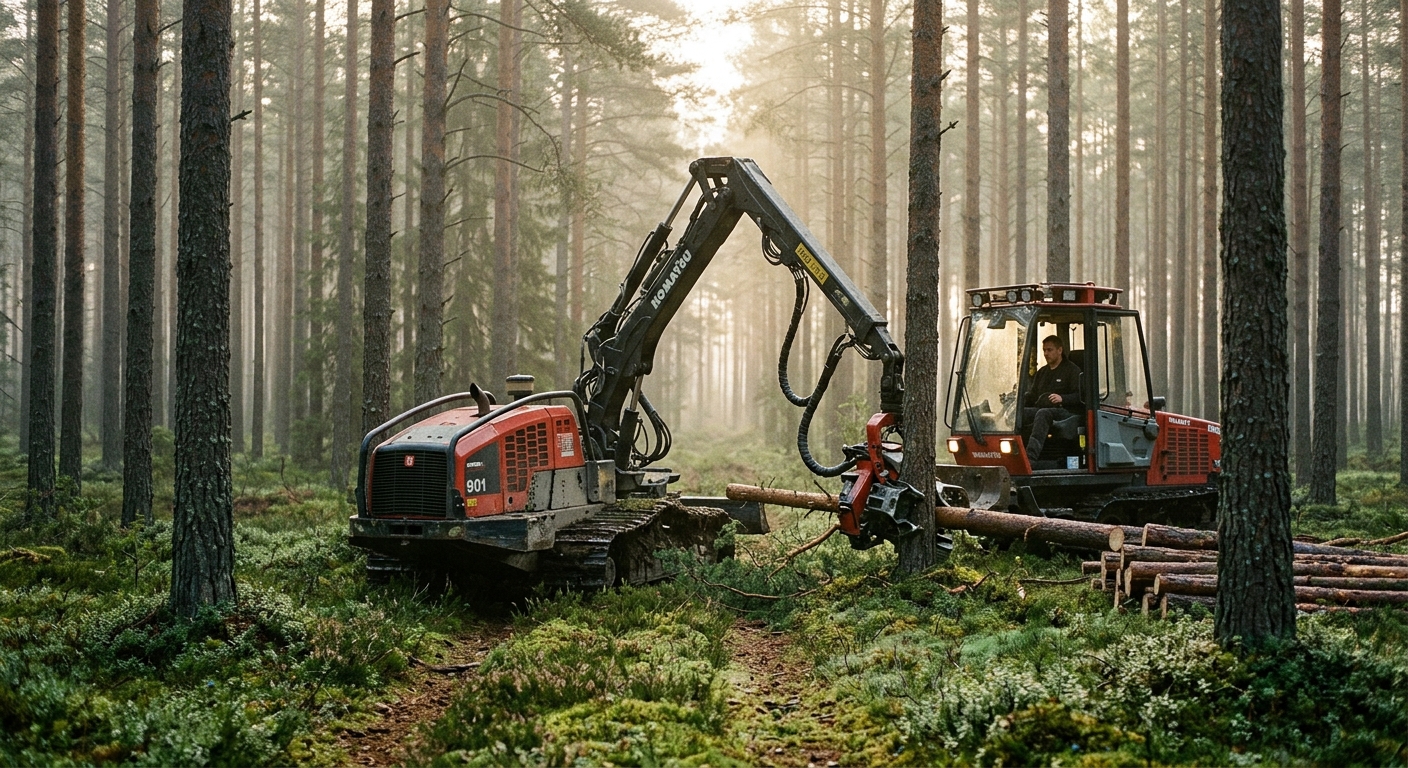
On April 1, 2026, Komatsu Forest AB finalized its acquisition of Malwa Forest AB, a small Swedish manufacturer based in Hyssna that has spent the last decade and a half building deliberately tiny cut-to-length forestry machines. Weight class around 5,400 kilograms. Width around two meters. Engine output measured in two-digit horsepower instead of three. The kind of machines that can drive between standing trees inside a sensitive stand without leaving a rut you can fall into.
That is not the direction most of the industry has been pointing. The center of gravity in forestry, construction, and even agriculture has been creeping upward — bigger carriers, bigger heads, more hydraulic flow, more horsepower for bigger attachments. Komatsu just went the other way on purpose.
It is worth thinking about why.
FieldFix Editor’s Note: Forestry economics live or die on uptime, and the math gets uglier the smaller the machine. A compact harvester that goes down in a sensitive stand is harder to recover, harder to swap out, and more expensive per scheduled hour than its size suggests. FieldFix gives small forestry fleets a clean way to track service intervals, downtime cost, and per-hour economics across compact harvesters, forwarders, and CTL combo units.
What Komatsu actually bought
Malwa is not a household name in North America, but it is well known in Scandinavia and increasingly in Quebec. The company was founded in 2009 and built its reputation around a narrow product range — small CTL machines designed specifically for thinning and selective cuts in sensitive terrain.
The current lineup includes the 560H Harvester, the 560F Forwarder, the 560C Combi (a single base machine that can be converted between harvester and forwarder modes in roughly twenty minutes), and the larger 980 Harvester. The 560H runs a Caterpillar C2.8 producing about 75 horsepower and pairs with a Log Max 2000T head capable of handling stems up to about 41 cm in diameter. The 560F forwarder hauls 5.5 tonnes solo, or up to 9 tonnes with a trailer.
Those numbers sound modest by North American logging standards. They are. That is the whole point.
The 560-series machines are roughly two meters wide, which is small enough to enter pre-commercial and first-thinning stands without taking out residual trees on the way in. The base weight of around 5,400 kg keeps ground pressure low enough that the machines can work boggy or sensitive sites year-round. With tracks on the bogie, ground pressure drops further. None of that matters on a clear-cut. All of it matters when the contract requires you to leave a residual stand standing, undamaged, on soils that will compact if you breathe on them wrong.
The deal also gives Komatsu a published roadmap. Malwa has been showing concept work like the 560.5T forwarder/processor combo, which suggests the platform is not done evolving. That kind of in-progress concept pipeline is part of what a strategic acquirer pays for. You are not just buying the machines on the floor today.
According to Komatsu’s official announcement, the financial impact on consolidated business results is expected to be minimal, which fits the profile of a strategic tuck-in rather than a transformative deal.
The thinning market is not small anymore
Forestry contractors who only watch the big iron tend to underestimate how much of the work has shifted toward thinning, fuel-load reduction, and selective harvesting.
According to Mordor Intelligence, the forestry machinery market is projected to grow from USD 12.54 billion in 2026 to USD 15.66 billion by 2031 at a 4.54% CAGR, with the analyst commentary calling out specifically that “forestry emphasizes low-impact tracks, tethered systems, and certified chain-of-custody, with electrified compacts and hybrid auxiliaries gaining traction where emissions and noise limits bite.”
Translated out of analyst-speak: the buyer mix is shifting. The customer who used to be a large industrial logger running big eight-wheel forwarders on flat ground is still there, but the growth on the margin is increasingly contractors who are doing thinning work, working under stricter soil-impact rules, working in habitat-protected areas, or working under certifications that audit residual stand damage and rutting.
In the United States, that buyer profile has another driver: wildfire fuel reduction. Federal and state forest restoration programs have been ramping up mechanical treatment dollars across the western states. The work is unglamorous — pre-commercial thinning, ladder-fuel reduction, brush removal, defensible-space treatments. It is also relentless. Every catastrophic fire season produces another political wave of money pointed at fuel reduction, and that money increasingly wants mechanized treatment with verifiable low-impact outcomes.
Big harvesters and big forwarders can do that work. They are usually the wrong tool. The economics break down when you are working in 4-to-8-inch stems, leaving residual trees standing, and getting paid by the acre rather than by the cord.
Why Komatsu is the right buyer here
Komatsu Forest already plays in the high-volume CTL market in a serious way. The brand’s larger harvesters and forwarders are familiar fixtures on industrial logging jobs in Sweden, Finland, the Pacific Northwest, the U.S. South, and across British Columbia and Quebec. The lineup runs deep at the upper end. It has not run very deep at the small end.
That is the gap Malwa fills.
According to Komatsu’s official statement, the strategic logic is “expanding value creation across the circular forestry process” — which is corporate-speak for “we want to sell you a machine for every part of the rotation, not just the production cuts.” Plant the seedlings. Pre-commercially thin them. First-thin and second-thin them. Final-harvest them. Site-prep the next rotation. That is the value chain Komatsu is now positioned to cover end-to-end with their own iron.
The dealer angle is also worth thinking about. Most Komatsu Forest dealers in North America already serve customers who are running thinning crews on the side — usually with a mix of older machines, third-party imports, or skid-steer-based mulching solutions. Now those dealers can sell Malwa-branded compact CTL machines without sending the customer to a competitor. Even if Malwa volume stays modest, the dealer-network effect is the kind of thing acquirers tend to underestimate at the time of a deal and then quietly enjoy for the next decade.
The competitive landscape
Komatsu is not the only OEM looking at this corner of the market. According to industry coverage, Logset Oy and Eco Log Sweden AB are gaining momentum in the Nordic region with compact harvesters engineered for maneuverability in rugged, uneven terrains. John Deere has been pushing operator-assistance features into its 900-series forestry machines. Ponsse continues to refine its smaller harvesters. Tigercat has its own compact strategy.
But the structural advantage here is that Malwa is not just compact for the sake of being compact. It was designed from a clean sheet to be a thinning specialist. The width is not the result of shrinking a bigger machine; it is the design constraint that the rest of the machine was engineered around. That is hard to replicate by simply scaling down an existing platform.
For competitors, the practical implication is that Komatsu now has a credible answer at the small end of the CTL market without having to do the multi-year R&D themselves. That changes the conversation in dealership showrooms. A contractor weighing a Logset compact harvester against a Komatsu/Malwa offering now gets to lean on Komatsu’s parts network, dealer footprint, financing, and brand familiarity — even if the underlying machine is technically a different lineage.
The North American question
The big open question is how aggressively Komatsu pushes Malwa into North America.
The Quebec market has already been a quiet success story for Malwa, where lightweight CTL machines have been adopted by contractors working on private woodlots and selective-harvest contracts. Forestnet has covered the spread of Swedish thinning equipment into Quebec forests in some detail. That is a small but proven foothold.
The U.S. market is harder to read. The dominant U.S. forestry contractor culture still leans toward feller-bunchers, skidders, and large-volume operations rather than CTL workflows. CTL has gained share, especially in the Lake States and the Northeast, but the small CTL niche where Malwa lives is even narrower in the U.S. than in Scandinavia or eastern Canada.
That said, the wildfire-driven fuel-reduction work in California, Oregon, Washington, Idaho, and Montana could reshape that math fairly quickly. The federal and state agencies cutting checks for mechanical fuel treatment are not all that picky about workflow style; they are picky about residual stand condition, soil disturbance, and verifiable acres treated per dollar. That is exactly the contract specification a Malwa-class machine is built to satisfy.
If Komatsu Forest’s North American dealers actually stock the small machines, train techs on them, and price them realistically against existing thinning solutions, there is a meaningful market. If the machines stay in Sweden and a few Quebec yards, the deal becomes a Nordic story with a North American footnote.
What contractors should actually take from this
For owner-operators and small fleet owners watching this deal from the outside, a few things are worth filing away.
First, the trend is real. Low-impact forestry equipment is not a press-release fad. Soil-impact rules, residual-stand-damage clauses, certification requirements, and fuel-reduction contracting are pulling the buyer mix toward smaller, narrower, lighter machines on the thinning side of the rotation. Komatsu just paid actual money to position itself for that shift, and Komatsu does not generally write checks on a hunch.
Second, the economics of compact CTL deserve real attention from anyone considering thinning work. The temptation is to use whatever is on the lot — a skid steer with a forestry head, an older harvester, or a piece of farm-tractor-derived gear. That can work, but the per-hour cost picture changes a lot when you spec the right tool. A purpose-built compact harvester that can stay productive in 4-to-12-inch stems without beating up the residual stand will eat the lunch of a repurposed solution over the course of a contract season.
Third, the dealer network is going to matter more than the spec sheet. Whether or not the Malwa platform succeeds in North America will probably hinge on how seriously Komatsu Forest dealers take the small-machine side of their business. Parts availability, trained techs, financing terms, and willingness to do warranty work in the field on machines that may sit in remote ranger-district contracts — those are the boring details that decide which compact CTL platform wins out.
Fourth, the broader signal here is worth respecting. When one of the largest construction- and forestry-equipment makers in the world spends real money to acquire a deliberately small, deliberately narrow, deliberately low-horsepower product line, that is not an accident. That is a read on where the work is heading.
The bottom line
Komatsu’s Malwa deal is small in dollar terms and modest in immediate revenue impact. It is not going to move the company’s quarterly results in any noticeable way.
It is also one of the more interesting structural moves the heavy-equipment industry has made in 2026, because it runs counter to the loud, horsepower-driven narrative coming out of CONEXPO and most of the OEM press releases. While other manufacturers are pushing CTL horsepower over 100, hydraulic flow toward 50 gpm, and operating weights into ever-heavier territory, Komatsu just paid to add a 5,400-kilogram, 75-horsepower, two-meter-wide forestry machine to its catalog.
That is not a contradiction. That is a hedge. The market is bifurcating, and the contractor of the next decade is going to have to decide which side of that split they are on — production-volume harvesting at scale, or specialty thinning, fuel reduction, and low-impact work at premium per-acre rates.
Komatsu just made sure it can sell a machine to either one.
Sources:
- Komatsu Newsroom — Komatsu to Acquire Malwa Forest AB
- Malwa Forest AB — Komatsu Forest to Acquire Malwa
- Heavy Equipment Guide — Komatsu to acquire Malwa Forest AB
- Forestry Journal — Komatsu to purchase Malwa as it eyes ‘low-impact’ market
- IVT International — Komatsu to acquire Swedish forestry machinery manufacturer Malwa Forest
- Mordor Intelligence — Forestry Machinery Market Report
- Forestnet — Swedish Thinning Equipment Finds a Home in Quebec Forests