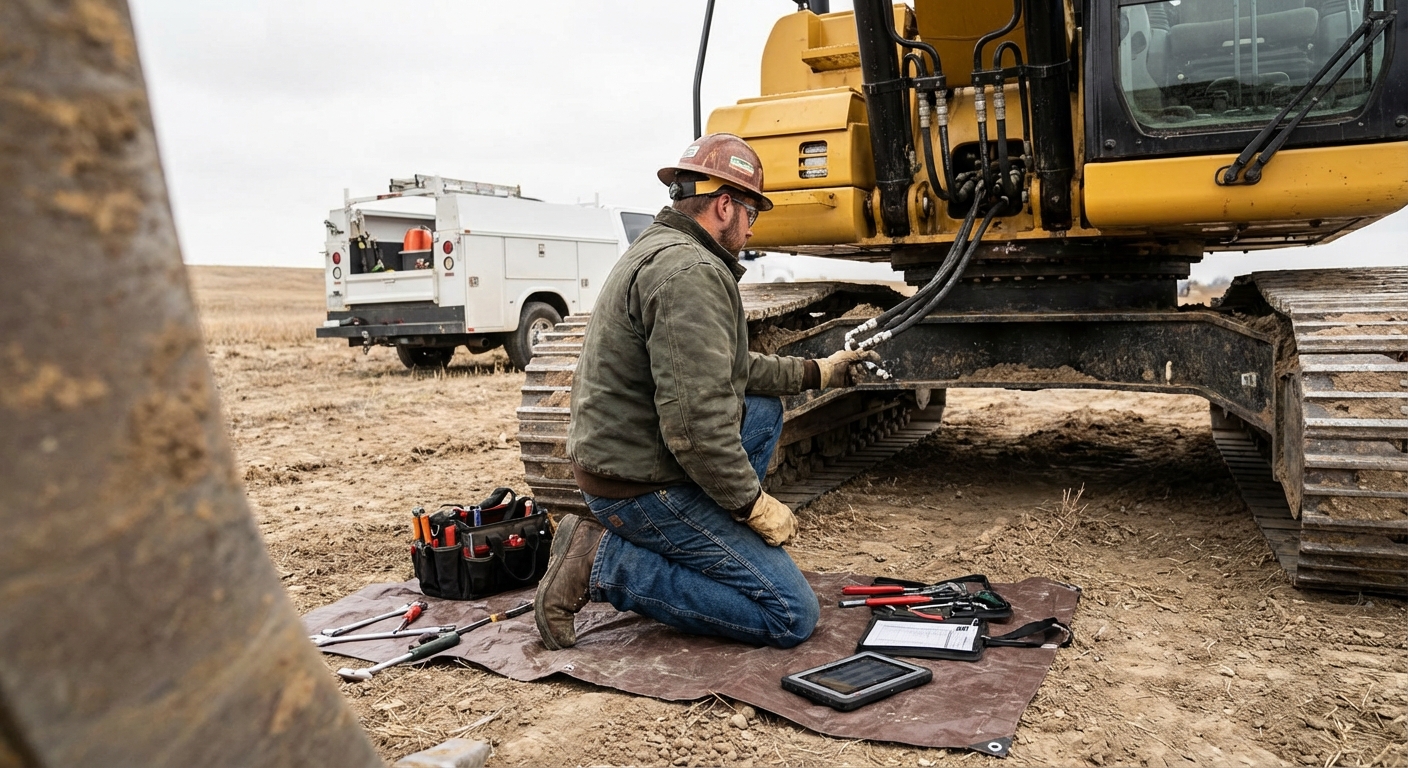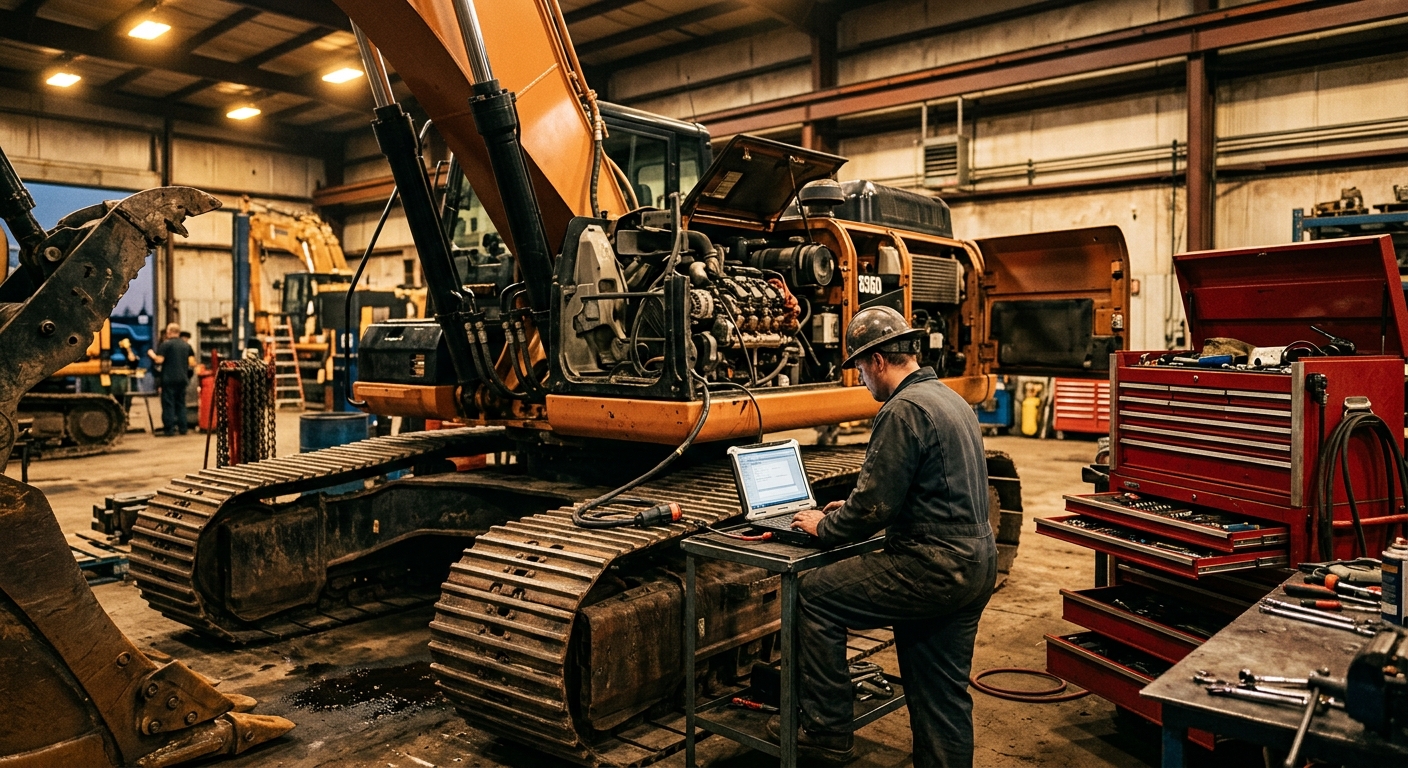

The Filter Story Nobody Talks About: How a $40 Cartridge Quietly Becomes a $40,000 Engine
Filters are the smallest line item in any maintenance budget and one of the biggest line items in any failure. Most operators know that. Most operators still get it wrong. Here is what the field keeps proving — and what the spec sheet won't tell you.
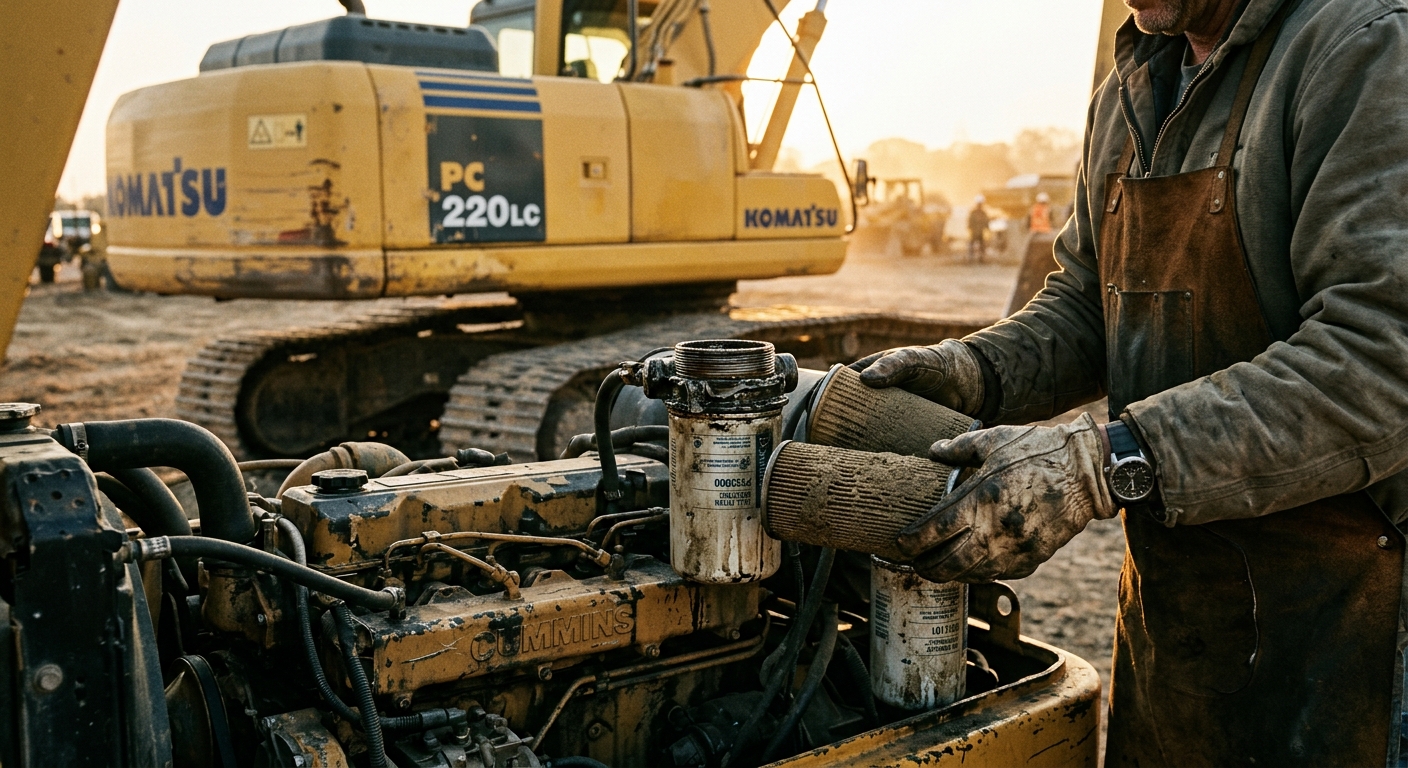
There is a strange contradiction in how the heavy equipment industry talks about filters. Every operator manual treats them as critical. Every dealer service writer talks about them as if they are routine. Every aftermarket parts catalog pretends they are commodities. And every catastrophic engine, hydraulic, or fuel-system failure that lands a machine on a hook seems to trace back, eventually, to a filter that did not do its job.
The filter is the cheapest part on the machine. It is also the part most likely to be the difference between a normal Tuesday and a $40,000 invoice. Operators who have run iron long enough know this in their gut. The newer crews coming up — the ones who never had a mentor walk them through a torn-down engine — do not. That gap is costing contractors more money every year than any line item on any quote sheet.
FieldFix Editor’s Note: Filter intervals look simple on a sticker and complicated in the field. Duty cycle, dust load, fuel quality, oil viscosity, and ambient conditions all move the right interval up or down. FieldFix tracks filter changes against hours and operating conditions so the next service is based on the machine you actually have, not the brochure version.
The price of a filter is not the cost of a filter
The retail price of a filter is a misleading number. A primary air filter for a mid-size skid steer might run thirty to sixty dollars. A fuel filter for a Tier 4 Final diesel might run sixty to a hundred. A hydraulic return filter for a compact excavator can be a hundred and fifty on the parts shelf and three hundred at the dealer counter. Add a couple of cartridges per service interval and a fleet of five machines, and the annual filter bill starts to look like real money. It is still nothing compared to what those filters are protecting.
A common-rail Tier 4 Final engine in a mid-size loader represents thirty to fifty thousand dollars in parts and labor on a full rebuild. The high-pressure fuel pump on that same engine is a five-figure replacement on its own. A hydraulic pump and motor on a forestry mulcher head is in the same ballpark. The DEF system, the EGR cooler, the turbocharger, the aftercooler, the injectors — every one of those components is downstream of a filter that is doing the hard work of keeping particulate, water, and contamination out of places they cannot survive.
The filter is not a maintenance item. It is insurance. Cheap insurance. And like most cheap insurance, it works perfectly until the day it does not, at which point the deductible turns out to be much larger than the premium.
Three filter failures the field keeps proving
There are three failure patterns the industry keeps seeing on machines that lose engines or hydraulic systems before their time. None of them are exotic. All of them are preventable. All of them are still happening every week.
The first is the missed interval. A machine runs five hundred hours past its scheduled service because the schedule lives in a binder in a glove box and the operator forgot, the supervisor is too busy, and the dealer’s reminder email went to an inbox nobody checks. The air filter loads up. The fuel filter clogs. The hydraulic filter goes into bypass and stops doing anything at all. Nothing dramatic happens for a while. Then a turbocharger eats a piece of debris, an injector loses its spray pattern, or a hydraulic pump starts polishing its own internals. By the time the machine flags a fault, the damage is done.
The second is the wrong filter. Aftermarket cross-references are not always perfect. A filter that looks like the right part number, fits the housing, and seals up cleanly can still have the wrong micron rating, the wrong bypass setting, the wrong media, or the wrong housing relief. Cheaper aftermarket filters often cut corners on the media itself — fewer pleats, lighter paper, less surface area, weaker bypass valves. The filter goes on. The machine runs. Nobody notices. Months later, an oil sample comes back ugly, or a component shows wear that should not be there for another two thousand hours.
The third is the silent install. A filter that was changed but not seated properly. A gasket that double-stacked. A fuel filter that was primed wrong. A hydraulic filter cap that was hand-tightened and never torqued. These mistakes are usually invisible. They show up as a slow leak that nobody traces, a pressure spike that does not get flagged, or a subtle drop in performance that the operator chalks up to a hot day. Until they show up as a major component failure six months later.
The Tier 4 Final problem most fleets underestimate
Newer engines are harder on filters than older engines were. That is not a manufacturer flaw. It is a consequence of the emissions architecture every OEM is now building around. Common-rail injection runs at extreme pressures — 25,000 to 35,000 psi on modern systems. At those pressures, a particle the size of a fine sand grain is no longer a nuisance. It is a projectile inside the injector body. The tolerances inside a modern injector are measured in microns. So is the contamination that destroys them.
That tightening of tolerances has moved the filter from a forgiving component to a non-negotiable one. A fuel filter on an older mechanical diesel could miss a service interval by a couple hundred hours without much consequence. A fuel filter on a Tier 4 Final common-rail engine that misses by the same margin can take out a set of injectors at five to seven thousand dollars apiece. Multiply that across a fleet, and the math gets brutal.
The same shift has happened on the hydraulic side. Pilot-controlled hydraulics, electronic load-sensing systems, and high-precision motors all demand cleaner oil than the systems of fifteen years ago. The acceptable particulate count has dropped substantially. A hydraulic system that ran fine on ISO 20/18/15 cleanliness in 2005 may require ISO 18/16/13 or cleaner today. Hitting that target depends on filter media, filter integrity, oil quality, and the discipline to actually change the filters at the right interval — not the convenient one.
What spec sheets do not tell you about filter strategy
Every OEM publishes a recommended service schedule. Those schedules assume an average duty cycle, average ambient conditions, average dust load, and average fuel quality. Most jobs are not average.
A forestry mulcher running ten-hour days in dry, dusty conditions, with a head that throws fine wood dust back across the cab and intake, is not going to last the recommended interval on a primary air filter. A compact track loader that runs a cold-planing attachment near asphalt fines and grit is going to load a hydraulic return filter faster than the chart says. A skid steer working off-road diesel from a contractor’s tank rather than a clean rack at a truck stop is going to overload the fuel-water separator at a different rate than the schedule predicts.
This is why the manufacturer’s interval is a starting point, not a contract. The real interval depends on what the machine is doing, where it is doing it, and what is going into the tank. Smart maintenance programs treat the OEM schedule as the longest acceptable interval and use oil samples, dust load, and operator observations to shorten it when conditions demand.
The cost of cutting an interval short is a few extra filters per year. The cost of stretching one too far is the part the filter was supposed to protect.
The operator habit that saves engines
There is a habit that experienced operators have and newer operators do not, and it is worth more than any telematics package on the market. Experienced operators look at filters during their walk-around. Not just to check that the filter is there. To actually look at it.
The condition of a removed filter tells a story. A primary air filter that comes out looking like it has been through a sandstorm tells you the machine is loading dust faster than the interval allows. A fuel filter with water in the bowl tells you the tank or the supply chain has a problem. A hydraulic filter element with metallic glitter on the media tells you something inside the system is wearing in a way it should not be. A used filter is a free diagnostic report. Most operators throw it in a trash bag without looking at it.
The same applies to the new filter going on. Is it the right part number? Is the gasket in place and free of damage? Is the housing clean? Is the seal seated, or is there an O-ring riding up out of the groove? Is the cartridge oriented correctly? These are thirty-second checks that prevent five-figure repairs.
Building this habit into a fleet is a culture problem more than a training problem. Most operators can be taught to look at a removed filter in a single conversation. Getting them to do it every time — and getting supervisors to ask about it — is the harder part. The fleets that do this consistently are the same fleets whose engines somehow last twenty percent longer than everyone else’s. It is not luck.
The math on doing it right
Run the numbers on a single mid-size machine. Assume two thousand hours a year. Assume a full service interval set every five hundred hours, plus a primary air filter check every two hundred and fifty. Annual filter cost on a typical compact loader or excavator works out to somewhere between four hundred and twelve hundred dollars, depending on the brand, the dealer, and how much of it is done at the aftermarket level.
Now run the numbers on one premature failure. A set of injectors on a Tier 4 Final engine. A high-pressure pump. A hydraulic main pump or motor. A turbocharger replaced before its time. Any one of those events is between six thousand and forty thousand dollars in parts and labor, plus a week or more of downtime on a machine that should have been earning money. One bad outcome erases ten years of filter savings in a single repair order.
The math is not subtle. The smartest dollar in a maintenance budget is the one spent on filters changed on time, sourced from a known supplier, installed correctly, and inspected on the way out. Everything else downstream depends on it.
The bottom line
Filters are not glamorous. They are not the part anyone wants to talk about. They do not get the trade-show floor space the new excavator or the new mulcher head gets. They are also the difference between a machine that earns its way through a decade and a machine that ends up on a hook with a torn-down engine in the back of a service truck.
The contractors who run iron well treat filter strategy as a serious line item, not an afterthought. They source from known suppliers. They change on the shorter side of the interval, not the longer one. They train their operators to look at the filter coming off as a diagnostic, not just a piece of trash. They keep records. And they spend the extra forty or eighty dollars on a quality cartridge instead of the cheapest one on the shelf.
That discipline is not exciting. It is just one of the small, repeatable habits that separates the fleets that make money on their iron from the fleets that fund the dealer’s repair bay. The cheapest part on the machine, taken seriously, protects the most expensive ones. That is the whole filter story.