OPINION: Fuel Prices Don't Matter as Much as You Think
Every operator panics when diesel spikes, but fuel is rarely in your top three cost drivers. Here's where your money actually goes — and what to worry about instead.
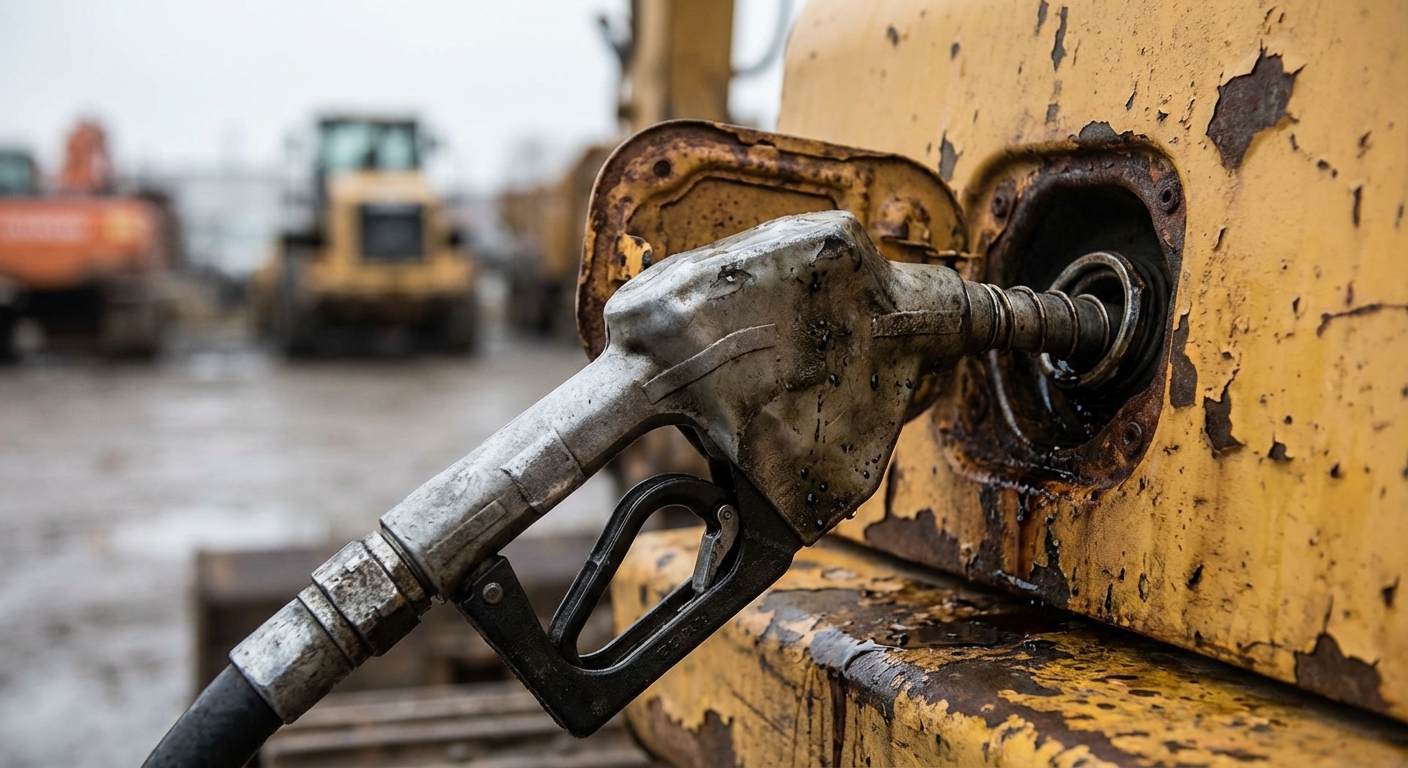
Every time diesel prices spike, my phone blows up.
“Are you adjusting your rates?” “How do you handle the fuel surcharge conversation?” “Man, these fuel prices are killing me.”
I get it. I really do. When you’re watching the pump tick past $500 to fill up your skid steer carrier, it feels catastrophic. Diesel at $4.50 a gallon hits different than diesel at $3.00. That pain is real.
But here’s what I’ve learned running a land clearing operation for the past several years: fuel is almost never the thing that actually makes or breaks my year. It’s not even close.
The operators who are struggling right now? Most of them aren’t struggling because of fuel. They’re struggling because they’re not tracking the costs that actually matter — and fuel is a convenient excuse because it’s visible, volatile, and completely out of their control.
Let me show you the math that changed how I think about this.
The Fuel Panic vs. The Actual Numbers
Last year, my company burned through roughly $48,000 in diesel. That sounds like a lot, right? It is a lot. Diesel is expensive.
But here’s my total operating cost breakdown for the year:
- Labor (wages, taxes, workers’ comp): $168,000
- Insurance (liability + equipment): $47,000
- Equipment payments and leases: $84,000
- Repairs and maintenance: $52,000
- Fuel: $48,000
- Everything else (admin, marketing, misc): $32,000
Fuel was my fifth largest expense. Fifth.
And here’s the thing — when fuel prices went from $3.20 to $4.10 last spring (a 28% increase), my annual fuel cost went up about $10,500. That’s real money.
But you know what else happened last year? My insurance renewed at 23% higher than the year before — that was $8,800 in new costs I didn’t have before. Parts prices increased across the board, adding probably $6,000 to my maintenance budget. I had to bump operator pay $2/hour to keep my best guy from jumping ship — that’s over $4,000 annually.
Fuel got more expensive, sure. But so did everything else. And when you stack them up, fuel is just one piece of a much bigger puzzle.
Why We Obsess Over Fuel (And Ignore the Real Killers)
Fuel prices are psychologically powerful for a few reasons:
It’s visible. You see the price on the sign every time you drive by a gas station. You feel the hit at the pump in real time. Insurance? That’s an annual gut punch. Parts? You don’t add them up until tax season.
It changes constantly. Fuel prices move daily. Your insurance premium is locked for 12 months. Variable costs feel more threatening than fixed ones, even when the fixed ones are larger.
It’s out of your control. OPEC, refineries, geopolitics — you can’t do anything about any of it. That helplessness creates anxiety. Meanwhile, you can control your labor costs, your maintenance program, your insurance shopping — so there’s less emotional charge around them.
Other operators talk about it. When you’re at the supply house or grabbing lunch after a job, everyone’s complaining about fuel. Nobody’s sitting around discussing their workers’ comp experience mod rate. The conversation reinforces the obsession.
But here’s the reality check: fuel costs are actually one of the easiest line items to manage, precisely because they scale directly with revenue. When you’re burning more fuel, it’s because you’re running more jobs. When you’re running more jobs, you’re billing more hours. Fuel is a variable cost tied to production — it goes up and down with your activity level.
Labor overhead, insurance premiums, and equipment payments don’t work that way. Those hit you whether you’re slammed with work or sitting idle.
The Costs That Actually Kill Small Operators
Let me tell you what I’ve watched take out operators in my market over the past few years. It wasn’t fuel prices.
Insurance. I wrote about this a couple weeks ago, but it bears repeating. I’ve watched operators get renewal quotes 40-60% higher than the prior year, with zero claims. When your insurance goes from $28,000 to $45,000 overnight, that’s not a “fuel surcharge conversation” — that’s an existential crisis.
One bad hire. A single operator who damages equipment, creates liability exposure, or just doesn’t produce makes a bigger dent in your year than any fuel price swing. I’ve done the math on one problematic employee I had years ago: between repairs, rework, customer credits, and the opportunity cost of jobs we couldn’t take — that mistake cost me over $30,000 in a single season. That’s more than a 40% fuel price increase would cost me.
Underpriced bids. Most operators lose more money to bad estimates than they’ll ever lose to fuel. Underbid a job by 15% on a $20,000 project and you just threw away $3,000. Do that three times in a season — which is easy if your estimating process is sloppy — and you’ve lost $9,000. That’s the equivalent of fuel going from $3.50 to $4.40 for the entire year.
Equipment downtime. A major repair that puts your primary machine down for two weeks during peak season is brutal. Not just the repair cost — which can easily hit $8,000-$15,000 for hydraulic or engine work — but the lost revenue. If you’re billing $400/hour and you’re down for 80 potential billing hours, that’s $32,000 in revenue you didn’t capture. Show me a fuel price increase that does that kind of damage.
Slow-paying customers. Net-60 terms on a $35,000 job mean you’re floating that money for two months. If you’re running on thin margins and your next equipment payment comes due before that check clears, you’re in trouble. Cash flow problems kill more businesses than fuel prices ever will.
The Fuel Surcharge Trap
Here’s where this gets practical.
I know operators who’ve built their entire pricing structure around fuel surcharges. They quote a base rate, then add a variable fuel adjustment based on the weekly diesel price.
In theory, this protects you from fuel volatility. In practice, it creates problems.
It makes your pricing confusing. Customers hate unpredictable invoices. When you quote $3,500 and the final invoice is $3,847 because fuel went up, they feel nickel-and-dimed — even if your math is perfectly reasonable.
It signals that you’re not accounting for your costs. Sophisticated customers — commercial property managers, general contractors, developers — will wonder what else you’re not building into your rates. Are they going to get hit with a “parts surcharge” next?
It keeps you focused on the wrong variable. Every hour you spend calculating fuel adjustments is an hour you’re not spending on the things that actually move your business forward.
Here’s what I do instead: I build a fuel buffer into my rates based on a reasonable assumption — let’s say $4.00/gallon diesel — and I revisit my rates twice a year. If fuel goes up 30%, I’m not panicking in real-time; I’m adjusting my rates at the next review cycle like a normal business. If fuel drops, my margins improve. Over a multi-year period, it averages out.
This approach is less precise but more sane. I’m not managing my business one tank of diesel at a time.
What You Should Actually Worry About
If you’re reading this and feeling defensive — “But fuel IS a huge part of my costs!” — I’d challenge you to run the numbers yourself. Pull your last 12 months of expenses and categorize them honestly.
But more importantly, here’s where I’d put my attention if I were a small operator trying to tighten up:
Insurance shopping. If you haven’t gotten competitive quotes in two years, you’re probably overpaying. A good broker who specializes in contractors can save you 15-20% with a phone call. On a $40,000 annual premium, that’s $6,000-$8,000 — more than most fuel spikes will cost you.
Labor efficiency. Are your operators actually billing 6+ hours per day, or are they burning time on mobilization, lunch runs, and unproductive setup? A 10% improvement in billable hours across your crew is massive.
Maintenance programs. Preventive maintenance is genuinely cheaper than reactive repairs. I know guys who “save money” by skipping filter changes and greasing schedules, then act surprised when they’re facing a $12,000 hydraulic pump rebuild. The math on this is not complicated.
Estimating accuracy. Track your actual vs. estimated hours for every job. If you’re consistently under-estimating by 15-20%, you’re leaving more money on the table than any fuel price swing will take from you.
Collections. How old is your A/R? If you’ve got receivables sitting at 60+ days, that’s money you’ve already earned that isn’t in your account. Tightening up your billing and collection process is free money.
None of this is as emotionally satisfying as blaming fuel prices. But all of it will have a bigger impact on your bottom line.
The Exception: Long-Haul and High-Travel Operations
I’ll be fair: there are business models where fuel really is a top-three cost driver. If you’re running a hotshot trucking operation, a long-haul moving company, or a traveling crew that mobilizes 200+ miles per job, fuel math is different. Your fuel-to-revenue ratio is fundamentally higher than mine.
But even then, I’d argue that fuel is a known variable you can plan around. Long-haul operators have dealt with fuel volatility for decades. The successful ones build it into their pricing and move on. The ones who panic every time prices spike are telling on themselves — it means they’re not actually running their numbers.
The Bottom Line
Here’s my honest take: fuel prices are a convenient scapegoat for operators who aren’t tracking their real costs.
When someone tells me fuel is killing their business, I hear one of two things: either they’re dramatically underpriced across the board (in which case fuel is just the visible symptom), or they’re not paying attention to the cost categories that actually determine profitability.
Fuel at $5.00/gallon would hurt. I’m not pretending it wouldn’t. But I know exactly what it would do to my margins because I’ve run the scenarios. Do you know what a 25% insurance increase, or one major equipment failure, or losing your best operator would do to your numbers?
Stop watching the diesel sign and start watching your P&L. That’s where the real answers are.
Alex Boyd runs a forestry mulching and land clearing company in Ohio. He’s also a contributing writer for Equipment Insider. Follow him on X @bprintco.