Bobcat Just Split Its Entire Loader Lineup in Two — Here's Why
Doosan Bobcat dropped 17 new skid steers and compact track loaders at CONEXPO 2026, killing the M-Series and R-Series names in favor of a new Classic vs. Pro structure. The Pro models get AI voice commands, radar-based safety systems, and automotive-style drive modes.
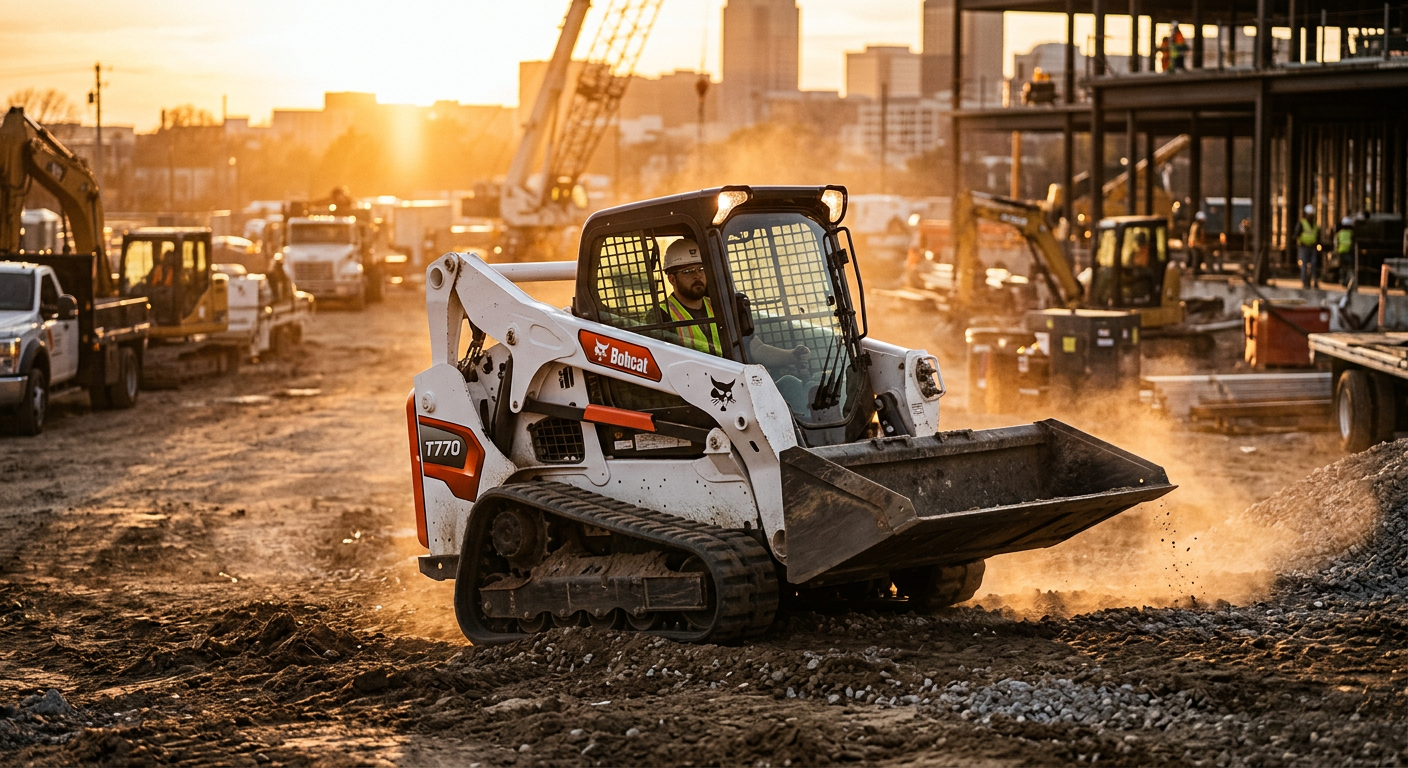
Doosan Bobcat used CONEXPO 2026 to do something unusual: launch 17 machines at once and scrap two product line names in the process.
The M-Series and R-Series are gone. In their place, Bobcat is splitting its skid steer and compact track loader lineup into two tiers — Classic and Pro. The Classic models replace the M-Series with familiar controls and competitive pricing. The Pro models replace the R-Series with a loaded tech stack that includes AI voice commands, radar-based collision avoidance, and four drive modes borrowed from the automotive world.
It’s the biggest single product announcement Bobcat has made in years, and it signals where the company thinks the compact equipment market is headed.
Editor’s Note: Running a fleet of skid steers and compact track loaders? FieldFix tracks maintenance schedules, cost-per-hour, and service history across your entire fleet — so you know exactly what each machine costs you. Free for up to 3 machines.
The Pro Lineup: AI in the Cab
The Pro side of the split gets nine models:
- Compact track loaders: T64-2, T66-2, T76-2, T86-2
- Skid steers: S64-2, S66-2, S76-2, S86-2
The “-2” suffix on each model number distinguishes Pro from Classic. Specs are shifting from the R-Series too — the flagship T86-2 and S86-2 get a bump to 115 horsepower (up from 110) and an extra foot of lift height, reaching 12 feet. Full specs haven’t been released yet, but the range spans 68 to 115 horsepower and roughly 7,000 to 11,500 pounds of operating weight.
The headline feature is Bobcat’s Jobsite Companion, an AI voice-command system that debuted as a concept at CES earlier this year. Operators press a button on the joystick and talk to the machine. The system can automate over 50 functions, optimize machine settings for specific attachments, pull up fault code explanations, and even track job costs against estimates in real time.
That last part is worth dwelling on. A compact track loader that can tell its operator whether a job is running over budget — while the operator is still running it — is a different kind of machine than what this segment has seen before.
Scott Johnson, Bobcat’s senior director of construction products, said operators can keep their hands on the controls the entire time. No touchscreen menus, no pulling out a phone. Just talk.
Drive Modes: Borrowed from Your Truck
The Pro models also get four drive modes, a concept Bobcat says is directly inspired by modern trucks and SUVs:
- Balanced — Smooth and predictable for grading, material placement, and tight spaces.
- Agile — The everyday mode for mixed tasks.
- Dynamic — Sharper acceleration and faster response for high-production work.
- Charged — Maximum speed and responsiveness for experienced operators in open areas.
This is a clear play for operator comfort and retention. The skilled labor shortage in construction hasn’t gone away, and making machines feel more intuitive — more like a vehicle operators already know how to drive — is one way to flatten the learning curve for newer workers.
Safety Tech That Actually Intervenes
The safety package on Pro models goes beyond cameras. Bobcat introduced three systems:
Bobcat View is a camera system offering rear-only or a wider view covering the rear and sides of the machine.
Rear Object Detection and Avoidance uses radar to detect people and objects behind the machine. When it picks something up, it can alert the operator — or automatically slow and stop the loader. This is active intervention, not just a warning.
360 People Detection uses cameras to identify people around the machine and alert the operator, though it doesn’t intervene in machine motion.
Active safety systems on compact equipment have been slow to arrive compared to larger machines. Bobcat putting radar-based auto-stop on a skid steer is a notable step. OSHA data consistently shows compact equipment among the most common machine types involved in struck-by incidents on job sites. If the system works as described, it addresses a real problem.
The Classic Lineup: Built for Simplicity
The Classic side is eight models that replace the aging M-Series:
- Compact track loaders: T450, T595, T650, T770
- Skid steers: S70, S450, S590, S650, S770
These range from the tiny S70 at 23.5 horsepower and 2,892 pounds all the way up to the S770 and T770 at 92 horsepower and over 10,000 pounds. They keep familiar joystick controls, with optional hand-and-foot controls available.
The updates are practical rather than flashy: refreshed styling, simplified package options, a “deluxe display” with optional integrated rear camera, two-speed travel, automatic ride control, and keyless ignition.
Brad Claus, Bobcat’s senior vice president, framed the split this way: “If you value simplicity, utility and controllability you already trust, Classic is exactly your lane. If you want the most operator experience we’ve ever offered, Pro is ready and waiting for you.”
The message is clear — Bobcat isn’t pushing everyone toward the tech-heavy option. Some operators want a straightforward machine that starts, runs, and doesn’t ask questions. The Classic line is for them.
What This Means for Buyers and Fleets
The Classic/Pro split creates an interesting dynamic for fleet managers. A rental company stocking general-purpose machines can lean Classic and keep costs down. A contractor running high-production earthwork with tight safety requirements can spec Pro models and get features that would have required aftermarket add-ons a few years ago.
Pricing hasn’t been announced, but the gap between Classic and Pro will matter. If the Pro premium is modest — say, 10-15% — many buyers will opt up for the safety and productivity features alone. If it’s a 25%+ jump, the Classic models become the volume play and Pro stays a niche option for tech-forward operators.
The timing is strategic too. Both lineups hit dealerships this summer, right as the 2026 construction season ramps up. Bobcat is giving dealers a clear, simple story: two tiers, two types of buyer, pick the one that fits.
The Bigger Picture
Bobcat isn’t the first to add AI or advanced safety to compact equipment, but the scale of this launch is unusual. Seventeen models at once, a complete brand restructure, and a flagship AI system — that’s a company betting heavily that technology differentiation, not just horsepower and bucket capacity, will drive buying decisions in the compact segment.
Cat just entered the mini skid steer market with the TUL100. Kubota launched the SVL110-3 with best-in-class auxiliary flow. CASE rolled out the electric TL100eV mini track loader. The compact equipment space is getting more competitive, and the table stakes are rising.
Bobcat’s response is to let customers choose their own level of complexity. It’s a bet that the market isn’t moving uniformly toward high-tech — some operators want it, some don’t, and trying to force everyone onto the same platform is a losing strategy.
Whether that bet pays off depends on execution: how well Jobsite Companion works in the field, how reliable the safety systems prove to be, and how Bobcat’s dealer network handles selling what are essentially two different product philosophies under one brand.
The machines arrive at dealerships this summer. We’ll be watching closely.
Source: Equipment World