
OPINION: Stop Calling Yourself a Business Owner If You Don't Know Your Numbers
Most equipment operators have no idea what their real cost per hour is. They're self-employed with expensive toys, not business owners.
I’m going to say something that’ll make a lot of people in this industry mad: most of you running equipment aren’t business owners. You’re self-employed people with expensive toys and a lot of hope.
I know because I was one of you.
Three years ago I started a forestry mulching company in Ohio. Bought a Bobcat T770, a mulching head, and a trailer. Got my LLC, threw up a website, posted on Facebook. I was a “business owner.” At least that’s what I told myself.
What I actually was: a guy working 60 hours a week who had no idea if he was making money.
The Number Most Operators Can’t Answer
Here’s my litmus test. If you can’t answer this question in under 10 seconds, you have a problem:
What does it cost you to run your primary machine for one hour?
Not your rate. Not what you charge. What it costs you. Fuel, maintenance, insurance, depreciation, finance payments, transport, wear parts. All of it, divided by your annual operating hours.
When I ask this at trade shows or in online groups, I get a lot of blank stares. Or I get a number that’s clearly made up on the spot. “Uh, probably around $60 an hour?” Probably? You’re running a business on probably?
My T770 costs me $87 per operating hour when I factor everything in. That’s not a guess. I track every fuel fill, every service, every wear part, every insurance payment. I know that number because it determines whether a job makes me money or loses it.
The Guy Who Was “Killing It”
Last summer I met a guy at a local equipment expo. Nice dude, runs a small excavation outfit. Two machines, a mini ex and a mid-size. He told me he was “killing it” that year. Busiest season ever. Booked out three months.
I asked him what his margins looked like. He said, “I mean, I’m charging $185 an hour and fuel’s maybe $30, so pretty good.”
That’s not a margin calculation. That’s a fantasy.
I asked if he was accounting for his $2,800 monthly payment on the mid-size. The $400/month insurance. The $3,500 he spent on a hydraulic repair in April. The set of teeth he replaced in June. The trailer tires. His own health insurance. His phone bill. His accountant.
His face changed. He hadn’t thought about most of it.
This guy was billing $185/hour, probably costing himself $140/hour when everything was loaded in, and thinking he was getting rich because his checking account had money in it during busy season. Come January, when the work dries up and those payments keep hitting? Different story.
Why We Avoid the Math
I get it. Most of us got into this business because we like running equipment. We like being outside. We like the freedom of not answering to someone else. We didn’t get into it because we love spreadsheets.
But here’s the thing: the spreadsheet is what keeps you outside running equipment instead of going back to work for somebody else.
I avoided the numbers for my first full year. I was scared of what they’d tell me. What if I was actually losing money? What if the dream was a lie? It was easier to just keep bidding jobs off gut feel and hoping the bank account stayed positive.
When I finally sat down and did the math, I found out I’d been undercharging on about 40% of my jobs. Not by a little. Some of those early jobs, I was basically paying the customer to let me mulch their property when you factored in transport, fuel, and wear parts.
That’s not a business. That’s an expensive hobby.
The Three Numbers That Changed Everything
When I got serious, I boiled it down to three numbers I check every month:
Cost per operating hour. Every dollar that goes into keeping a machine running, divided by the hours it runs. This is your floor. Anything below this and you’re losing money on that machine.
Revenue per operating hour. What you actually collect (not quote, collect) divided by hours the machine was working. This tells you your real rate, not the rate on your estimate.
Utilization rate. Hours your machines actually work versus hours they’re available. A machine sitting on a trailer in your yard isn’t making you money, but it’s still costing you. Finance payments don’t care if the machine runs or not.
The first time I calculated my utilization rate, I almost threw up. My second machine was running about 35% utilization. I was making payments on it 100% of the time and using it a third of the time. That’s burning cash.
”But I Check My Bank Account”
Yeah, so does every operator who goes broke.
Your bank account lies to you. It tells you everything is fine when a big payment comes in after a good week. It doesn’t tell you that you haven’t set aside money for that $8,000 undercarriage replacement coming in 800 hours. It doesn’t tell you that your tax bill is going to eat half of what you think is profit.
I talk to guys who run $500K in annual revenue through their business and take home $50K. After you factor in the hours they work, they’re making less per hour than the operator they could hire to do the job for them. That’s not a business. That’s a job with extra liability.
A bank balance is a snapshot. Your P&L and your cost tracking are the movie. You need the movie.
What I Actually Do Now
Every week, I spend about 45 minutes on the numbers. That’s it. Not hours of accounting. Just 45 minutes.
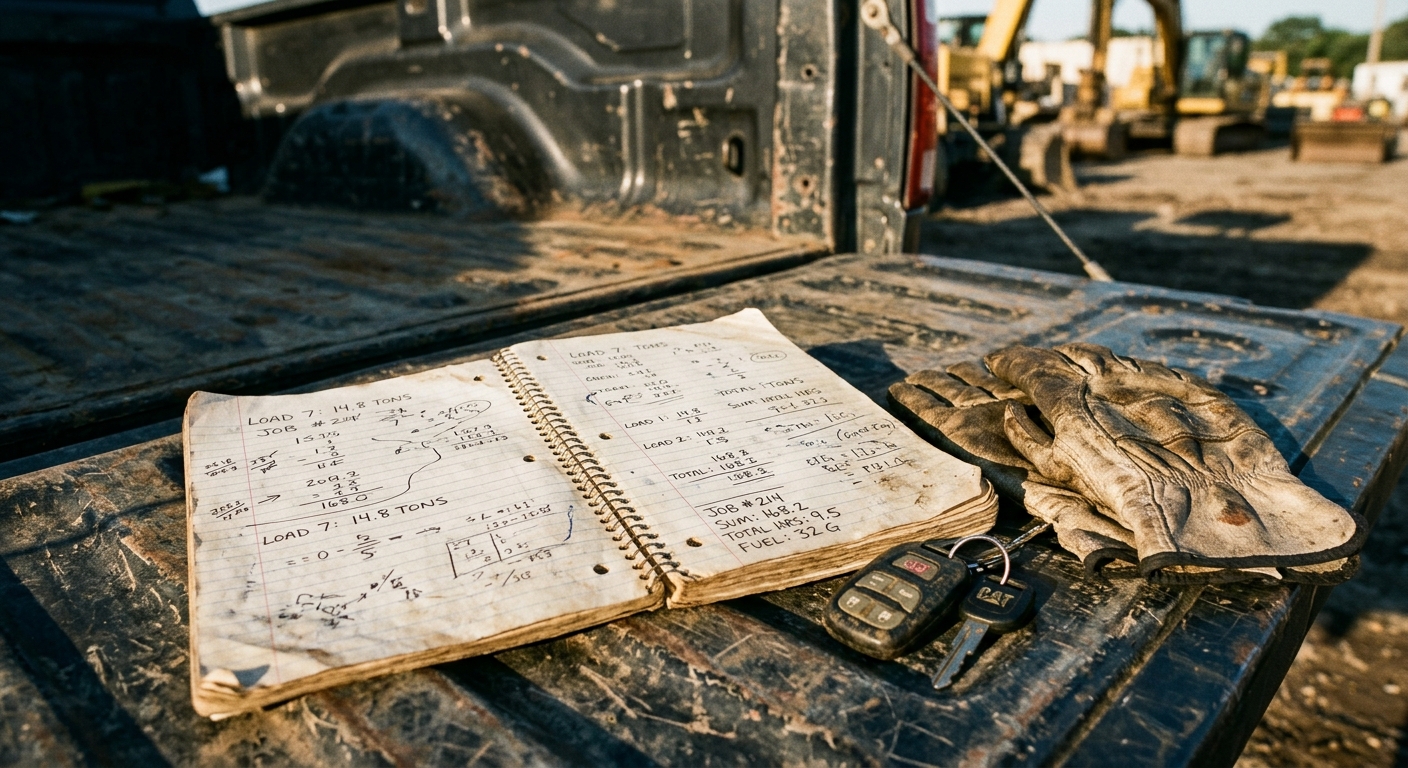
I log every fuel fill when it happens. Takes 30 seconds at the pump. I photograph every receipt and drop it in a folder. At the end of the week, I update my cost tracking spreadsheet. Machine hours, fuel gallons, any parts or service that happened.
Once a month, I pull a real P&L. Revenue minus all costs, including the ones that are easy to forget. My cell phone is a business expense. The boots I buy every four months are a business expense. The $150/month I spend on software to run the business is a cost.
When I bid a job now, I know exactly what my floor is. I know what I need to charge per hour to hit my margin target. I’m not guessing. And because I’m not guessing, I don’t panic when a customer pushes back on price. I know my number. I can either do the job at that number or I can’t.
The Seasonal Cash Flow Trap
This is the one that gets almost everyone in seasonal work like mine. April through November, the money flows. December through March, it doesn’t. But payments on iron, insurance, and your shop lease don’t take the winter off.
If you’re not setting aside 20-25% of your busy season revenue for winter operating costs, you’re going to be sweating in February. I’ve seen guys sell machines at a loss in January because they couldn’t make the payment. Machines they needed for the spring season. Then they lease something else at a higher rate. It’s a cycle that crushes people.
I keep a separate account now. Every invoice payment that hits, 25% moves to a reserves account automatically. That money doesn’t exist until winter. It’s not profit. It’s the cost of running a seasonal business.
The Ego Problem
Let’s talk about the real reason people don’t track their numbers: ego.
It’s a lot more fun to post a picture of your new machine on Instagram than to admit you’re not sure if you can actually afford it. It’s a lot more fun to talk about your gross revenue than your net income. It’s a lot more fun to pretend you’re a successful business owner than to sit down with a spreadsheet and find out you might not be.
I’ve been there. I bought my second T770 partly because I wanted to look like I was scaling. Two machines! Two crews! Growing the business! In reality, I didn’t have enough work to keep both machines busy full time, and the second one was bleeding me dry.
The moment I got honest with myself about the numbers was the moment my business actually started working. I sold the underutilized machine. I focused on keeping one machine running at high utilization. My net income went up despite cutting my fleet in half.
What This Looks Like in Practice
Last month I quoted a 3-acre mulching job. The customer got another quote that was $2,000 less than mine. He asked if I could match it.
I pulled up my numbers. I knew the job would take roughly 14 machine hours based on the terrain and density. At my cost-per-hour of $87, that’s $1,218 just to operate the machine. Add transport ($350 round trip), labor for my second guy ($420), and overhead allocation ($280). My floor on that job was $2,268.
My quote was $4,200. The other guy’s was $2,200.
I told the customer I couldn’t match it, and honestly, the other guy is probably losing money on that job. He just doesn’t know it yet.
The customer went with the other guy. And that’s fine. I’d rather lose a job than do it at a loss. That’s something I never could have said when I didn’t know my numbers.
Start Here
If you’re reading this and you don’t know your cost per hour, here’s what to do this week:
Pull your bank and credit card statements for the last 12 months. Add up everything that went to your equipment: payments, fuel, parts, service, insurance, registration, tires, wear items. Everything.
Estimate your total operating hours for those 12 months. If you don’t track hours, check your machine’s hour meter and think back to where it was a year ago.
Divide the first number by the second. That’s your cost per hour. It’s going to be higher than you think.
Now look at what you’ve been charging. If your rate isn’t at least 1.5x your cost per hour, you’re either working for free or close to it once you factor in your time, overhead, and risk.
The Bottom Line
Running equipment is fun. Running an equipment business is work. The operators who survive long-term are the ones who respect the math, not the ones with the nicest iron or the most followers on social media.
I’m not saying you need a finance degree. I’m saying you need to know three numbers cold: what it costs you, what you bring in, and how much of the time your iron is working.
If you can’t rattle those off right now, close this article and go figure them out. Your business depends on it.
Alex Boyd is the owner of Brushworks Services Co., a forestry mulching and land clearing company based in Ohio. He writes about the business side of running equipment at Equipment Insider.