OPINION: The Insurance Racket Is Eating Your Margins
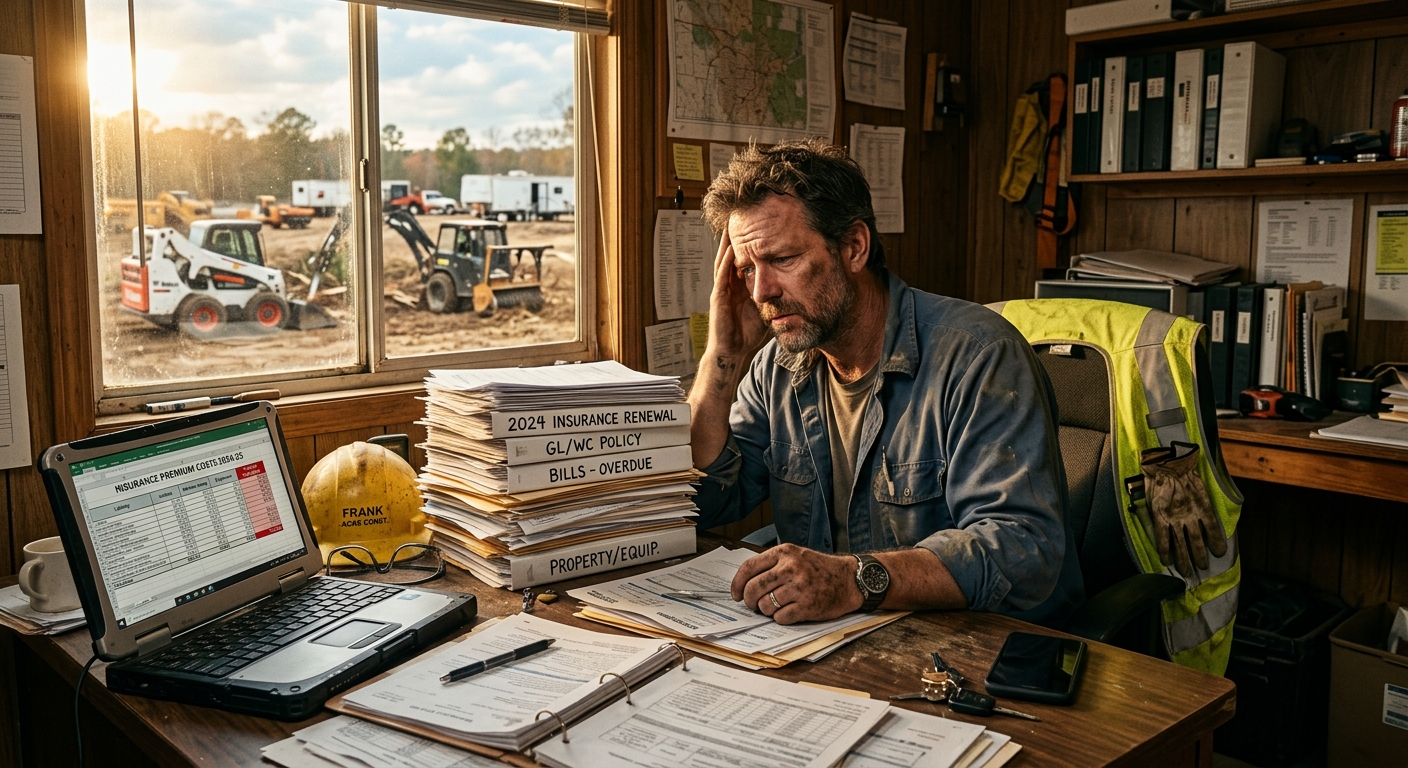
A lot of operators think fuel, repairs, or payroll are their biggest silent cost. I think it's insurance, because every year we pay more, fight harder for coverage, and somehow get less protection in return.
Every operator I know complains about fuel. We complain about parts. We complain about hiring. All fair. But I think the bigger problem, the one that’s really chewing through margins without enough people talking about it, is insurance.
Not because insurance is optional. It isn’t. If you’re running real equipment, hauling it on the road, hiring people, and stepping onto customer property, you need coverage. What drives me nuts is how the whole thing works now. Rates keep climbing, exclusions keep multiplying, deductibles keep getting fatter, and the people selling the policy act like they’re doing you a favor by letting you buy it.
At some point this stopped feeling like risk management and started feeling like a tax on trying to build something.
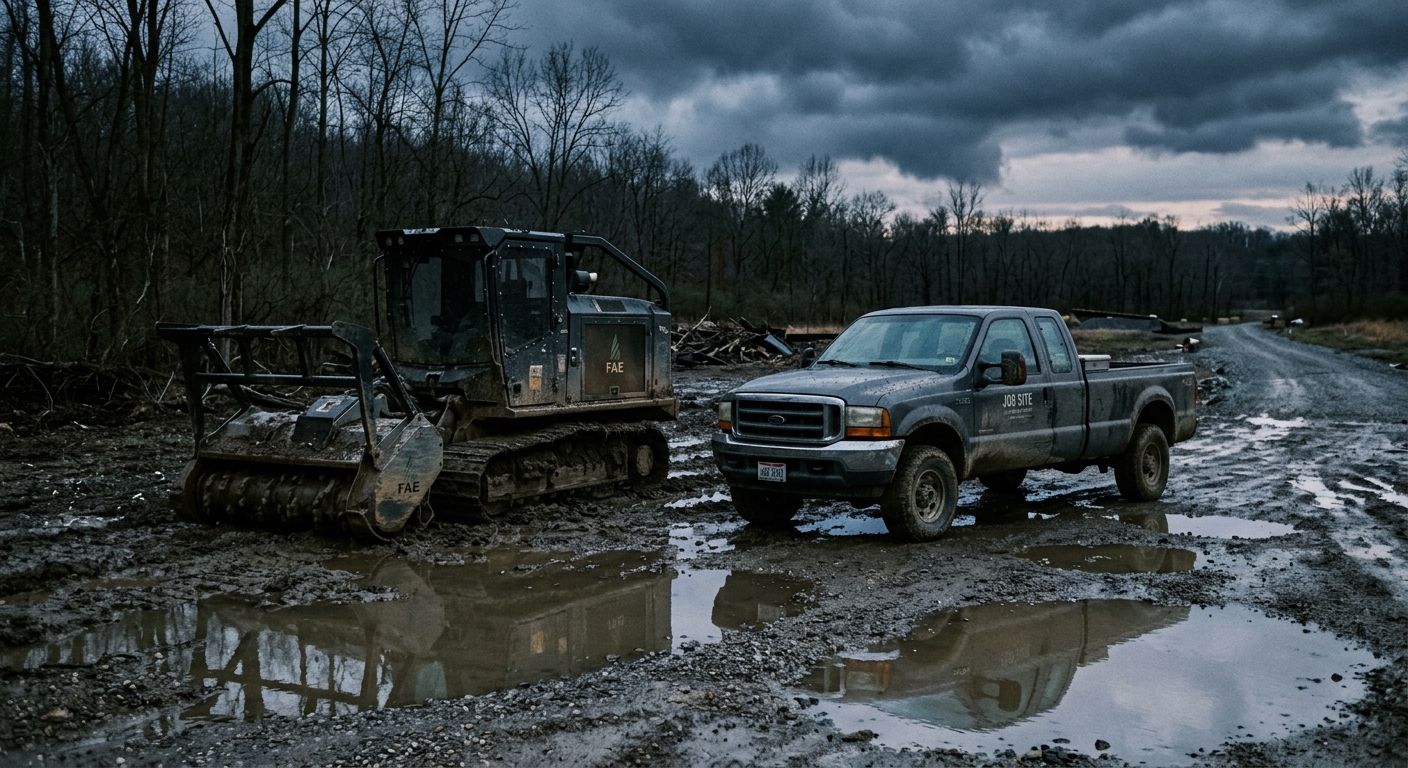
I run a land clearing company in Ohio. We’ve got machines, trailers, trucks, a crew, job sites, transport risk, fire risk, storm damage risk, theft risk, and the usual circus that comes with operating in the real world. I understand why an insurer looks at our business and sees exposure. I get it. A forestry mulcher is not a crockpot. But the way small operators are getting squeezed right now is getting ridiculous.
A lot of guys still price jobs like it’s 2021. They remember what insurance cost them three or four years ago, then wonder why the checking account feels tight even when the schedule is full. Meanwhile general liability is up, commercial auto is up, inland marine is up, workers comp is up, umbrella is up. You can do everything right, have a clean claims history, and still get hit with a renewal that makes you stare at the email for ten minutes.
Last year I sat down and looked at what we were actually spending across every policy tied to the business. General liability, auto, equipment, umbrella, workers comp. By the time it all shook out, insurance was right up there with some of our biggest operating line items. That’s insane when you think about what you’re buying. You’re not buying a better machine. You’re not buying more production. You’re buying permission to keep playing the game.
The Bill Is Bigger Than Most Operators Admit
The problem starts with guys lying to themselves.
A lot of owner-operators only talk about one premium. They’ll say, “My insurance is about four grand a year,” and what they mean is their general liability policy by itself. That’s not their insurance cost. That’s one slice of it.
If you’re serious, you need to count the full stack. General liability. Commercial auto. Equipment coverage. Workers comp if you’ve got employees. Umbrella if you want to sleep at night. Sometimes pollution coverage, depending on the work. Sometimes additional insured endorsements all over the place because every decent customer wants paperwork before your tracks touch the ground.
Let’s use real-world rough numbers that won’t shock anybody actually running equipment. Say you’ve got two trucks, a trailer, a CTL with a mulcher head, maybe a mini excavator, and two or three employees. It is not hard to end up spending $18,000 to $30,000 a year on insurance once everything is added together. If you’ve got a rough auto history, younger drivers, storm claims in your region, or a carrier pulling out of your market, you can blow right past that.
Now spread that cost over the year. Say you’re trying to bill 1,200 productive machine hours. Insurance alone can be costing you $15 to $25 an hour before you buy diesel, fix a hose, replace teeth, pay labor, or make a machine payment.
Guys will fight over three bucks an hour on their rates and ignore a five-figure insurance burden because it gets paid monthly and feels abstract. That’s stupid. If it’s draining the account, it’s real.
Insurance Companies Love “High Risk” Businesses Until It’s Time to Pay
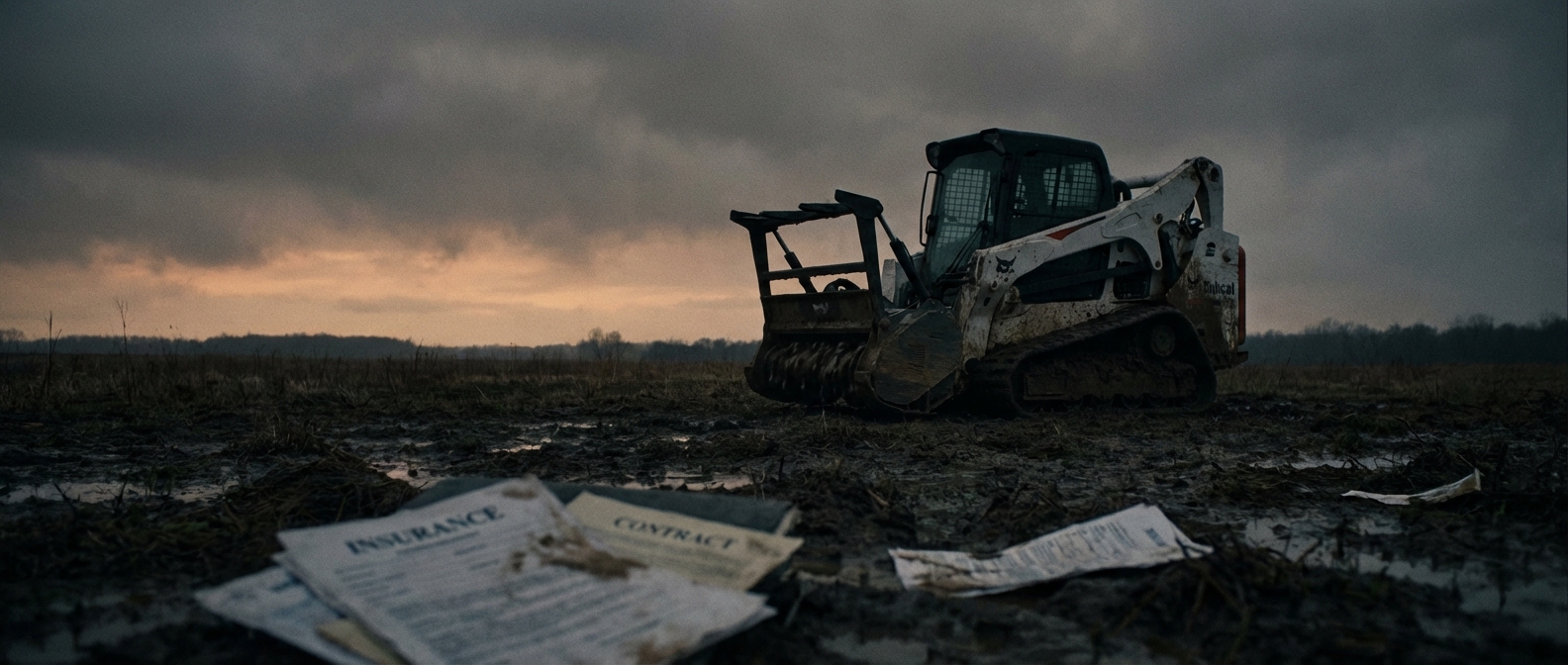
Here’s the part that really irritates me. Carriers are perfectly happy to classify your business as high risk when it’s time to price the policy. Suddenly you’re dangerous, specialized, unusual, severe exposure, all the buzzwords. But when you actually need help after a loss, everybody turns into a contract lawyer.
Was the trailer stolen from a lot that wasn’t fenced exactly the way they wanted? Maybe that’s an issue. Did the machine catch fire after an electrical problem and now they want maintenance records, operator logs, purchase dates, photos, serial numbers, and a blood sample? Cool. Did a driver back into something and now the renewal punishes your whole company for three years? Of course it does.
I know operators who paid premiums like clockwork for years, had one claim, then got treated like they were trying to pull a scam. One guy I know had a skid steer stolen off a site. He had the police report, proof of ownership, GPS data, photos, everything. It still turned into a slow-motion wrestling match. Meanwhile he still had jobs on the calendar and no machine. That’s when you realize insurance isn’t really built around helping small operators recover fast. It’s built around preserving the carrier’s balance sheet.
Commercial Auto Is Where the Pain Gets Stupid
If I had to pick one line item that makes me want to throw something, it’s commercial auto.
You can have solid equipment practices, good employees, clean machines, and still get smoked on auto because you’re towing heavy, driving long distances, or employing humans instead of robots. One fender bender, one claim that wasn’t even catastrophic, and suddenly the premium jumps like you started a demolition derby.
Small contractors get boxed into this corner where they need capable trucks and trailers to make money, but the more legitimate the operation looks, the more there is to insure. So the guy trying to do things correctly with the one-ton, gooseneck, DOT compliance, decent driver standards, and proper paperwork can end up feeling more punished than the clown dragging a machine around with bald tires and crossed fingers.
That’s the backwards part of the whole system. Discipline does not get rewarded enough.
I’ve talked to owners who quietly stopped adding drivers because the quote changed so much when they listed younger employees. It limits training, limits growth, and keeps owners chained to the steering wheel because the insurance math says delegation costs too much.
The Hidden Cost Is How It Warps Behavior
The premium is only the obvious cost. The hidden cost is how insurance changes the way people run their businesses.
It makes operators hang onto worn-out trucks because replacing them spikes premiums. It makes companies underinsure equipment because the quote comes back ugly. It makes owners avoid hiring. It makes people take smaller jobs closer to home, not because that’s smart strategically, but because they don’t want another truck on the road or another person on payroll.
It also makes people weird about claims. Plenty of business owners will eat a hit they should probably turn in because they know the long-term pain on renewal might be worse than the short-term repair cost. That’s not a healthy system. If you’re paying substantial premiums but are scared to use the product, what exactly are we doing?
I know a contractor who had damage during transport that probably should have been filed. He ended up paying for most of it himself because he was more afraid of what the loss run would do to the next two renewals. That’s not insurance functioning well.
Brokers Matter More Than Most People Think
One hard lesson here, and I learned it the annoying way, is that not all insurance brokers are equal.
Some are basically order takers. They collect your info, send over a quote, and disappear until renewal. Those people are useless in a hard market. You need somebody who understands contractor risk, heavy equipment, transport, certificates, and how to package your operation so it doesn’t look like chaos on paper.
A good broker will ask better questions. They’ll catch gaps. They’ll tell you when your limits are stupid. They’ll push carriers for better terms. They’ll help you clean up the story around your business instead of just forwarding a PDF with a higher number every year and saying, “market conditions.”
That phrase alone should be illegal. Market conditions is just a polite way of saying, “Everybody figured out they can charge you more.”
If your broker isn’t helping you think through driver eligibility, claims handling, asset schedules, certificates, and jobsite requirements, get a new broker. Loyalty is overrated here. This is not your barber. Shop it.
Operators Need to Price Insurance Into Every Hour
This is where my opinion gets blunt. If you don’t know what insurance costs your business per productive hour, you’re guessing. And if you’re guessing in this market, you’re probably underbidding.
Insurance has to get buried into your rate the same way fuel, maintenance, hauling, and labor get buried into your rate. Not as a vague overhead blob. I mean actually measured.
Take your total annual insurance spend. Divide it by realistic billable hours, not fantasy hours. If weather, seasonality, travel, and breakdowns mean your machine only really earns for 1,000 or 1,200 hours, use that number. Then add the insurance cost into your model and quit pretending the customer only pays for iron and diesel.
I’ve seen too many guys price a forestry mulching job at a rate that would make sense if nothing ever went wrong and nobody had to insure anything. Then they’re shocked when revenue looks decent and cash still feels tight. Insurance is one reason. It’s death by a thousand withdrawals.
The operators who stay healthy are usually the ones who stopped apologizing for their rates. They know what it costs to put a machine on a site legally and responsibly. They know the guy charging far less is either missing costs, hiding risk, or buying himself a headache later.
The Bigger Risk Is What Happens to Small Operators Next
Here’s what worries me. If this trend keeps going, insurance won’t just be a margin problem. It’ll become a consolidation problem.
Large fleets can spread costs better. They have more leverage, more formal safety programs, more negotiating power, and usually somebody in-house who actually manages this stuff. The small operator with three machines and a handful of employees gets squeezed from both ends. Premiums rise, customers still want cheap prices, and one bad claim can throw the whole year off.
That means fewer young companies survive long enough to get good. Fewer owners take the leap from one machine to three. Fewer crews get built. You don’t get a stronger industry that way. You get an industry that’s harder to enter and more dependent on a shrinking pool of players big enough to absorb the nonsense.
I’m a fan of capitalism. I like competition. I think if you run a tighter business, you should win. But this doesn’t feel like healthy competition. It feels like a structural drag that hits smaller, growing operators the hardest.
My Takeaway
Insurance is not a side expense anymore. For a lot of equipment businesses, it’s one of the main things deciding whether the year feels good or feels like a grind.
So here’s my advice.
First, calculate your true annual insurance spend across every policy. Not one policy. All of it.
Second, turn that into an hourly cost and bake it into your pricing.
Third, shop your broker hard and stop accepting lazy renewals.
Fourth, document everything. Maintenance, training, driver standards, photos, serial numbers, inspections. The cleaner your business looks on paper, the less ammunition you give people to jack you around.
And finally, quit bragging about low rates if you haven’t accounted for the real cost of operating. Cheap work is not tough. Cheap work is usually sloppy math wearing a Carhartt jacket.
If you’re an operator and insurance is hammering you too, talk about it. Compare notes. Compare structures. Compare brokers. Because right now too many of us are getting bled quietly, one premium increase at a time, and acting like it’s normal.
It isn’t normal. It’s a racket. And if you don’t price for it, it’ll eat your margins alive.