
Volvo CE Is Bringing More Excavator and Wheel Loader Production to Pennsylvania
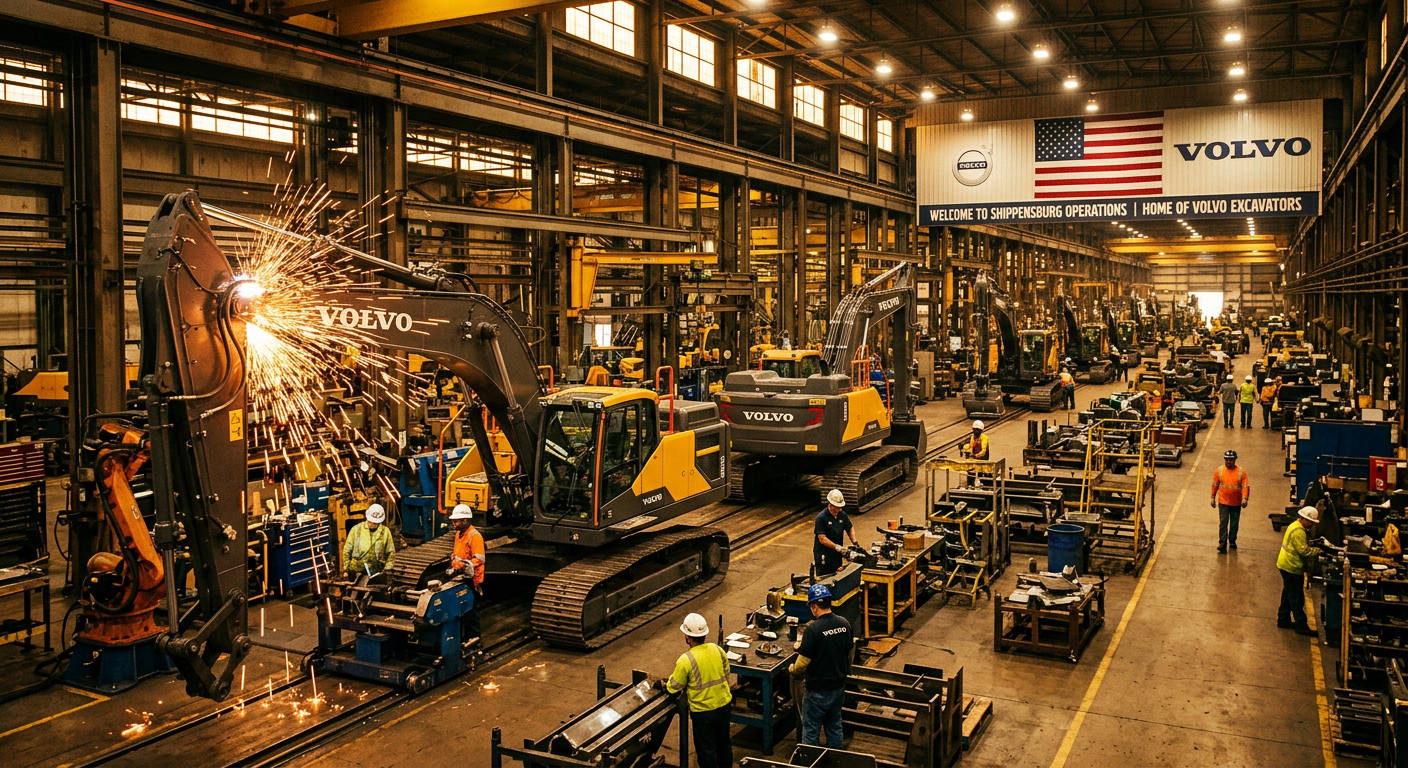
Volvo Construction Equipment plans to build crawler excavators and four additional large wheel loader models in Shippensburg, Pennsylvania, part of a $261 million global manufacturing push that could shorten lead times and shift more supply closer to North American buyers.
Volvo Construction Equipment is making a bet that a lot of OEMs have talked about since the pandemic and fewer have acted on at this scale: build more of the iron closer to the customer.
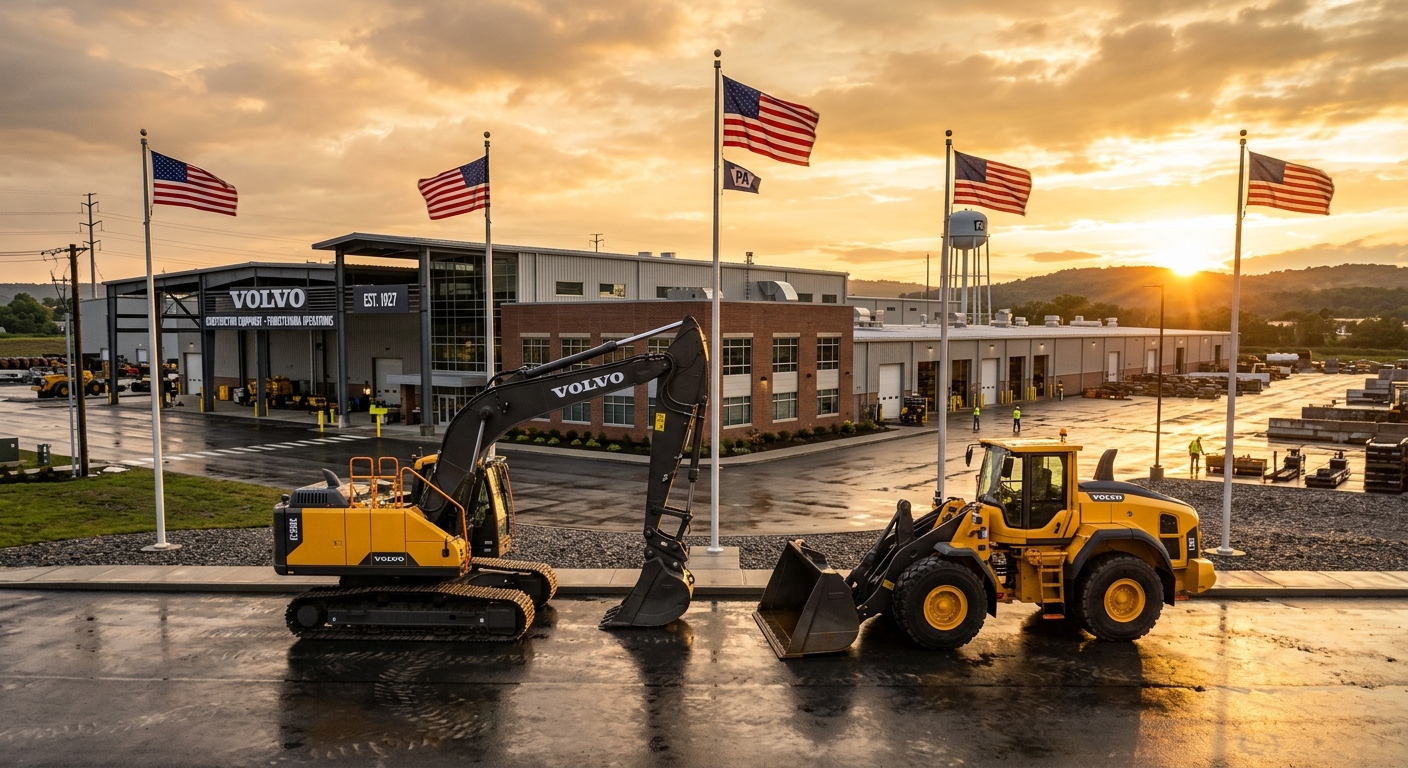
The company says it will add crawler excavator production and four large wheel loader models at its Shippensburg, Pennsylvania, plant as part of a broader $261 million global investment across the United States, South Korea, and Sweden. Production in Pennsylvania is scheduled to begin in the first half of 2026.
That is the headline. The more interesting part is what it says about where the equipment market is headed.
For years, OEMs got comfortable with long supply chains, centralized production, and the idea that North American dealers and contractors would simply wait. Then freight costs blew up, supply chains got weird, and lead times became their own form of market damage. Buyers do not forget that stuff quickly. When a machine is six months late, the brochure stops mattering.
Volvo is responding to that reality by pushing more production capacity into North America while also spreading crawler excavator output across three major global sites. It is a manufacturing story, sure, but it is also a risk story, a dealer story, and a customer-trust story.
FieldFix Editor’s Note: If shorter lead times actually put more machines in the field, the next headache is keeping them maintained once they hit mixed fleets. FieldFix gives equipment owners one place to track service history, costs, and downtime across excavators, loaders, and support machines.
What Volvo actually announced
According to Volvo CE’s June 10, 2025 release, Shippensburg will gain the ability to produce mid- to large-size crawler excavators and add four large wheel loader models to the factory’s current output. The site already manufactures soil and asphalt compactors along with mid-size wheel loaders.
Volvo says the investment is part of a wider plan to expand crawler excavator production in three core locations: Shippensburg in the United States, Changwon in South Korea, and a site in Sweden. The company tied the move to growing demand, lower supply-chain exposure, and less dependence on long-distance logistics.
Those are not throwaway talking points. They are the three pressure points that have been hanging over heavy equipment manufacturing for the past several years.
First, demand has not disappeared. Even with interest-rate pressure and some project hesitation in parts of the market, contractors, rental houses, and infrastructure buyers still need replacement machines. They also need availability they can trust.
Second, supply-chain fragility is still real. It does not take a once-in-a-century event to jam up machine flow anymore. A port disruption, supplier issue, tariff move, or transport bottleneck can ripple farther and faster than it used to.
Third, long-distance logistics are expensive even when they work. When they do not work, they become a margin killer.
Volvo’s release also said the Shippensburg facility will be updated with assembly lines, more automation, and employee training before production starts. Scott Young, head of Volvo CE’s North American region, said the expansion means more than half of the company’s North American machine supply could eventually be built in Shippensburg.
That number matters.
It means this is not just a symbolic announcement aimed at politicians, dealers, or LinkedIn applause. If Volvo gets there, Shippensburg becomes a much more central piece of the company’s North American supply strategy.
Why Shippensburg makes sense
This is not a random dot on the map.
Volvo CE bought the Shippensburg operation in 2007 from Ingersoll Rand and moved its North American regional headquarters there in 2012. The plant already has manufacturing history, workforce familiarity, and operational importance inside Volvo’s regional footprint. Expanding an existing site is usually a lot cleaner than trying to build a new identity from scratch somewhere else.
Pennsylvania also gives Volvo a practical east-of-the-Mississippi position for dealer support and freight access. It is not the cheapest location on paper for every scenario, but equipment manufacturing is not won on paper. It is won on how fast you can build, move, support, and adjust.
And there is another layer here that does not get enough attention: supplier development.
Volvo explicitly tied the move to growth opportunities for domestic suppliers. That matters because local production is only as resilient as the supplier base under it. You do not really de-risk your business by assembling the machine in the U.S. if critical components still depend on a brittle chain half a world away.
The hard part is not making the announcement. The hard part is building enough regional supplier depth that the announcement holds up when the market gets ugly.
This is really about lead times
OEMs love talking about strategy. Customers care about availability.
Volvo framed the Shippensburg expansion around shorter lead times in North America, and that is exactly how buyers will judge it. Not by the investment figure. Not by the automation language. Not by how many executives stood in front of the plant for the photo.
Just this: can dealers get machines faster, and can customers plan around realistic delivery windows?
If more than 50% of Volvo CE’s North American machine supply can be built in Shippensburg, the company should have a stronger shot at controlling both lead time and machine flow for this region. That does not eliminate delays. It does make the business less dependent on ocean freight, port congestion, and intercontinental production balancing.
That is a real advantage if competitors are still leaning harder on imports for similar classes of equipment.
It also gives Volvo more flexibility when product demand shifts. If wheel loaders heat up in one quarter and excavators move in the next, regional production can help the company adapt faster than a rigid long-haul supply model.
Dealers will notice that quickly. So will rental buyers.
The excavator angle may be bigger than the loader angle
The press release mentions both crawler excavators and large wheel loaders, but I keep coming back to the excavator side.
Excavators are one of the most important battlegrounds in the equipment market. They are central to earthmoving, utility work, roadbuilding, site development, and an enormous chunk of rental demand. They are also a category where availability and support carry real weight because buyers usually have alternatives.
If Volvo can produce more mid- to large-size crawler excavators in North America with consistent quality and decent lead times, that helps the company in one of the most competitive parts of the business.
It is also a signal that Volvo does not want North America to function mainly as a sales and distribution region. It wants the region to matter more industrially.
That matters internally too. A region with real production gravity tends to get more influence over product planning, supplier relationships, and long-term investment.
The loader piece should not be ignored
The wheel loader part of the announcement is easy to underrate because it feels like an add-on. I do not think it is.
Shippensburg already builds mid-size wheel loaders. Adding four large wheel loader models extends that capability upmarket and makes the plant more useful across a wider range of demand. That kind of flexibility can matter a lot when product cycles are uneven.
Wheel loaders also live in a broad set of end markets: aggregates, site work, snow, industrial yards, municipal fleets, waste, and general construction. A deeper local loader lineup gives Volvo more chances to respond to regional buying patterns without routing everything through longer global channels.
And from a plant-utilization standpoint, more product mix can be healthy. A factory that can build a wider slice of the portfolio has more ways to stay relevant when one class softens.
There is a bigger manufacturing trend underneath this
The equipment industry spent years optimizing for efficiency. Now it is relearning the value of resilience.
Those two things are not always the same.
The old logic was straightforward: build where cost structure and scale look best, then move product around the world. That model still works in many cases. But the margin for disruption is thinner now, and customers have become a lot less patient about delays they cannot control.
Volvo is hardly the only manufacturer rethinking footprint strategy, but this move is a clean example of where the industry is going. More regional capacity. More automation. More effort to spread production risk instead of stacking too much of it in one place.
That does not mean every OEM will suddenly localize everything. They won’t. It does mean the ones with real regional demand are under pressure to prove they can supply that region without crossing their fingers every time something goes sideways in global trade.
What could go right
If Volvo executes well, a few things should happen.
North American dealers could get more predictable machine flow. Customers could see shorter waits on certain excavator and wheel loader models. Suppliers around the plant could grow alongside the program. And Volvo could improve its position in a region where machine availability still shapes brand loyalty more than some executives want to admit.
There is also the local economic angle. Volvo said it will invest about $40 million locally over five years on top of recent investments. That should matter in central Pennsylvania, not just because of jobs inside the plant but because industrial expansions tend to spill into tooling, logistics, services, and supplier activity nearby.
If the company really does push past the 50% mark for North American machine supply coming from Shippensburg, that would be a serious statement about the plant’s long-term role.
What could go wrong
Let us not pretend factory expansions are magic.
Adding production lines is one thing. Ramping them without quality slips is another. Training labor, integrating automation, qualifying suppliers, and hitting launch timing all sound tidy in a press release. In the real world, each one can create delays or headaches.
There is also the demand question. Volvo is making this move because it sees enough long-term demand to justify it. That may prove right. But if parts of the market cool harder than expected, new capacity can feel less heroic and more expensive.
Then there is the supplier issue again. A local plant is useful. A local plant with weak supplier redundancy is less useful than it looks.
And finally, customers will not grade this on intent. They will grade it on delivery dates, machine quality, parts support, and uptime once the iron is out working.
That is fair.
My read
This is a smart move.
Not flashy. Smart.
Volvo is putting more industrial weight behind North America at a time when buyers still care deeply about lead time, supply certainty, and whether an OEM can support the region without excuses. The fact that the company is pairing North American expansion with added production in South Korea and Sweden makes the strategy more credible, not less. It looks like a network decision, not a one-off headline chase.
The Shippensburg piece is the part North American dealers should care about most. If it does what Volvo says it will do, the plant becomes more than a regional outpost. It becomes a bigger lever for excavator and wheel loader availability in this market.
And honestly, that is where the score will be settled.
Not in the announcement. In the yard.
Sources
- Volvo Construction Equipment, “Volvo Construction Equipment to Expand Production in North America” (June 10, 2025): https://www.volvoce.com/united-states/en-us/about-us/news/2025/volvo-ce-to-expand-production-in-north-america/
- Volvo Group / Business Wire distribution, “Volvo Construction Equipment to Expand Production in North America” (June 10, 2025): https://www.financialcontent.com/article/bizwire-2025-6-10-volvo-construction-equipment-to-expand-production-in-north-america
- Rental Equipment Register, “Volvo Construction Equipment to Expand Production in North America, South Korea and Sweden” (June 11, 2025): https://www.rermag.com/news-analysis/headline-news/article/55296606/volvo-construction-equipment-to-expand-production-in-north-america-south-korea-and-sweden