Repair Capacity Is Becoming the Equipment Bottleneck
Fleets are running older machines, shops are charging more for labor, and technician supply is still tight. The next equipment constraint may be service capacity, not machine availability.
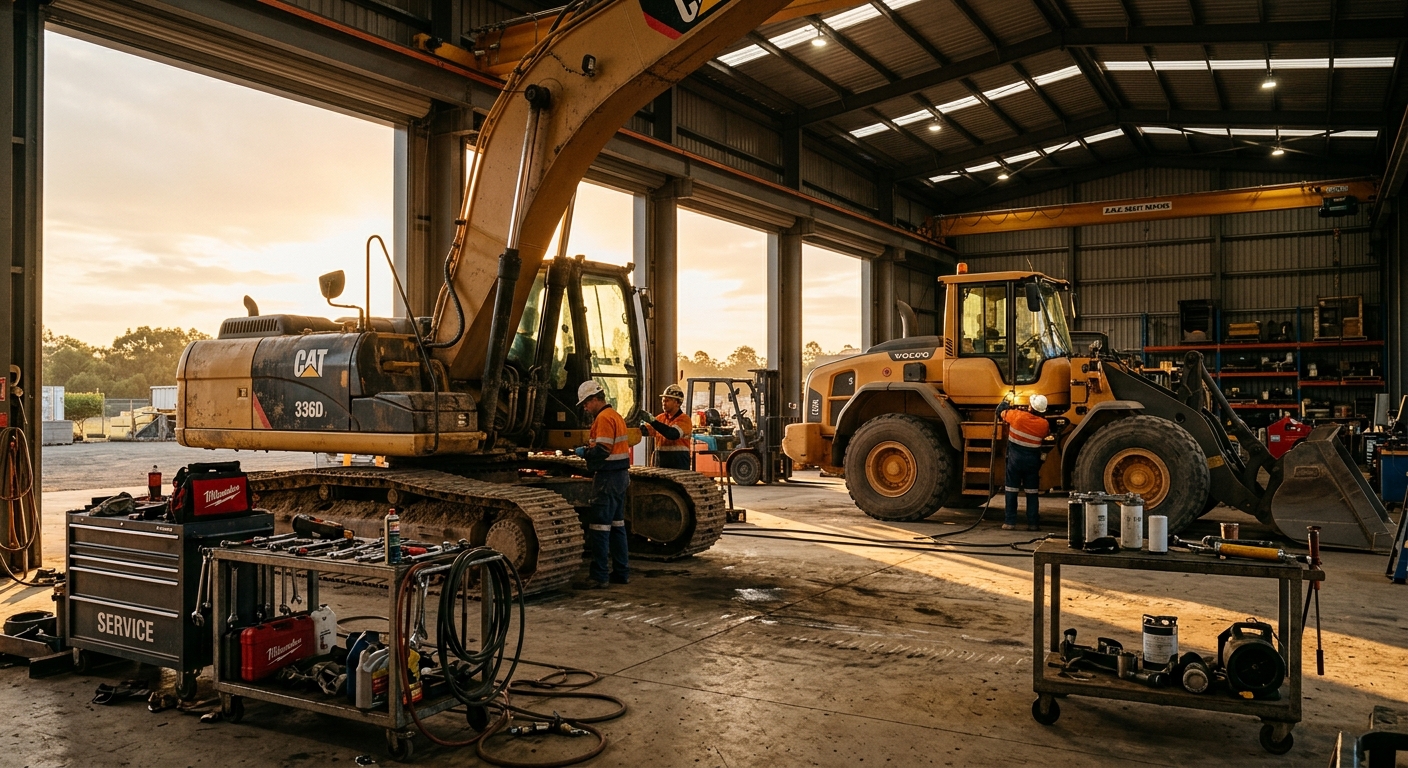
The equipment market has spent the last few years talking about machine supply, interest rates, used prices, and rental demand. Those still matter. But another constraint is getting harder to ignore: repair capacity.
It is showing up in a few places at once. Fleets are keeping machines longer. Independent and internal shops are charging more for labor. Technicians are harder to hire. Dealers still need more service people. Parts are not always the only delay. Sometimes the problem is simpler and more painful: there is nobody free to diagnose the machine, tear it down, wait on the right part, and put it back together.
For contractors, rental companies, dealers, and owner-operators, that changes the way equipment decisions should be made in 2026. A machine is not just a purchase price, monthly payment, rental rate, or auction value. It is also a claim on scarce service time.
FieldFix Editor’s Note: Repair capacity gets expensive when fleets do not know which machines are eating the most time and money. FieldFix helps equipment owners track service history, downtime, repair spend, machine hours, fuel, and cost per hour, so maintenance decisions are based on the units actually causing pain.
The service side is under pressure
Fullbay’s latest State of Heavy-Duty Repair report covers independent and internal shops that work on Class 6-8 vehicles, construction equipment, agricultural machinery, emergency vehicles, heavy machinery, and commercial fleets. The report has been picked up across fleet and repair trade publications because its numbers line up with what many operators are feeling.
Fleet Equipment reported that the 2026 report points to labor rates around $149 per hour, technician pay up 10 percent, and older equipment driving more service demand. Construction Equipment’s sponsored report summary also noted that 26 percent of shops reported repairing older assets year over year, while 85 percent of fleets approved repairs at the same rate or more often in 2025.
Those numbers are not just repair shop trivia. They change equipment math.
When hourly shop rates rise, every preventable failure costs more. When tech pay rises, shops have to recover that cost somewhere. When older machines make up a larger share of repair orders, bays stay full longer. When fleets keep approving repairs, shops do not get slack in the schedule.
That is a tough setup for equipment owners who have been trying to stretch machines another season.
Running older iron can still be the right call. A paid-off excavator, loader, dozer, skid steer, or truck can be a profit machine if it is reliable, supported, and used on work it can handle. The problem is that older fleets do not age evenly. One 6,000-hour machine may be fine. Another may be one hydraulic failure away from eating the margin on a job.
The difference is not always visible from the seat.
The technician shortage is not a talking point
The equipment industry has known about the technician shortage for years, but it is becoming more obvious as the fleet gets older and repair complexity rises.
The AED Foundation’s technician shortage page says the industry needs to fill up to 73,500 heavy equipment technician jobs over five years. It also says the equipment industry has a job opening rate three times higher than the national average, nearly 90 percent of AED member dealerships have a job opening rate above the national average, 95 percent of surveyed members see a skills gap, and 89 percent report a worker shortage in their company.
Those are dealer-side numbers, but the pain does not stay at the dealer.
If dealer shops are short-handed, warranty repairs can take longer. Field service availability tightens. Preventive maintenance appointments get harder to schedule. Rental companies wait longer for support. Contractors with mixed fleets spend more time deciding whether to send a machine to the dealer, call an independent shop, or pull their own tech off other work.
The shortage also changes what “dealer support” means. A good dealer relationship still matters. But even a strong dealer cannot create experienced technicians out of thin air. When the whole market needs service at the same time, relationship, planning, and machine documentation matter more than they used to.
The best fleets will treat technician time like a limited resource. That means fewer mystery failures, better service records, cleaner inspections, earlier parts planning, and more discipline around which machines deserve money.
Older fleets make every weak habit worse
Keeping equipment longer is not automatically a mistake. In many cases, it is rational. New machine prices are still high. Financing is not free. Used values have not collapsed enough to make replacement painless. Rental rates are not cheap either.
But older machines punish sloppy systems.
A newer machine with warranty coverage, telematics alerts, and dealer support can absorb some owner laziness. An older unit will not. The failures get less convenient. Small leaks become major repairs. Electrical issues become intermittent. Pins, bushings, hoses, tracks, tires, pumps, motors, aftertreatment systems, cooling systems, and undercarriages all start asking for attention.
The owner who tracks hours, fault codes, inspections, fluids, filter changes, PM intervals, repair history, and operating cost can make a decent call. The owner working from memory is guessing.
That guess gets more expensive when repair capacity is tight. A machine that used to be down for two days may be down for a week if the shop is buried. A part that arrives quickly does not help if the technician schedule is backed up. A simple repair can still disrupt a job if the machine is mission-critical and no backup is available.
This is where a lot of contractors fool themselves. They count the repair invoice but ignore the downtime. They count the downtime but ignore the crew cost. They count the crew cost but ignore the lost schedule slot, rental replacement, customer frustration, extra mobilization, and manager time burned coordinating around the failure.
The invoice is only the easy part to see.
Rental companies feel it twice
Rental fleets are especially exposed because repair capacity hits both utilization and customer experience.
If a rental branch has strong demand but cannot turn machines fast enough, it loses rental days. If a returned skid steer, mini excavator, telehandler, compressor, lift, generator, or pump sits in the yard waiting for service, it is unavailable inventory. The branch may look well stocked from the fence while the rent-ready count tells a different story.
That creates a harder operating problem than simple demand forecasting.
Rental companies have to decide how much older equipment to keep, which categories deserve replacement, which repairs should happen in-house, which should go to outside shops, and how much redundancy they need in high-demand classes. They also have to manage customer expectations when a reserved machine fails inspection, throws a code, or comes back damaged.
The worst version is a fleet that is large on paper and thin in reality.
A branch may have enough units in the category, but too many are down, waiting on parts, waiting on diagnostics, missing attachments, overdue for PM, or not quite reliable enough to send to a good customer. In a softer market, that weakness can hide. In a busy pocket of infrastructure, utility, industrial, or seasonal work, it shows immediately.
For rental managers, repair capacity is not a maintenance department problem. It is revenue capacity.
Buying decisions need a service-capacity filter
Equipment owners usually ask whether a machine will produce enough revenue to justify the payment. That question is still necessary, but it is incomplete.
The better question is: can the business actually support this machine?
That includes operator skill, transport, attachments, insurance, storage, fuel, job mix, and utilization. It also includes service capacity. Who will maintain it? Who will diagnose it? Who has the laptop, software, tooling, parts access, manuals, and experience? How far away is dealer support? What happens when the machine breaks during the busiest month of the year?
The answer should influence what a company buys.
A contractor with a strong internal mechanic may be able to run older machines profitably. A contractor with no shop, no records, and no backup plan may need newer equipment, more rental flexibility, or fewer specialized units. A small operator buying a cheap high-hour machine at auction may be buying a repair queue they cannot control.
That does not mean every old machine is bad. It means every machine needs a support plan.
This matters even more with technology-heavy equipment. Modern engines, emissions systems, hydraulics, grade control, telematics, machine control, electric accessories, and software-linked diagnostics can make equipment more productive. They can also narrow the list of people who can fix the problem quickly.
If the only person who can diagnose the issue is booked out, that machine is not available. It is parked capital.
Preventive maintenance is becoming margin protection
Preventive maintenance has always been cheaper than major failure. That line is so old it sounds like shop-wall wallpaper. But in this market, PM is less about mechanical virtue and more about capacity protection.
Every avoidable breakdown competes for scarce technician time. Every rushed repair creates a chance of a second failure. Every undocumented machine burns time during diagnosis. Every missed inspection makes the eventual repair more expensive.
The practical move is not complicated. Fleets need boring discipline.
Track machine hours accurately. Log service work the day it happens. Keep repair histories by serial number, not in someone’s head. Watch repeat failures. Separate wear-item cost from abnormal repairs. Know which machines are profitable and which are just familiar. Schedule PM before the season crushes the shop. Build a short list of outside repair partners before a crisis. Keep common filters, fluids, hoses, teeth, cutting edges, and undercarriage parts where it makes sense.
None of that is glamorous. Good. Glamour is usually expensive in equipment.
The owners who win this cycle will not be the ones with the longest equipment list. They will be the ones who know which machines can be trusted, which ones need to leave, and which ones deserve repair money before they fail at the worst possible time.
The bottleneck is moving
Machine availability is better than it was during the worst supply-chain stretch. That does not mean equipment owners are out of the woods.
The bottleneck is moving from “Can I get a machine?” to “Can I keep the machine earning?”
That shift favors disciplined operators. It hurts owners who treat maintenance like an afterthought. It rewards shops that can recruit, train, document, and communicate well. It gives dealers with real service depth an edge. It makes rental fleet readiness more important than raw unit count.
Most of all, it changes the replacement conversation. A machine that spends too much time waiting on service is not cheap, even if it is paid off. A newer machine with better support may be cheaper than it looks. A rental unit may be the right call when a contractor needs capacity without another long-term maintenance burden.
There is no universal answer. There is a sharper question: where is your real constraint?
For more fleets in 2026, the answer is going to be service capacity.