Saudi Arabia Is Buying Every Piece of Iron It Can Get Its Hands On
Vision 2030 has turned Saudi Arabia into the world's hungriest market for heavy equipment. With $500 billion in active infrastructure projects and a $1.9 billion equipment market growing fast, here's what operators and dealers need to know.
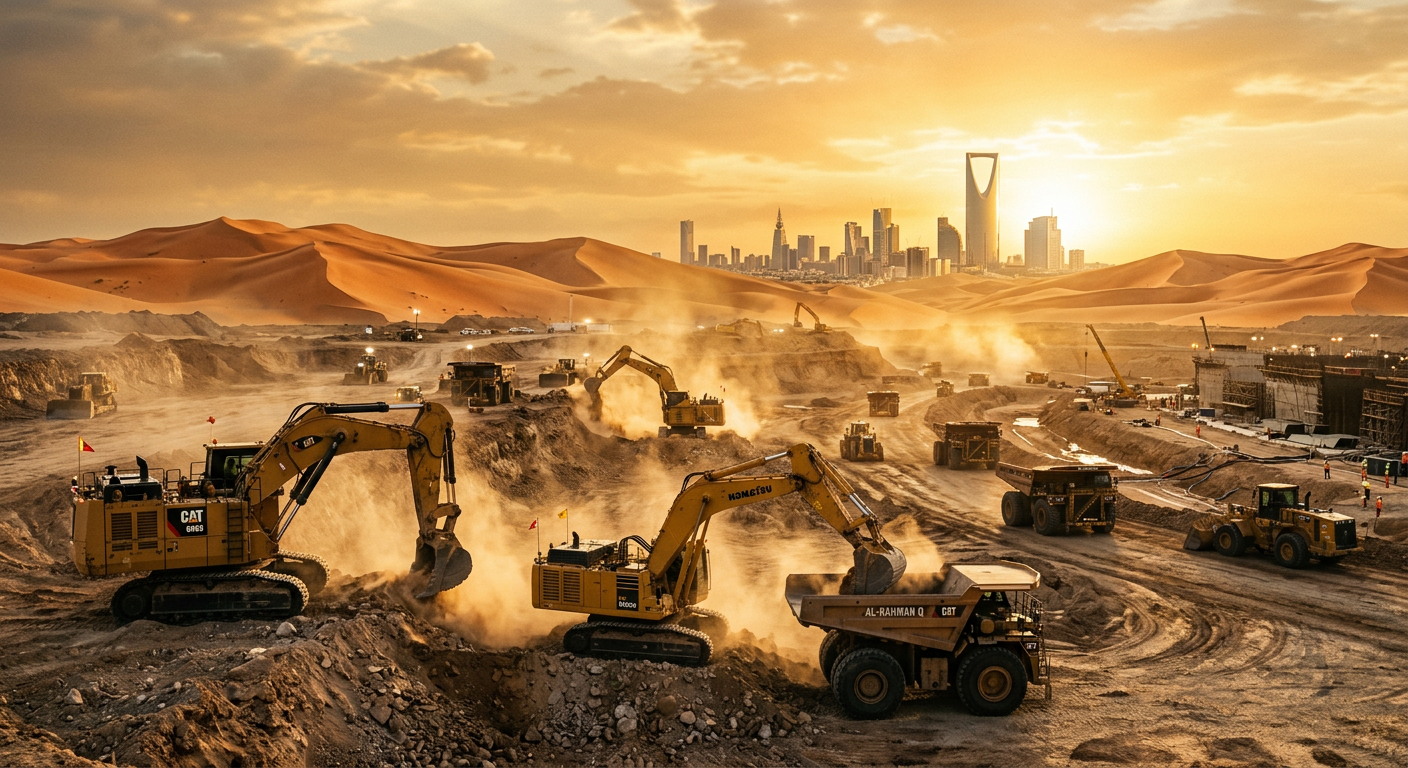
The biggest construction boom on the planet isn’t happening in Texas or Florida. It’s in the Saudi Arabian desert, where the Kingdom is spending north of $500 billion to build entire cities from scratch, and the demand for heavy equipment has outpaced almost every forecast.
Saudi Arabia’s construction equipment market hit $1.78 billion in 2025 and is on track to reach $1.89 billion this year, according to Mordor Intelligence. By 2031, that number could top $2.55 billion. The rental market is growing even faster — projected to hit $5.51 billion by 2034, with a compound annual growth rate above 10%.
For equipment manufacturers, dealers, and rental companies watching from North America, this isn’t just another overseas story. It’s a market that’s reshaping global supply chains and creating real opportunities for anyone who can ship iron to the Middle East.
FieldFix Editor’s Note
Tracking equipment across international job sites? FieldFix helps operators and fleet managers log maintenance, monitor costs per hour, and keep machines running — whether they’re working in Ohio or the Arabian Peninsula. Free for up to 3 machines.
What’s Driving the Boom
The short answer is Vision 2030, Saudi Arabia’s national economic diversification plan. The longer answer involves a half-dozen mega-projects that are each larger than most countries’ entire infrastructure budgets.
NEOM is the headline grabber — a $500 billion development zone in the northwest corner of the country that was supposed to include “The Line,” a 170-kilometer linear city. That particular piece of NEOM hit some reality checks in 2025. Construction on The Line was suspended in September after feasibility concerns and cost overruns forced a rethink. But NEOM itself hasn’t stopped. The green hydrogen plant at Oxagon is nearing completion, and the project has pivoted hard toward AI and data centers.
Beyond NEOM, there’s the Red Sea Project (a luxury tourism development along 28,000 square kilometers of coastline), AMAALA (an ultra-luxury resort), Qiddiya (an entertainment mega-city outside Riyadh), and dozens of transportation, housing, and urban development projects scattered across the Kingdom.
The Saudi government plans to allocate roughly $40 billion specifically for infrastructure in the near term. That money needs to move dirt, pour concrete, and build roads — which means it needs equipment.
Earthmoving Equipment Is King
Excavators, dozers, and loaders are doing most of the heavy lifting. Earthmoving equipment held 46.35% of the Saudi market in 2025, and excavators are the fastest-growing segment with a projected 8.3% CAGR through 2031.
That makes sense when you look at the scope of work. These aren’t renovation projects or tenant improvements. They’re building roads through empty desert, grading sites for cities that don’t exist yet, and moving millions of cubic yards of sand and rock. That’s excavator and dozer work, day in and day out.
Building applications accounted for 42.8% of the market, but infrastructure development is catching up fast — projected to grow at 11.1% annually through 2031. The western region (home to Red Sea tourism projects and Hajj-related construction in Mecca) is expected to see the strongest growth at 8.3% CAGR.
The Rental Market Is Exploding
One of the more interesting trends is the shift toward equipment rental over ownership. Volatile steel prices and ocean freight costs have squeezed purchasing budgets, and contractors are increasingly choosing to rent rather than buy.
This is familiar to anyone who’s watched the North American market over the past few years. When you’re not sure how long a project will run or what your next job looks like, renting keeps your overhead flexible. In Saudi Arabia, that logic is amplified by the sheer scale of the projects — a contractor might need 50 excavators for 18 months and then nothing. Owning that fleet doesn’t make financial sense.
The Saudi rental market’s projected growth to $5.51 billion by 2034 (at a 10.2% CAGR) tells you that contractors on the ground have already figured this out.
Regional Breakdown
Central Saudi Arabia (Riyadh and surrounding areas) led equipment demand in 2025 with a 35.4% market share. Riyadh is undergoing massive urban expansion, including a metro system that’s one of the largest public transit projects ever built.
The western region is projected to grow fastest, driven by the Red Sea Project and religious tourism infrastructure around Mecca. Every year, millions of Hajj pilgrims require expanded infrastructure, and that construction never really stops.
NEOM’s region in the northwest accounts for a large chunk of demand, though the pace there depends on which parts of the project get the green light next.
What This Means for North American Companies
The obvious play is exports. Caterpillar, Deere, and the other major OEMs are already deeply involved in the Saudi market, but there’s room for mid-size players too — especially in attachments, specialized equipment, and aftermarket parts.
Dealers with international shipping experience are in a good position. The Saudi market wants proven brands and reliable supply chains, and they’re willing to pay for both.
The less obvious impact is on domestic supply. When manufacturers are shipping machines to the Middle East, that’s inventory that isn’t going to dealers in the U.S. and Canada. We’ve seen this dynamic before — strong international demand creates longer lead times and tighter supply at home.
For equipment owners watching this from the States, the takeaway is practical: if you’re thinking about buying new iron in 2026, order early. Global demand isn’t slowing down, and Saudi Arabia’s appetite for equipment is only getting bigger.
The NEOM Reality Check
It’s worth being honest about NEOM, because the project has gotten more press coverage than probably any construction project in history, and not all of it has been accurate.
The Line — the 170-km mirrored city — was the most ambitious piece of the puzzle, and it’s been scaled back. Construction suspended in September 2025. The reasons were practical: the engineering challenges were enormous, costs were running well ahead of projections, and some of the original concepts just weren’t buildable with current technology.
But NEOM is more than The Line. The broader development zone still has active construction across six regions: Trojena (a mountain tourism destination), Magna, The Islands, a Nature Reserve, and Oxagon (an industrial and logistics hub). The green hydrogen facility at Oxagon — built by the NEOM Green Hydrogen Company — is nearing completion and could be one of the world’s largest.
The pivot toward AI and data centers is also significant. Saudi Arabia sees data infrastructure as central to its post-oil economy, and building those facilities still requires plenty of earthwork, concrete, and heavy equipment.
Challenges Ahead
The boom isn’t without problems. Skilled labor is in short supply — finding enough qualified operators, mechanics, and technicians to run all this equipment is a constant challenge. Environmental regulations on major projects are getting stricter, which adds cost and complexity.
And there’s the basic question of whether $500 billion in construction spending can actually be executed on schedule. History says mega-projects almost always run over budget and behind timeline. Saudi Arabia has the cash to absorb overruns, but some projects will inevitably be delayed or scaled back (as The Line already demonstrated).
Still, even if you discount the most optimistic projections by 30 or 40 percent, what’s left is still one of the largest construction markets in the world. The equipment has to come from somewhere, and a lot of it is coming from the same factories that supply North American dealers.
The Bottom Line
Saudi Arabia’s equipment market is real, it’s growing, and it has direct implications for buyers and sellers in North America. Whether you’re an OEM looking at export opportunities, a dealer tracking global inventory, or an operator wondering why lead times keep stretching — the Saudi boom is part of the answer.
The Kingdom is spending money at a pace that’s hard to comprehend from the outside. Not all of it will go as planned. But enough of it will go forward to keep demand for heavy iron elevated for years to come.